Borner Tito, Arnold Myrtha, Ruud Johan, Breit Samuel N, Langhans Wolfgang, Lutz Thomas A, Blomqvist Anders, Riediger Thomas
Vetsuisse Faculty, Institute of Veterinary Physiology, University of Zurich, Zurich, Switzerland.
Zurich Center for Integrative Human Physiology (ZIHP), University of Zurich, Zurich, Switzerland.
J Cachexia Sarcopenia Muscle. 2017 Jun;8(3):417-427. doi: 10.1002/jcsm.12169. Epub 2016 Dec 26.
The cancer-anorexia-cachexia syndrome (CACS) negatively affects survival and therapy success in cancer patients. Inflammatory mediators and tumour-derived factors are thought to play an important role in the aetiology of CACS. However, the central and peripheral mechanisms contributing to CACS are insufficiently understood. The area postrema (AP) and the nucleus tractus solitarii are two important brainstem centres for the control of eating during acute sickness conditions. Recently, the tumour-derived macrophage inhibitory cytokine-1 (MIC-1) emerged as a possible mediator of cancer anorexia because lesions of these brainstem areas attenuated the anorectic effect of exogenous MIC-1 in mice.
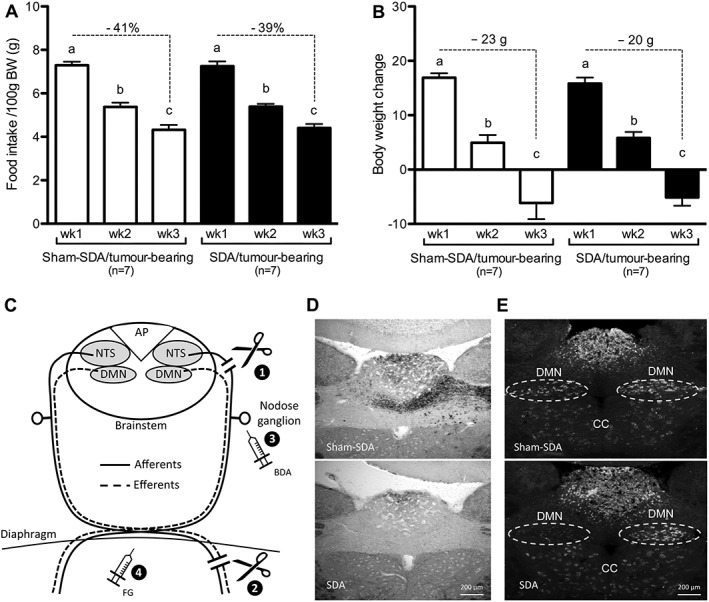
Using a rat hepatoma tumour model, we examined the roles of the AP and of vagal afferents in the mediation of CACS. Specifically, we investigated whether a lesion of the AP (APX) or subdiaphragmatic vagal deafferentation (SDA) attenuate anorexia, body weight, muscle, and fat loss. Moreover, we analysed MIC-1 levels in this tumour model and their correlation with tumour size and the severity of the anorectic response.
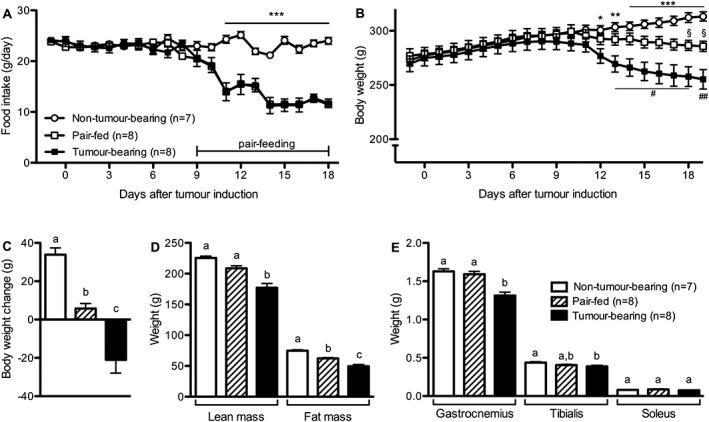
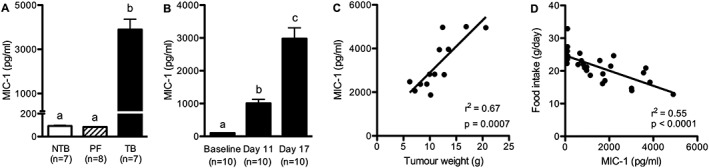
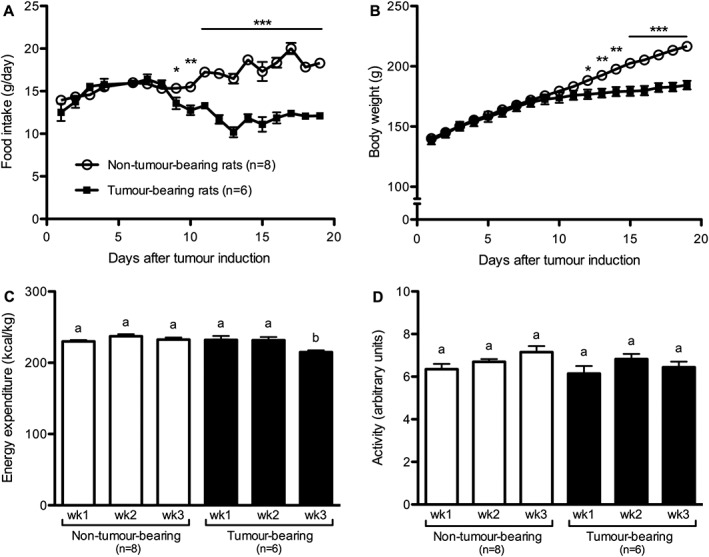
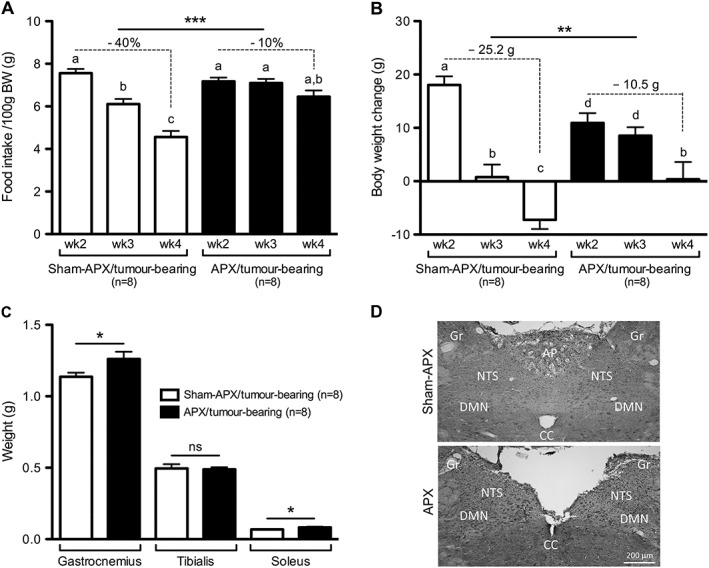
In tumour-bearing sham-operated animals mean daily food intake significantly decreased. The anorectic response was paralleled by a significant loss of body weight and muscle mass. APX rats were protected against anorexia, body weight loss, and muscle atrophy after tumour induction. In contrast, subdiaphragmatic vagal deafferentation did not attenuate cancer-induced anorexia or body weight loss. Tumour-bearing rats had substantially increased MIC-1 levels, which positively correlated with tumour size and cancer progression and negatively correlated with food intake.
These findings demonstrate the importance of the AP in the mediation of cancer-dependent anorexia and body weight loss and support a pathological role of MIC-1 as a tumour-derived factor mediating CACS, possibly via an AP-dependent action.
癌症恶病质综合征(CACS)对癌症患者的生存及治疗效果产生负面影响。炎症介质和肿瘤衍生因子被认为在CACS的病因学中起重要作用。然而,导致CACS的中枢和外周机制尚未得到充分了解。最后区(AP)和孤束核是急性疾病状态下控制进食的两个重要脑干中枢。最近,肿瘤衍生的巨噬细胞抑制细胞因子-1(MIC-1)成为癌症厌食症的一种可能介质,因为这些脑干区域的损伤减弱了外源性MIC-1对小鼠的厌食作用。
使用大鼠肝癌肿瘤模型,我们研究了AP和迷走神经传入在介导CACS中的作用。具体而言,我们调查了AP损伤(APX)或膈下迷走神经去传入(SDA)是否能减轻厌食、体重、肌肉和脂肪损失。此外,我们分析了该肿瘤模型中的MIC-1水平及其与肿瘤大小和厌食反应严重程度的相关性。
在假手术的荷瘤动物中,平均每日食物摄入量显著下降。厌食反应伴随着体重和肌肉量的显著减少。APX大鼠在肿瘤诱导后可防止厌食、体重减轻和肌肉萎缩。相比之下,膈下迷走神经去传入并未减轻癌症引起的厌食或体重减轻。荷瘤大鼠的MIC-1水平显著升高,与肿瘤大小和癌症进展呈正相关,与食物摄入量呈负相关。
这些发现证明了AP在介导癌症相关性厌食和体重减轻中的重要性,并支持MIC-1作为一种肿瘤衍生因子介导CACS的病理作用,可能是通过依赖AP的作用。