Lu Zhihao, Yang Li, Yu Jingwei, Lu Ming, Zhang Xiaotian, Li Jian, Zhou Jun, Wang Xicheng, Gong Jifang, Gao Jing, Li Jie, Li Yan, Shen Lin
Key laboratory of Carcinogenesis and Translational Research (Ministry of Education), Department of Gastrointestinal Medical Oncology, Peking University School of Oncology, Beijing Cancer Hospital & Institute, Beijing, China.
Department of Oncology, Zhangzhou Municipal Hospital, Zhangzhou, Fujian Province, China.
PLoS One. 2014 Feb 28;9(2):e88553. doi: 10.1371/journal.pone.0088553. eCollection 2014.
Weight loss in advanced gastric cancer (GC) has been widely acknowledged to be a predictor for poor survival. However, very few studies have investigated the weight loss that occurs during chemotherapy. Therefore, we focused on weight loss during chemotherapy in patients with advanced GC and investigated the concentrations of macrophage inhibitory cytokine-1 (MIC-1), which has been recognized as a probable etiological factor in anorexia and weight loss.
We analyzed 384 patients with inoperable locally advanced or metastatic GC receiving first-line chemotherapy. Patients were assigned to one of two groups on the basis of their weight change during chemotherapy: >3% weight loss and ≤ 3% weight loss. Serum MIC-1 and C-reactive protein (CRP) concentrations were also assessed in these patients.
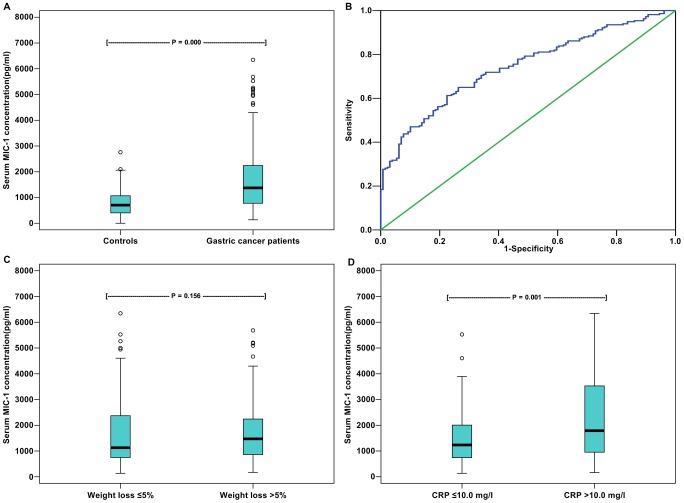
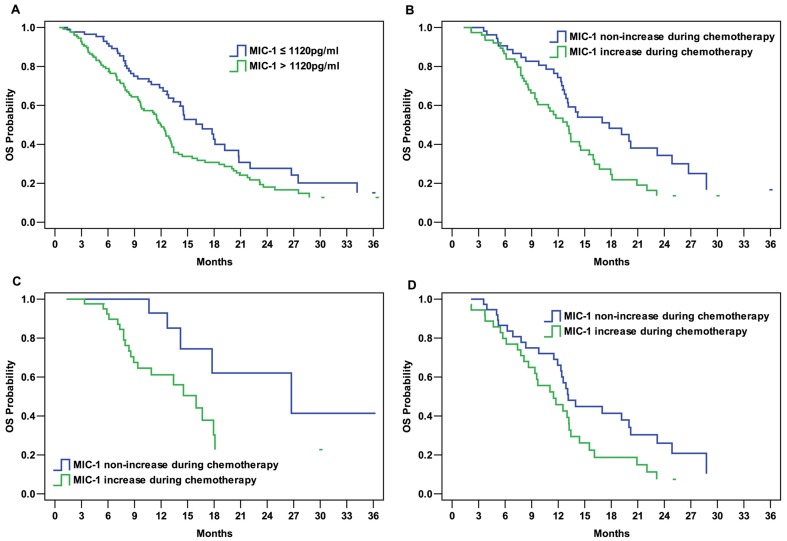
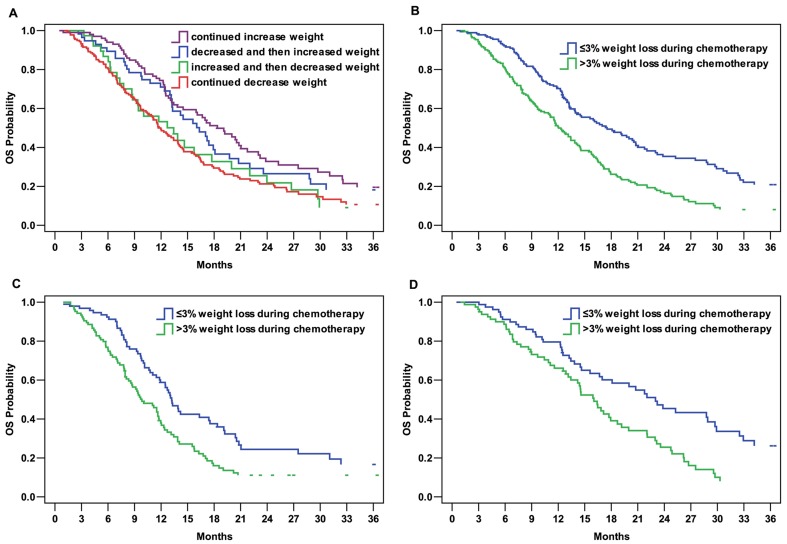
The >3% weight loss group had shorter overall survival (OS; 12.0 months vs. 17.5 months, P = 0.000) than the ≤ 3% weight loss group, and the survival rates improved if the weight loss was reversed during chemotherapy. Although the MIC-1 concentrations were not correlated with weight loss before (P = 0.156) or during chemotherapy (P = 0.164), it correlated significantly with the CRP concentration (P = 0.001). Furthermore, elevated MIC-1 concentrations before chemotherapy (P = 0.017) and increased MIC-1 concentrations during chemotherapy (P = 0.001) were both found to be predictors of poor OS.
Changes in the body weight during chemotherapy could influence the prognosis in patients with advanced GC, and the MIC-1 might be a potential predictive and prognostic biomarker in those patients.
晚期胃癌(GC)患者体重减轻一直被广泛认为是生存预后不良的一个预测指标。然而,极少有研究调查化疗期间出现的体重减轻情况。因此,我们重点关注晚期GC患者化疗期间的体重减轻情况,并研究巨噬细胞抑制细胞因子-1(MIC-1)的浓度,该因子已被认为是厌食和体重减轻的一个可能病因。
我们分析了384例接受一线化疗的无法手术的局部晚期或转移性GC患者。根据化疗期间的体重变化,将患者分为两组:体重减轻>3%和体重减轻≤3%。还对这些患者的血清MIC-1和C反应蛋白(CRP)浓度进行了评估。
体重减轻>3%组的总生存期(OS;12.0个月对17.5个月,P = 0.000)短于体重减轻≤3%组,且如果化疗期间体重减轻得到逆转,生存率会提高。虽然MIC-1浓度与化疗前(P = 0.156)或化疗期间(P = 0.164)的体重减轻均无相关性,但它与CRP浓度显著相关(P = 0.001)。此外,化疗前MIC-1浓度升高(P = 0.017)和化疗期间MIC-1浓度升高(P = 0.001)均被发现是OS不良的预测指标。
化疗期间体重的变化可能影响晚期GC患者的预后,且MIC-1可能是这些患者潜在的预测和预后生物标志物。