Gispan Ariel, Carmi Miri, Barkai Naama
Department of Molecular Genetics, Weizmann Institute of Science, Rehovot 76100, Israel.
Genome Res. 2017 Feb;27(2):310-319. doi: 10.1101/gr.205849.116. Epub 2016 Dec 27.
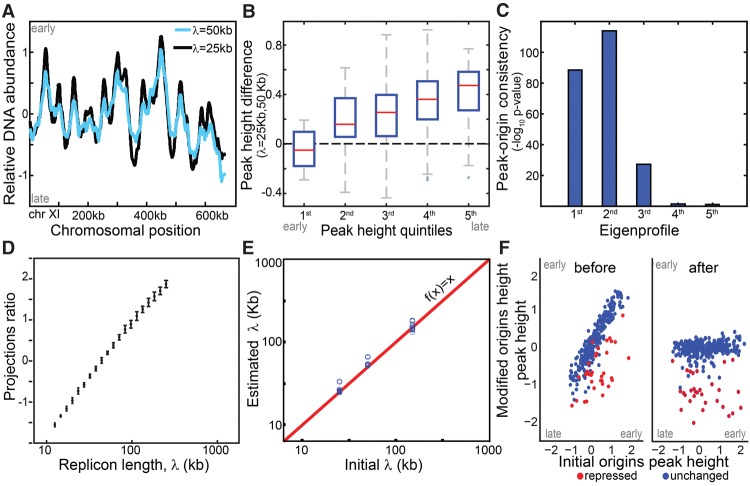
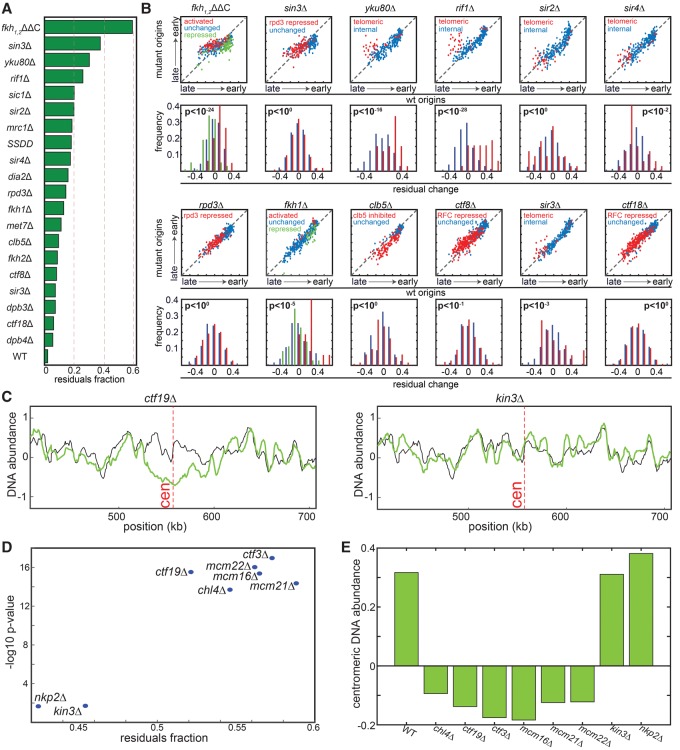
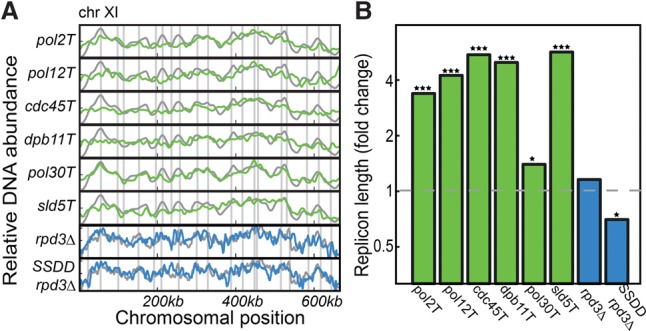
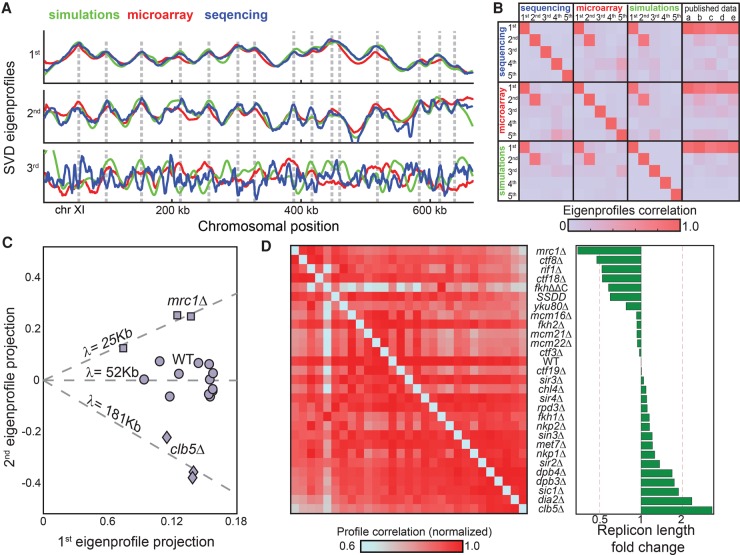
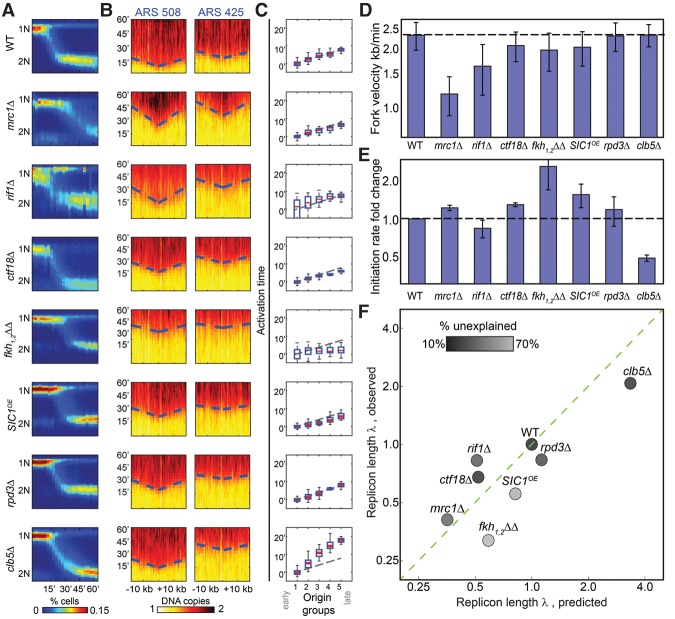
Eukaryotic cells initiate DNA synthesis by sequential firing of hundreds of origins. This ordered replication is described by replication profiles, which measure the DNA content within a cell population. Here, we show that replication dynamics can be deduced from replication profiles of free-cycling cells. While such profiles lack explicit temporal information, they are sensitive to fork velocity and initiation capacity through the passive replication pattern, namely the replication of origins by forks emanating elsewhere. We apply our model-based approach to a compendium of profiles that include most viable budding yeast mutants implicated in replication. Predicted changes in fork velocity or initiation capacity are verified by profiling synchronously replicating cells. Notably, most mutants implicated in late (or early) origin effects are explained by global modulation of fork velocity or initiation capacity. Our approach provides a rigorous framework for analyzing DNA replication profiles of free-cycling cells.
真核细胞通过数百个复制起点的顺序激活来启动DNA合成。这种有序的复制由复制图谱描述,复制图谱测量细胞群体中的DNA含量。在这里,我们表明复制动态可以从自由循环细胞的复制图谱中推导出来。虽然这些图谱缺乏明确的时间信息,但它们通过被动复制模式(即由其他地方发出的叉进行起始点的复制)对叉速度和起始能力敏感。我们将基于模型的方法应用于一组图谱,这些图谱包括大多数与复制相关的有活力的芽殖酵母突变体。通过对同步复制细胞进行分析,验证了预测的叉速度或起始能力的变化。值得注意的是,大多数与晚期(或早期)起始点效应相关的突变体可以通过叉速度或起始能力的全局调节来解释。我们的方法为分析自由循环细胞的DNA复制图谱提供了一个严格的框架。