Naganawa Kensuke, Koto Masashi, Takagi Ryo, Hasegawa Azusa, Ikawa Hiroaki, Shimozato Kazuo, Kamada Tadashi, Okamoto Yoshitaka
National Institute of Radiological Sciences Hospital, National Institutes for Quantum and Radiological Sciences and Technology, 4-9-1 Anagawa, Inage-ku, Chiba 263-8555, Japan.
Department of Oral and Maxillofacial Surgery, Aichi Gakuin University, School of Dentistry, 2-11 Suemori-dori, Chikusa-ku, Nagoya, Aichi 464-8651, Japan.
J Radiat Res. 2017 Jul 1;58(4):517-522. doi: 10.1093/jrr/rrw117.
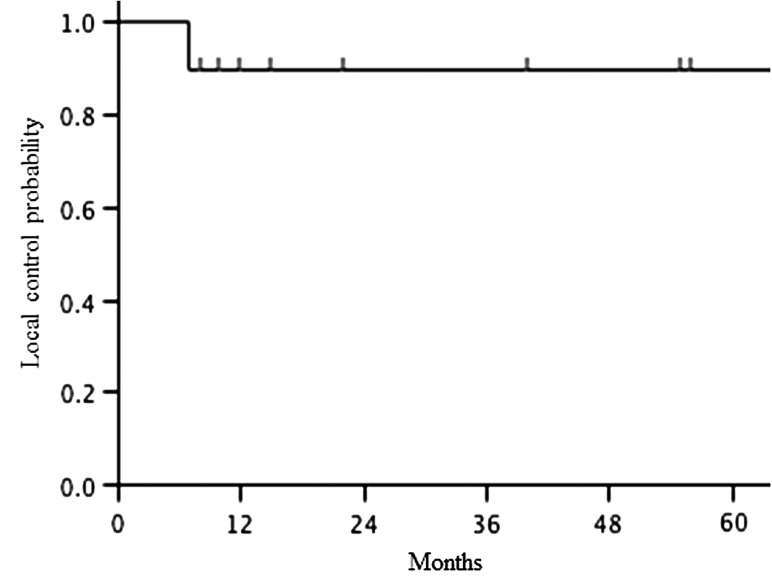
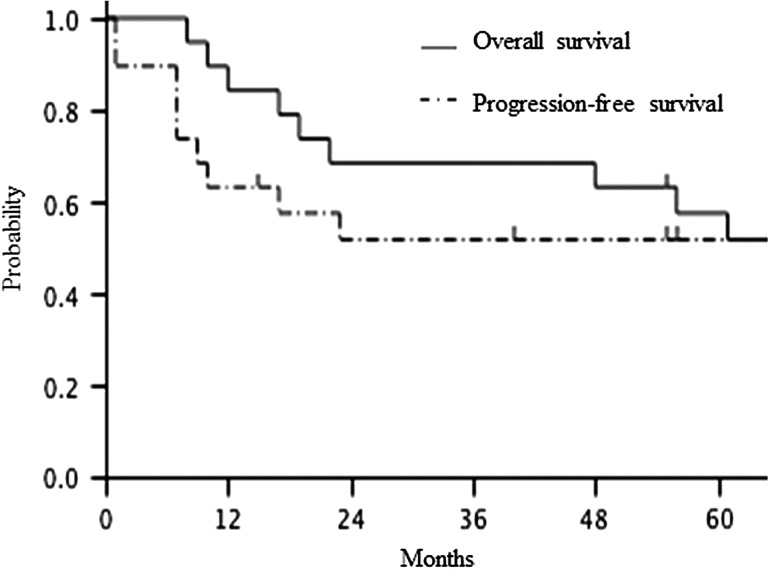
Oral mucosal malignant melanoma (OMM) is extremely rare and has a poor prognosis. Owing to its rarity, it has not yet been possible to establish an optimal treatment modality. The objective of this study was to evaluate the long-term efficacy of carbon-ion radiotherapy (C-ion RT) for OMM. Between 1997 and 2013, 19 patients with OMM were treated with C-ion RT alone. Patient ages ranged from 44 to 84 years (median, 69 years). Nine men and 10 women were included. OMMs were restaged in accordance with the seventh edition of the tumour/node/metastasis (TNM) Staging System of the International Union Against Cancer. Before treatment, 14 patients had T3 disease and 5 had T4a disease. Three patients were classified as having N1 disease. All patients were classified as having M0. The hard palate was the most frequently involved oral subsite. All patients were treated with 57.6 Gy (relative biological effectiveness) in 16 fractions. The median follow-up period was 61 months (range, 8-190 months). The 5-year local control, overall survival and progression-free survival rates were 89.5%, 57.4% and 51.6%, respectively. For local control and overall survival, T classification was found to be a significant prognostic factor. Grade 2 and 3 osteoradionecrosis was observed in three and four patients, respectively. The presence of teeth within the planning target volume was a significant risk factor for developing osteoradionecrosis. C-ion RT was an effective treatment option with acceptable toxicity for OMM.
口腔黏膜恶性黑色素瘤(OMM)极为罕见,预后较差。由于其罕见性,尚未能够确立最佳治疗方式。本研究的目的是评估碳离子放疗(C离子放疗)治疗OMM的长期疗效。1997年至2013年期间,19例OMM患者仅接受了C离子放疗。患者年龄范围为44至84岁(中位数为69岁)。其中包括9名男性和10名女性。OMM根据国际抗癌联盟肿瘤/淋巴结/转移(TNM)分期系统第七版进行重新分期。治疗前,14例患者为T3期疾病,5例为T4a期疾病。3例患者被分类为N1期疾病。所有患者均被分类为M0期。硬腭是最常受累的口腔亚部位。所有患者均接受了16次分割、总剂量为57.6 Gy(相对生物效应)的治疗。中位随访期为61个月(范围为8至190个月)。5年局部控制率、总生存率和无进展生存率分别为89.5%、57.4%和51.6%。对于局部控制和总生存而言,T分期被发现是一个显著的预后因素。分别有3例和4例患者观察到2级和3级放射性骨坏死。计划靶区内存在牙齿是发生放射性骨坏死的一个显著危险因素。C离子放疗是治疗OMM的一种有效且毒性可接受的治疗选择。