Tekleab Atnafu Mekonnen, Tadesse Birkneh Tilahun, Giref Ababi Zergaw, Shimelis Damte, Gebre Meseret
St Paul's Hospital Millennium Medical College, Addis Ababa, Ethiopia.
Hawassa University, Department of Pediatrics, Hawassa, Ethiopia.
PLoS One. 2016 Dec 28;11(12):e0167565. doi: 10.1371/journal.pone.0167565. eCollection 2016.
Antiretroviral therapy (ART) is a lifesaving intervention for HIV infected children. There is a scarcity of data on immunological recovery and its relation with growth indicators among HIV infected young children. The current study aims to assess the pattern of anthropometric Z-score improvement following initiation of first-line ART among under-five children and the relationship between anthropometric Z-score improvement and immunologic recovery.
We included under-five children who were on first-line ART at five major hospitals in Addis Ababa, Ethiopia. We measured anthropometry and collected clinical and laboratory data at follow up, and we retrieved clinical and anthropometric data at ART initiation from records. Z-scores for each of the anthropometric indices were calculated based on WHO growth standards using ENA for SMART 2011 software. Linear regression was used to assess the relationship between time on ART and anthropometric Z-score improvement; and the relationship between anthropometric Z-score improvement and immunologic recovery. Multiple linear regression was used to assess the independent predictors of anthropometric Z-score change.
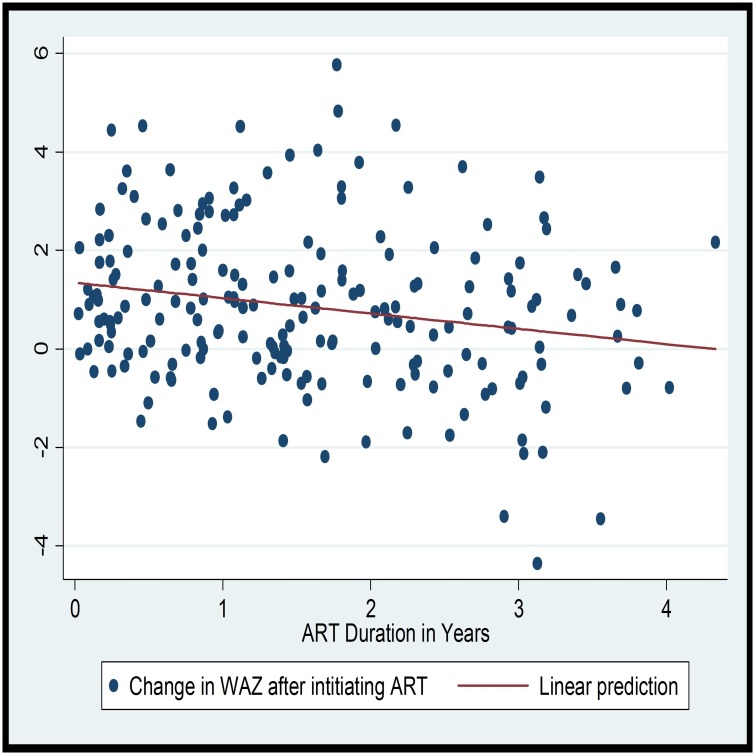
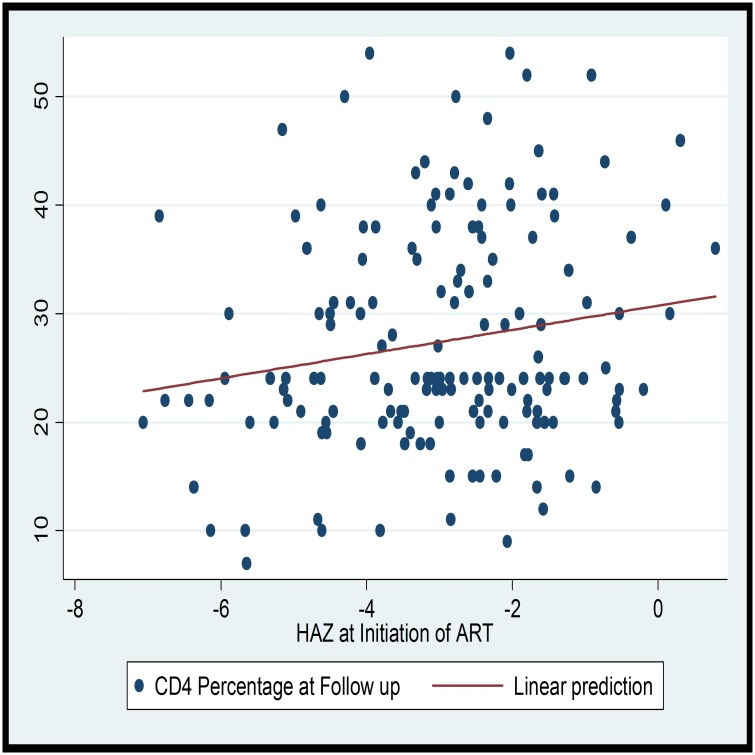
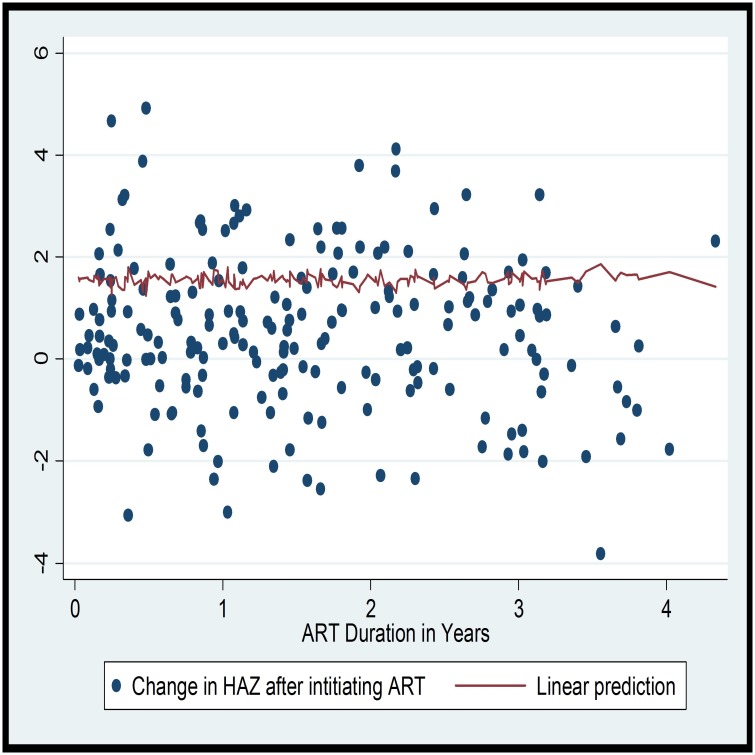
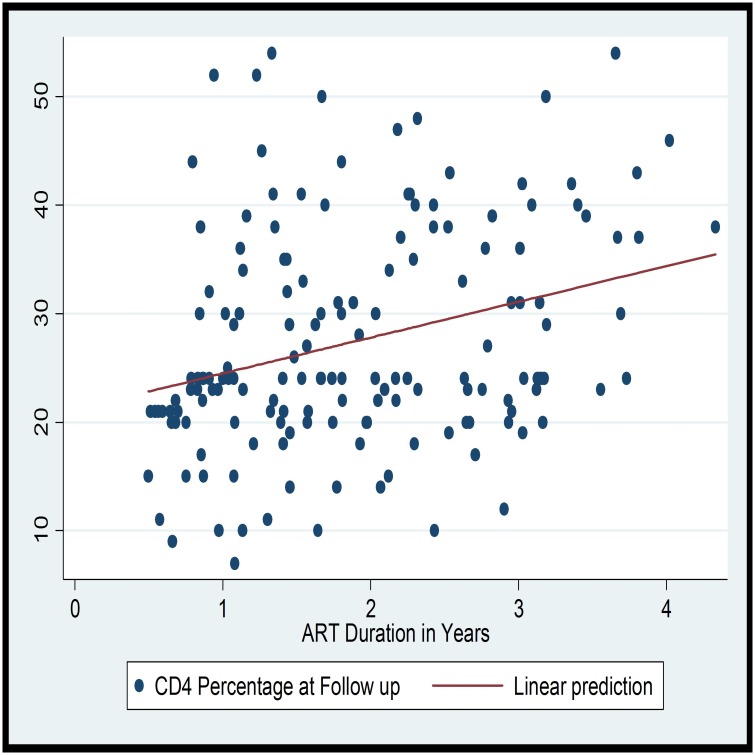
The median age of the participants was 4.1 (Interquartile range (IQR): 3.3-4.9) years. More than half (52.48%) were female. The median duration of follow up was 1.69 (IQR: 1.08-2.63) years. There was a significant improvement in all anthropometric indices at any follow up after initiation of first-line ART (underweight; 39.5% vs16.5%, stunting; 71.3% vs 62.9% and wasting; 16.3% vs 1.0%; p-value< 0.0001). There was an inverse relationship between improvement in weight for age Z-score (WAZ) and duration of ART (R2 = 0.04; F (1, 158); p = 0.013). Height for age Z-score (HAZ) both at the time of ART initiation and follow up has a positive linear relationship with CD4 percentage at follow up (Coef. = 1.92; R2 = 0.05; p-value = 0.002). Duration on ART (Std. Err. = 0.206, t = -1.99, p-value = 0.049) and level of maternal education (Std. Err. = 0.290, t = 2.64, p-value = 0.009) were the only independent predictors of the change in WAZ and change in HAZ at any follow up visit respectively.
There was a significant improvement in all anthropometric indices at any follow-up after initiation of first-line ART among under-five children. HAZ was linearly related with immunologic recovery following ART initiation. The findings indicate that anthropometric indices could be taken as proxy indicators of immunologic recovery for under-five children.
抗逆转录病毒疗法(ART)是挽救HIV感染儿童生命的干预措施。关于HIV感染幼儿免疫恢复情况及其与生长指标的关系,数据匮乏。本研究旨在评估五岁以下儿童开始一线抗逆转录病毒治疗后人体测量Z评分改善的模式,以及人体测量Z评分改善与免疫恢复之间的关系。
我们纳入了埃塞俄比亚亚的斯亚贝巴五家主要医院接受一线抗逆转录病毒治疗的五岁以下儿童。我们在随访时测量了人体测量指标,并收集了临床和实验室数据,还从记录中检索了开始抗逆转录病毒治疗时的临床和人体测量数据。使用ENA for SMART 2011软件,根据世界卫生组织生长标准计算每个人体测量指标的Z评分。采用线性回归评估抗逆转录病毒治疗时间与人体测量Z评分改善之间的关系,以及人体测量Z评分改善与免疫恢复之间的关系。采用多元线性回归评估人体测量Z评分变化的独立预测因素。
参与者的中位年龄为4.1岁(四分位间距(IQR):3.3 - 4.9岁)。超过一半(52.48%)为女性。中位随访时间为1.69年(IQR:1.08 - 2.63年)。开始一线抗逆转录病毒治疗后的任何随访中,所有人体测量指标均有显著改善(体重不足:39.5%对16.5%,发育迟缓:71.3%对62.9%,消瘦:16.3%对1.0%;p值<0.0001)。年龄别体重Z评分(WAZ)的改善与抗逆转录病毒治疗持续时间呈负相关(R2 = 0.04;F(1, 158);p = 0.013)。开始抗逆转录病毒治疗时和随访时的年龄别身高Z评分(HAZ)与随访时的CD4百分比呈正线性关系(系数 = 1.92;R2 = 0.05;p值 = 0.002)。抗逆转录病毒治疗持续时间(标准误 = 0.206,t = -1.99,p值 = 0.049)和母亲教育水平(标准误 = 0.290,t = 2.64,p值 = 0.009)分别是任何随访时WAZ变化和HAZ变化的唯一独立预测因素。
五岁以下儿童开始一线抗逆转录病毒治疗后的任何随访中,所有人体测量指标均有显著改善。HAZ与开始抗逆转录病毒治疗后的免疫恢复呈线性相关。研究结果表明,人体测量指标可作为五岁以下儿童免疫恢复的替代指标。