Department of Nursing, College of Health Sciences, Woldia University, Woldia, Ethiopia.
Department of Anatomy, College of Health Sciences, Woldia University, Woldia, Ethiopia.
PLoS One. 2020 Sep 17;15(9):e0238403. doi: 10.1371/journal.pone.0238403. eCollection 2020.
Malnutrition on the background of HIV (Human Immunodeficiency Virus) infection is a complex medical condition that carries significant morbidity and mortality for affected children, with greater mortality from SAM (Severe Acute Malnutrition) among HIV-positive children than their HIV-negative peers. HIV-induced immune impairment heightened risk of opportunistic infection and can worsen nutritional status of children. HIV infection often leads to nutritional deficiencies through decreased food intake, mal-absorption and increased utilization and excretion of nutrients, which in turn can hasten death.
The aim of this systematic review and meta-analysis was to assess the magnitude of underweight, wasting and stunting among HIV positive children in East Africa.
The authors systematically reviewed and meta-analyzed studies that assessed the prevalence of underweight, wasting and stunting among HIV positive children in East Africa from PubMed, Cochrane Library, Google Scholar, and Gray Literatures using PRISMA (Preferred Reporting Items for Systematic Reviews and Meta-analyses) guideline. The last search date was December 30/2019. The data was extracted in excel sheet considering country, study design, year of publication, prevalence reported. Then the authors transformed the data to STATA 14 for analysis. Heterogeneity across the studies was assessed by the Q and the I2 test. A weighted inverse variance random-effects model was used to estimate the magnitude of underweight, wasting and stunting. The subgroup analysis was done by country, year of publication, and study design. To examine publication bias, a funnel plot and Egger's regression test were used.
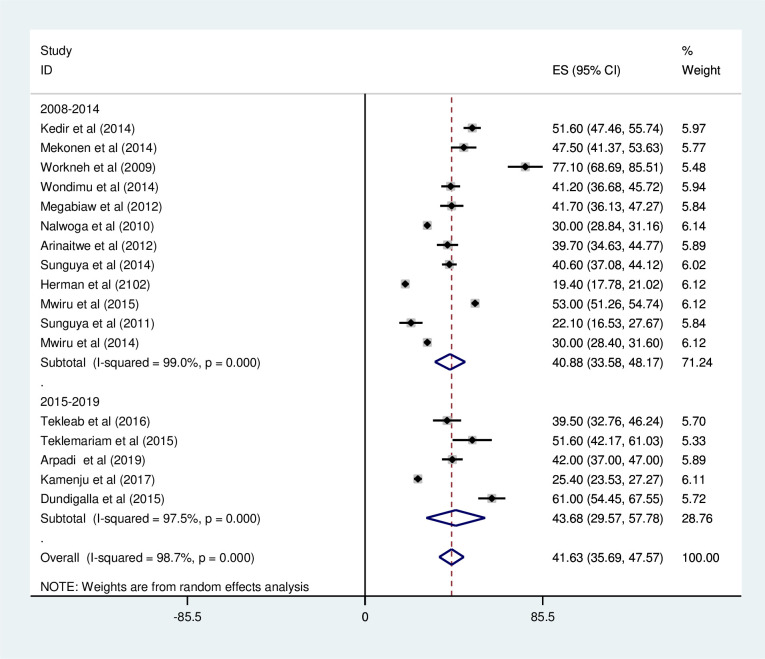
For the analysis a total of 22 studies with 22074 patients were used. The pooled prevalence of under-weight, wasting, and stunting among HIV positive children in East Africa was found to be 41.63% (95%CI; 35.69-47.57; I2 = 98.7%; p<0.001), 24.65% (95%CI; 18.34-30.95; I2 = 99.2%; p<0.001), and 49.68% (95%CI; 42.59-56.77; I2 = 99.0%; p<0.001) respectively. The prevalence of under-weight among HIV positive children was found to be 49.67% in Ethiopia followed by 42.00 in Rwanda. It was high among cohort studies (44.87%). Based on the year of publication, the prevalence of under-weight among HIV positive children was found to be 40.88% from studies conducted from January 2008-December 2014, while it was 43.68% from studies conducted from 2015-2019. The prevalence of wasting among HIV positive children was found to be 29.7% in Tanzania followed by 24.94% in Ethiopia. Based on the study design, the prevalence of wasting among HIV positive children was found to be high in cohort studies (31.15%). The prevalence of stunting among HIV positive children was found to be 51.63% in Ethiopia, followed by 48.21% in Uganda.
The results presented above provide evidence of a higher prevalence of under nutrition among HIV positive children in East Africa. Despite the country level variations of child under nutrition in East Africa, still it is high in all aspects compared to the studies from other parts of Africa. It is recommended that further systematic review and meta-analysis need to be conducted on magnitude of malnutrition among HIV positive children in Sub-Saharan Africa as a whole.
在 HIV(人类免疫缺陷病毒)感染背景下的营养不良是一种复杂的医学病症,会给受影响的儿童带来重大发病率和死亡率,HIV 阳性儿童中 SAM(严重急性营养不良)的死亡率高于其 HIV 阴性同龄人。HIV 引起的免疫损伤增加了机会性感染的风险,并可能使儿童的营养状况恶化。HIV 感染通常通过减少食物摄入、吸收不良以及增加营养物质的利用和排泄导致营养缺乏,这反过来又会加速死亡。
本系统评价和荟萃分析的目的是评估东非 HIV 阳性儿童中消瘦、消瘦和发育迟缓的程度。
作者使用 PRISMA(系统评价和荟萃分析的首选报告项目)指南,从 PubMed、Cochrane 图书馆、Google Scholar 和灰色文献中系统地回顾和荟萃分析了评估东非 HIV 阳性儿童消瘦、消瘦和发育迟缓患病率的研究。最后一次搜索日期为 2019 年 12 月 30 日。作者考虑了国家、研究设计、发表年份、报告的患病率,在 excel 表中提取数据。使用 Q 和 I2 检验评估研究之间的异质性。使用加权逆方差随机效应模型估计消瘦、消瘦和发育迟缓的程度。按国家、发表年份和研究设计进行亚组分析。使用漏斗图和 Egger 回归检验检查发表偏倚。
为了进行分析,共使用了 22 项研究,共 22074 名患者。东非 HIV 阳性儿童消瘦、消瘦和发育迟缓的总患病率分别为 41.63%(95%CI;35.69-47.57;I2 = 98.7%;p<0.001)、24.65%(95%CI;18.34-30.95;I2 = 99.2%;p<0.001)和 49.68%(95%CI;42.59-56.77;I2 = 99.0%;p<0.001)。埃塞俄比亚 HIV 阳性儿童消瘦的患病率为 49.67%,其次是卢旺达的 42.00%。队列研究中的患病率较高(44.87%)。根据发表年份,2008 年 1 月至 2014 年 12 月发表的研究中,HIV 阳性儿童消瘦的患病率为 40.88%,而 2015 年至 2019 年发表的研究中,该患病率为 43.68%。坦桑尼亚 HIV 阳性儿童消瘦的患病率为 29.7%,其次是埃塞俄比亚的 24.94%。根据研究设计,队列研究中 HIV 阳性儿童消瘦的患病率较高(31.15%)。埃塞俄比亚 HIV 阳性儿童发育迟缓的患病率为 51.63%,其次是乌干达的 48.21%。
上述结果提供了东非 HIV 阳性儿童营养不足患病率较高的证据。尽管东非国家在儿童营养不足方面存在差异,但与非洲其他地区的研究相比,各方面的患病率仍然很高。建议对整个撒哈拉以南非洲地区 HIV 阳性儿童营养不良的程度进行进一步的系统评价和荟萃分析。