Yang Li-Li, Liu Bing-Chen, Lu Xiao-Yu, Yan Yan, Zhai Yu-Jia, Bao Qing, Doetsch Paul W, Deng Xingming, Thai Tiffany L, Alli Abdel A, Eaton Douglas C, Shen Bao-Zhong, Ma He-Ping
Department of Radiology, The Fourth Affiliated Hospital of Harbin Medical University, Harbin, Heilongjiang, China.
Molecular Imaging Research Center of Harbin Medical University, Harbin, Heilongjiang, China.
Oncotarget. 2017 Jan 17;8(3):5123-5134. doi: 10.18632/oncotarget.14034.
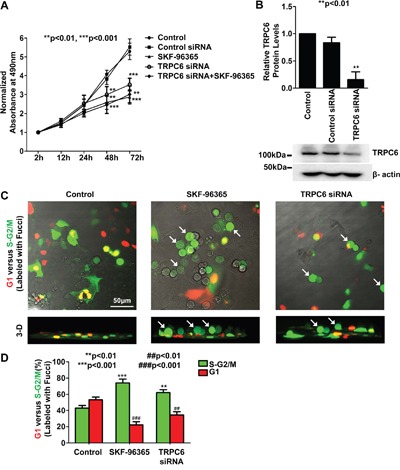
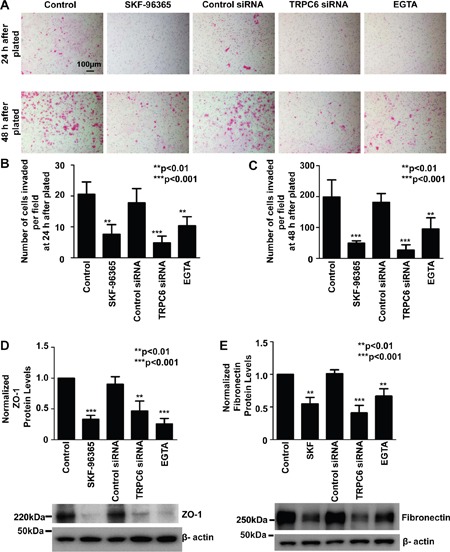
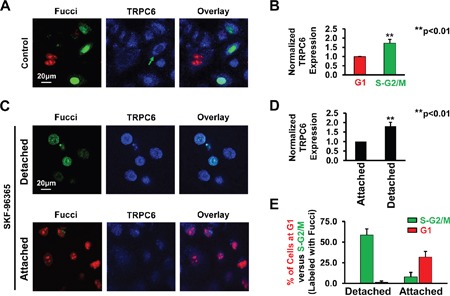
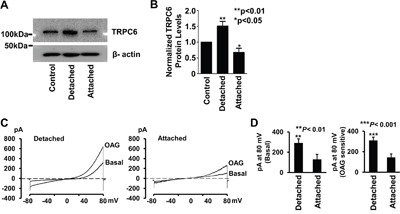
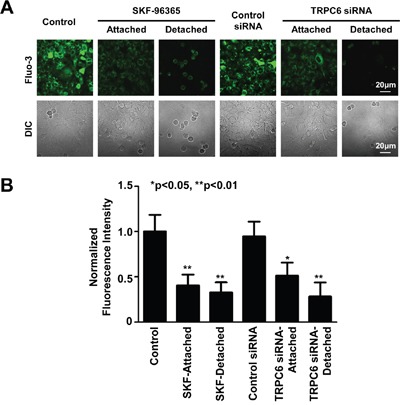
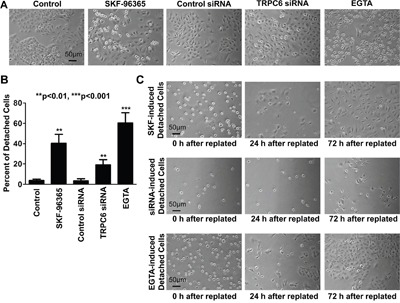
Recent studies indicate that the transient receptor potential canonical 6 (TRPC6) channel is highly expressed in several types of cancer cells. However, it remains unclear whether TRPC6 contributes to the malignancy of human non-small cell lung cancer (NSCLC). We used a human NSCLC A549 cell line as a model and found that pharmacological blockade or molecular knockdown of TRPC6 channel inhibited A549 cell proliferation by arresting cell cycle at the S-G2M phase and caused a significant portion of cells detached and rounded-up, but did not induce any types of cell death. Western blot and cell cycle analysis show that the detached round cells at the S-G2M phase expressed more TRPC6 than the still attached polygon cells at the G1 phase. Patch-clamp data also show that TRPC whole-cell currents in the detached cells were significantly higher than in the still attached cells. Inhibition of Ca2+-permeable TRPC6 channels significantly reduced intracellular Ca2+ in A549 cells. Interestingly, either blockade or knockdown of TRPC6 strongly reduced the invasion of this NSCLC cell line and decreased the expression of an adherent protein, fibronectin, and a tight junction protein, zonula occluden protein-1 (ZO-1). These data suggest that TRPC6-mediated elevation of intracellular Ca2+ stimulates NSCLC cell proliferation by promoting cell cycle progression and that inhibition of TRPC6 attenuates cell proliferation and invasion. Therefore, further in vivo studies may lead to a consideration of using a specific TRPC6 blocker as a complement to treat NSCLC.
最近的研究表明,瞬时受体电位阳离子通道亚家族C成员6(TRPC6)通道在几种类型的癌细胞中高度表达。然而,TRPC6是否促成人类非小细胞肺癌(NSCLC)的恶性程度仍不清楚。我们使用人NSCLC A549细胞系作为模型,发现TRPC6通道的药理学阻断或分子敲低通过使细胞周期停滞在S-G2M期来抑制A549细胞增殖,并导致相当一部分细胞脱离并变圆,但未诱导任何类型的细胞死亡。蛋白质免疫印迹和细胞周期分析表明,处于S-G2M期的脱离的圆形细胞比处于G1期仍附着的多边形细胞表达更多的TRPC6。膜片钳数据还表明,脱离细胞中的TRPC全细胞电流明显高于仍附着细胞中的电流。抑制Ca2+可渗透的TRPC6通道可显著降低A549细胞中的细胞内Ca2+。有趣的是,TRPC6的阻断或敲低均强烈降低了该NSCLC细胞系的侵袭能力,并降低了粘附蛋白纤连蛋白和紧密连接蛋白闭合蛋白-1(ZO-1)的表达。这些数据表明,TRPC6介导的细胞内Ca2+升高通过促进细胞周期进程来刺激NSCLC细胞增殖,而抑制TRPC6可减弱细胞增殖和侵袭。因此,进一步的体内研究可能会考虑使用特异性TRPC6阻滞剂作为治疗NSCLC的补充手段。