Qin Ling, Yao Zhi-Qiang, Chang Qi, Zhao Ya-Li, Liu Ning-Ning, Zhu Xiao-Shan, Liu Qin-Qin, Wang Li-Feng, Yang An-Gang, Gao Chun-Fang, Li Jun-Tang
Department of Hematology, First Affiliated Hospital, and College of Clinical Medicine of Henan University of Science and Technology, Luoyang, Henan, China.
Centre of Inflammation and Cancer Research, 150th Central Hospital of PLA, Luoyang, Henan, China.
Oncotarget. 2017 Jan 31;8(5):7391-7404. doi: 10.18632/oncotarget.14080.
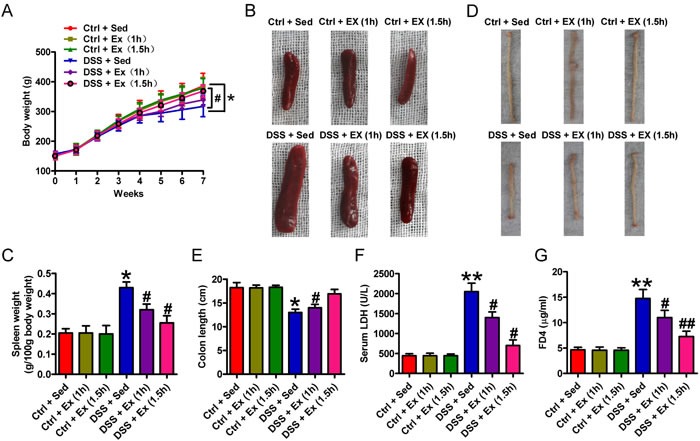
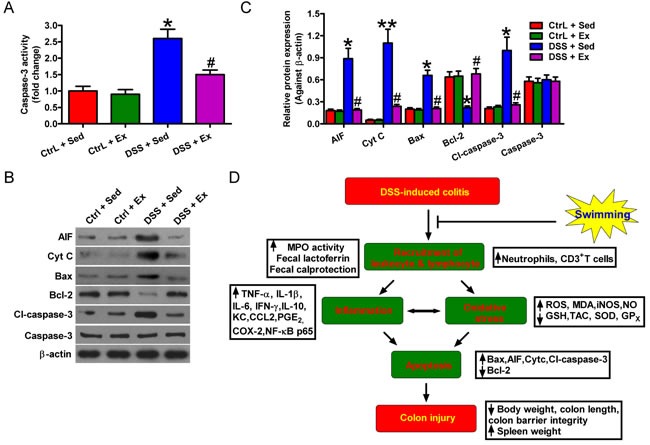
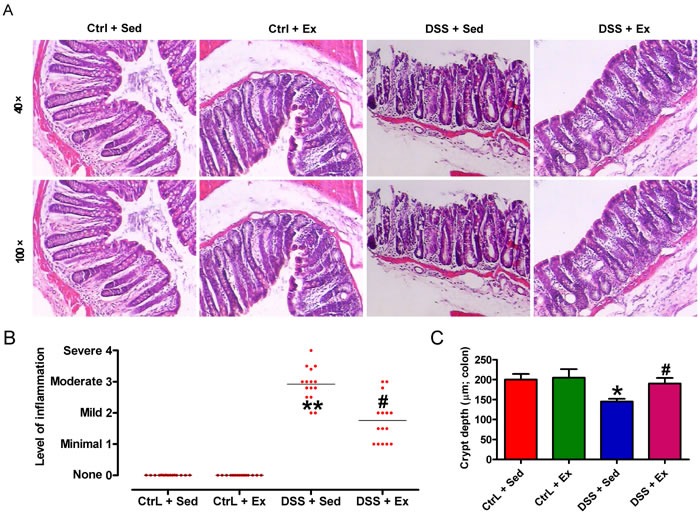
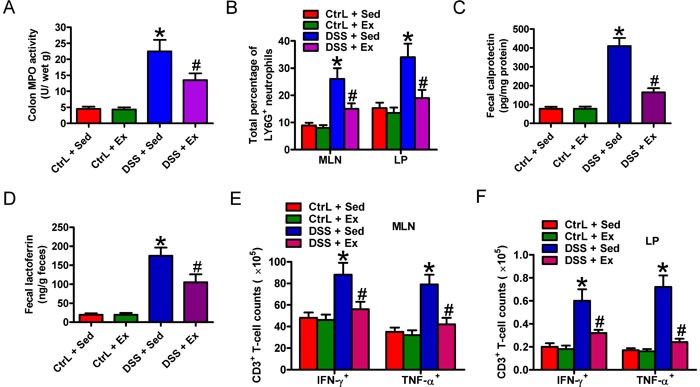
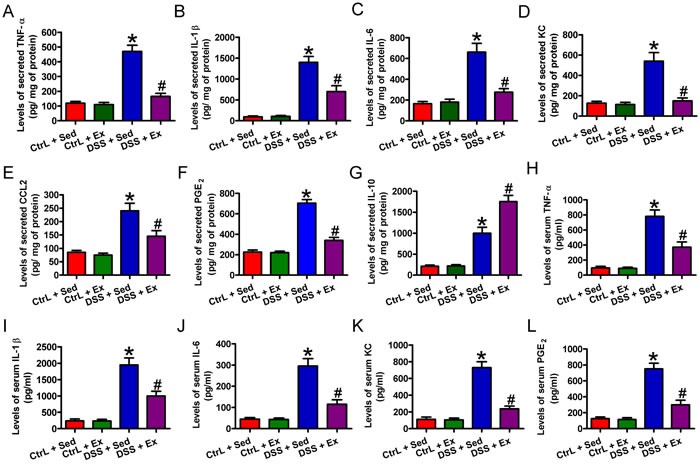
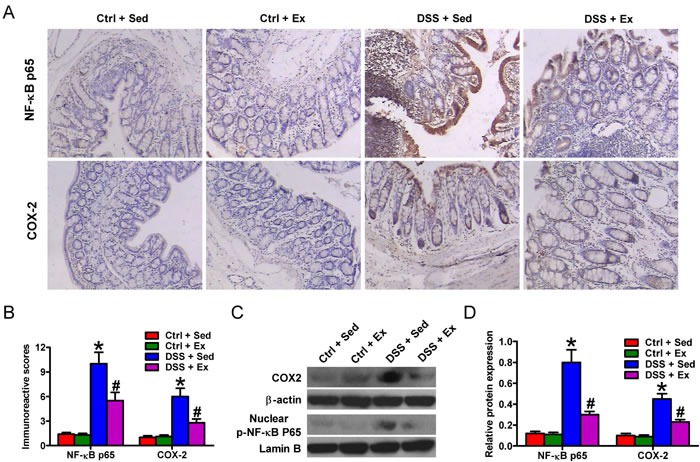
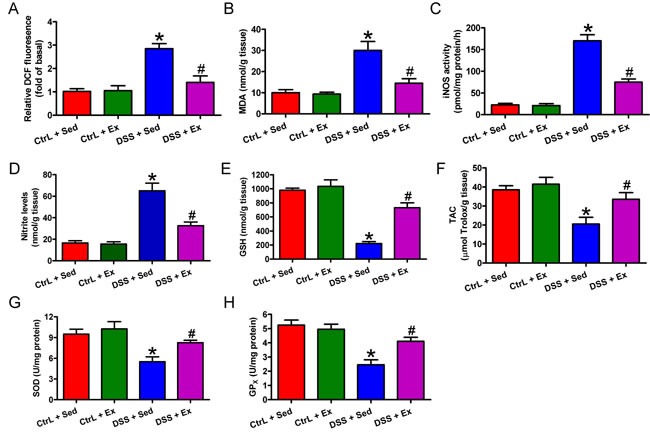
Increasing evidence suggests that regular physical exercise suppresses chronic inflammation. However, the potential inhibitory effects of swimming on dextran sulfate sodium (DSS)-induced chronic colitis, and its underlying mechanisms, remain unclear. In this study, rats were orally administered DSS to induce chronic colitis, and subsequently treated with or without swimming exercise. A 7-week swimming program (1 or 1.5 hours per day, 5 days per week) ameliorated DSS-caused colon shortening, colon barrier disruption, spleen enlargement, serum LDH release, and reduction of body weight gain. Swimming for 1.5 hours per day afforded greater protection than 1 hour per day. Swimming ameliorated DSS-induced decrease in crypt depth, and increases in myeloperoxidase activity, infiltration of Ly6G+ neutrophils and TNF-α- and IFN-γ-expressing CD3+ T cells, as well as fecal calprotectin and lactoferrin. Swimming inhibited pro-inflammatory cytokine and chemokine production and decreased the protein expression of phosphorylated nuclear factor-κB p65 and cyclooxygenase 2, whereas it elevated interleukin-10 levels. Swimming impeded the generation of reactive oxygen species, malondialdehyde, and nitric oxide; however, it boosted glutathione levels, total antioxidant capacity, and superoxide dismutase and glutathione peroxidase activities. Additionally, swimming decreased caspase-3 activity and expression of apoptosis-inducing factor, cytochrome c, Bax, and cleaved-caspase-3, but increased Bcl-2 levels. Overall, these results suggest that swimming exerts beneficial effects on DSS-induced chronic colitis by modulating inflammation, oxidative stress, and apoptosis.
越来越多的证据表明,规律的体育锻炼可抑制慢性炎症。然而,游泳对葡聚糖硫酸钠(DSS)诱导的慢性结肠炎的潜在抑制作用及其潜在机制仍不清楚。在本研究中,给大鼠口服DSS以诱导慢性结肠炎,随后进行或不进行游泳锻炼处理。为期7周的游泳计划(每天1或1.5小时,每周5天)改善了DSS引起的结肠缩短、结肠屏障破坏、脾脏肿大、血清乳酸脱氢酶释放以及体重增加减少的情况。每天游泳1.5小时比每天游泳1小时提供了更大的保护作用。游泳改善了DSS诱导的隐窝深度降低,以及髓过氧化物酶活性增加、Ly6G +中性粒细胞浸润以及表达肿瘤坏死因子-α和干扰素-γ的CD3 + T细胞增加,以及粪便钙卫蛋白和乳铁蛋白增加的情况。游泳抑制促炎细胞因子和趋化因子的产生,并降低磷酸化核因子-κB p65和环氧化酶2的蛋白表达,而提高白细胞介素-10水平。游泳阻碍了活性氧、丙二醛和一氧化氮的产生;然而,它提高了谷胱甘肽水平、总抗氧化能力以及超氧化物歧化酶和谷胱甘肽过氧化物酶活性。此外,游泳降低了半胱天冬酶-3活性以及凋亡诱导因子、细胞色素c、Bax和裂解的半胱天冬酶-3的表达,但增加了Bcl-2水平。总体而言,这些结果表明,游泳通过调节炎症、氧化应激和细胞凋亡对DSS诱导的慢性结肠炎发挥有益作用。