Julius Center for Health Sciences and Primary Care, University Medical Center Utrecht, Utrecht University, Utrecht, the Netherlands.
Department of Medical Oncology, University Medical Center Utrecht, Utrecht University, Utrecht, the Netherlands.
J Natl Cancer Inst. 2024 Apr 5;116(4):573-579. doi: 10.1093/jnci/djad245.
Although animal experiments suggest beneficial effects of physical activity (PA) on antitumor immunity, little is known about the effects of PA on immune checkpoint inhibitor (ICI) toxicity and effectiveness in humans. We assessed the association of PA with immune-related adverse events (irAE) and survival in patients undergoing ICI.
Patients receiving ICI who completed the Dutch short questionnaire to assess health enhancing physical activity (SQUASH) questionnaire at the start of treatment as part of the prospective UNICIT study in an academic hospital were included. PA was quantified by calculating total metabolic equivalent task hours per week (total PA) and hours per week of moderate- to vigorous-intensity PA during sport and leisure time (MVPA-SL). Associations of PA with severe irAE occurrence within 1 year and overall survival (OS) were evaluated using logistic regression and Cox proportional hazard regression, respectively, with adjustment for probable confounders.
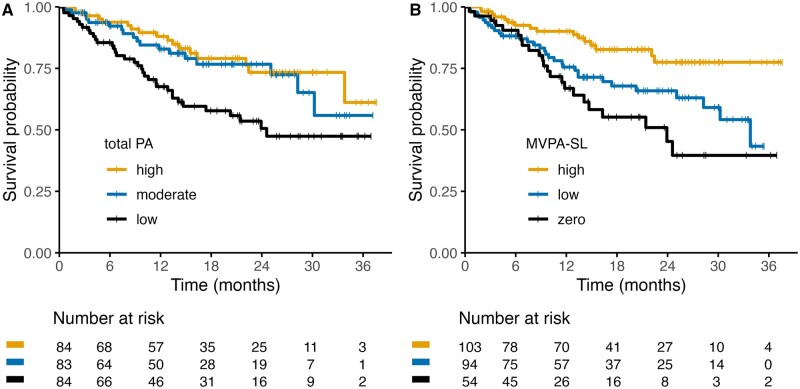
In total, 251 patients were included, with a median follow-up of 20 months. Moderate and high levels of total PA were associated with lower odds of severe irAE occurrence compared to low levels of total PA (adjusted OR: 0.34 [95% CI = 0.12 to 0.90] and 0.19 [95% CI = 0.05 to 0.55], respectively). Moderate and high levels of total PA were also associated with prolonged survival (adjusted HR: 0.58 [95% CI = 0.32 to 1.04] and 0.48 [95% CI = 0.27 to 0.89], respectively). Similar associations were observed in patients who performed more MVPA-SL.
Higher physical activity levels at the start of ICI treatment are associated with lower risk of severe irAEs and probably prolonged survival. Randomized controlled trials are needed to investigate whether patients indeed benefit from increasing PA levels after diagnosis.
尽管动物实验表明体力活动(PA)对抗肿瘤免疫有有益影响,但人们对 PA 对人类免疫检查点抑制剂(ICI)毒性和有效性的影响知之甚少。我们评估了 PA 与接受 ICI 治疗的患者的免疫相关不良事件(irAE)和生存之间的关系。
纳入在学术医院接受 ICI 治疗并作为前瞻性 UNICIT 研究的一部分在治疗开始时完成荷兰健康促进体力活动短问卷(SQUASH)问卷的患者。通过计算每周总代谢当量任务小时数(总 PA)和运动和休闲时间中等至剧烈强度体力活动(MVPA-SL)每周小时数来量化 PA。使用逻辑回归和 Cox 比例风险回归分别评估 PA 与 1 年内严重 irAE 发生和总生存(OS)的相关性,调整可能的混杂因素后进行。
共纳入 251 例患者,中位随访时间为 20 个月。与低水平总 PA 相比,高水平总 PA 与严重 irAE 发生的可能性降低相关(调整后的 OR:0.34 [95%CI = 0.12 至 0.90] 和 0.19 [95%CI = 0.05 至 0.55])。高水平总 PA 也与生存延长相关(调整后的 HR:0.58 [95%CI = 0.32 至 1.04] 和 0.48 [95%CI = 0.27 至 0.89])。在进行更多 MVPA-SL 的患者中也观察到类似的关联。
ICI 治疗开始时更高的体力活动水平与严重 irAE 风险降低和可能的生存延长相关。需要进行随机对照试验,以研究患者在诊断后是否确实受益于增加 PA 水平。