Link Daniel, Lang Steffen, Seidenschwarz Philipp
Department of Exercise Science and Sport Informatics, Technical University of Munich, Munich. Germany.
PLoS One. 2016 Dec 30;11(12):e0168768. doi: 10.1371/journal.pone.0168768. eCollection 2016.
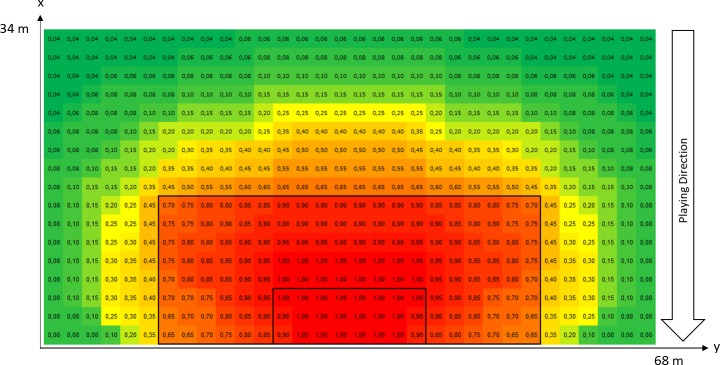
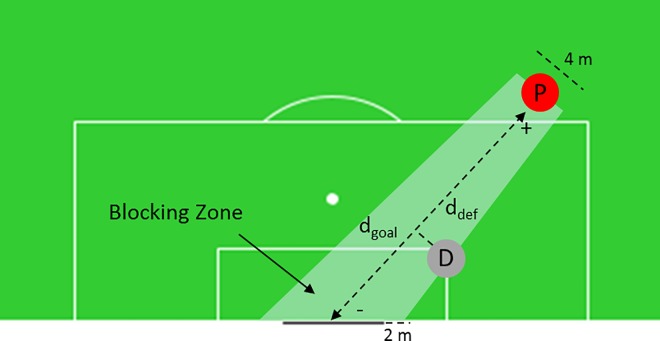
This study describes an approach to quantification of attacking performance in football. Our procedure determines a quantitative representation of the probability of a goal being scored for every point in time at which a player is in possession of the ball-we refer to this as dangerousity. The calculation is based on the spatial constellation of the player and the ball, and comprises four components: (1) Zone describes the danger of a goal being scored from the position of the player on the ball, (2) Control stands for the extent to which the player can implement his tactical intention on the basis of the ball dynamics, (3) Pressure represents the possibility that the defending team prevent the player from completing an action with the ball and (4) Density is the chance of being able to defend the ball after the action. Other metrics can be derived from dangerousity by means of which questions relating to analysis of the play can be answered. Action Value represents the extent to which the player can make a situation more dangerous through his possession of the ball. Performance quantifies the number and quality of the attacks by a team over a period of time, while Dominance describes the difference in performance between teams. The evaluation uses the correlation between probability of winning the match (derived from betting odds) and performance indicators, and indicates that among Goal difference (r = .55), difference in Shots on Goal (r = .58), difference in Passing Accuracy (r = .56), Tackling Rate (r = .24) Ball Possession (r = .71) and Dominance (r = .82), the latter makes the largest contribution to explaining the skill of teams. We use these metrics to analyse individual actions in a match, to describe passages of play, and to characterise the performance and efficiency of teams over the season. For future studies, they provide a criterion that does not depend on chance or results to investigate the influence of central events in a match, various playing systems or tactical group concepts on success.
本研究描述了一种量化足球进攻表现的方法。我们的程序确定了球员控球时每个时间点进球概率的定量表示——我们将此称为危险性。该计算基于球员和球的空间布局,包括四个组成部分:(1)区域描述了从控球球员位置进球的危险性,(2)控球代表球员根据球的动态实施其战术意图的程度,(3)压力表示防守球队阻止球员用球完成动作的可能性,(4)密度是动作后能够防守住球的机会。可以从危险性中得出其他指标,借助这些指标可以回答与比赛分析相关的问题。行动值表示球员控球能使局面变得更危险的程度。表现量化了一支球队在一段时间内进攻的数量和质量,而优势描述了球队之间表现的差异。该评估使用比赛获胜概率(从博彩赔率得出)与表现指标之间的相关性,并表明在净胜球差异(r = 0.55)、射正次数差异(r = 0.58)、传球准确率差异(r = 0.56)、抢断率(r = 0.24)、控球率(r = 0.71)和优势(r = 0.82)中,后者对解释球队技能的贡献最大。我们使用这些指标来分析比赛中的个人动作、描述比赛进程,并刻画球队在整个赛季中的表现和效率。对于未来的研究,它们提供了一个不依赖于偶然性或结果的标准,用于研究比赛中的核心事件、各种比赛体系或战术分组概念对成功的影响。