Atay Oguzhan, Skotheim Jan M
Department of Biology, Stanford University, Stanford, CA 94305.
Department of Biology, Stanford University, Stanford, CA 94305
J Cell Biol. 2017 Feb;216(2):317-330. doi: 10.1083/jcb.201609124. Epub 2017 Jan 2.
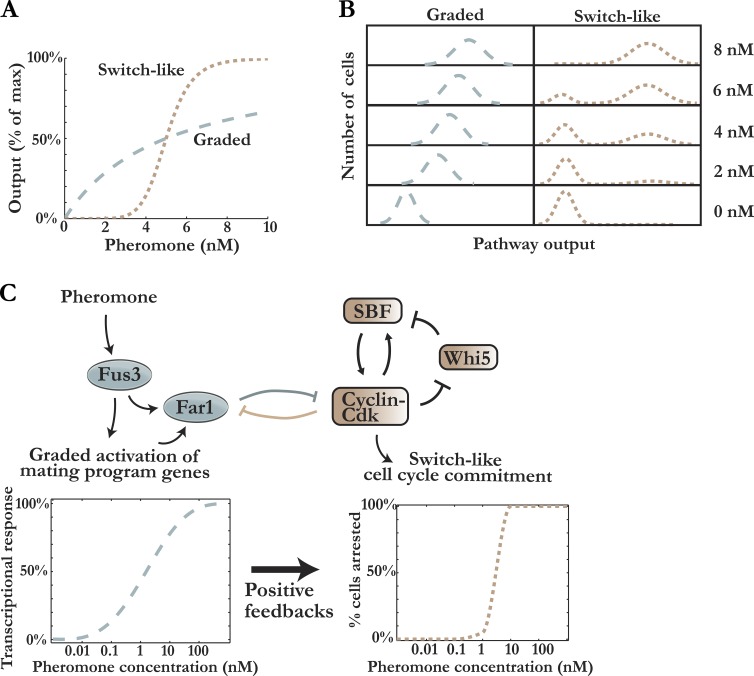
Mitogen-activated protein kinase (MAPK) pathways are conserved from yeast to man and regulate a variety of cellular processes, including proliferation and differentiation. Recent developments show how MAPK pathways perform exquisite spatial and temporal signal processing and underscores the importance of studying the dynamics of signaling pathways to understand their physiological response. The importance of dynamic mechanisms that process input signals into graded downstream responses has been demonstrated in the pheromone-induced and osmotic stress-induced MAPK pathways in yeast and in the mammalian extracellular signal-regulated kinase MAPK pathway. Particularly, recent studies in the yeast pheromone response have shown how positive feedback generates switches, negative feedback enables gradient detection, and coherent feedforward regulation underlies cellular memory. More generally, a new wave of quantitative single-cell studies has begun to elucidate how signaling dynamics determine cell physiology and represents a paradigm shift from descriptive to predictive biology.
丝裂原活化蛋白激酶(MAPK)通路从酵母到人类都高度保守,可调节多种细胞过程,包括增殖和分化。最新进展表明了MAPK通路是如何进行精确的时空信号处理的,并强调了研究信号通路动力学以理解其生理反应的重要性。在酵母的信息素诱导型和渗透应激诱导型MAPK通路以及哺乳动物细胞外信号调节激酶MAPK通路中,已证明了将输入信号处理为分级下游反应的动态机制的重要性。特别是,最近在酵母信息素反应中的研究表明,正反馈如何产生开关,负反馈如何实现梯度检测,以及相干前馈调节如何构成细胞记忆的基础。更普遍地说,新一轮的定量单细胞研究已开始阐明信号动力学如何决定细胞生理,这代表了从描述性生物学向预测性生物学的范式转变。