Kochanowski Karl, Gerosa Luca, Brunner Simon F, Christodoulou Dimitris, Nikolaev Yaroslav V, Sauer Uwe
Institute of Molecular Systems Biology, ETH Zurich, Zurich, Switzerland.
Life Science Zurich PhD Program on Systems Biology, Zurich, Switzerland.
Mol Syst Biol. 2017 Jan 3;13(1):903. doi: 10.15252/msb.20167402.
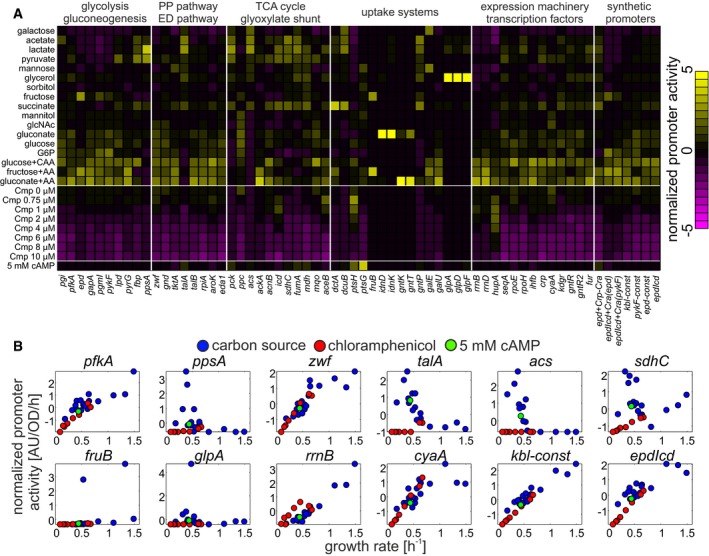
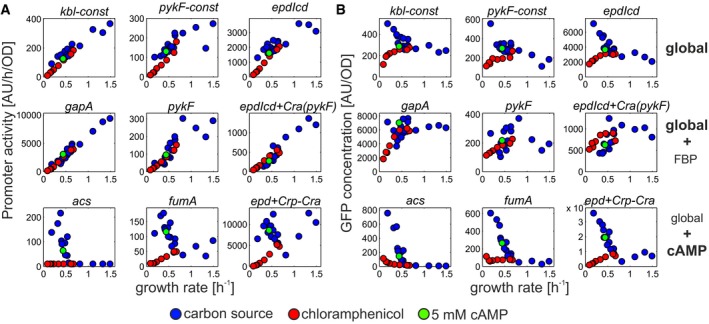
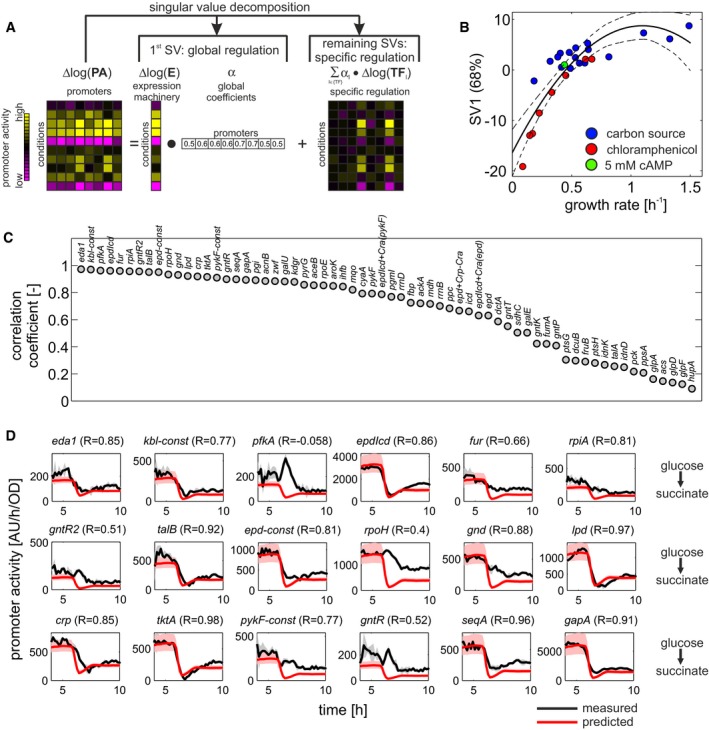
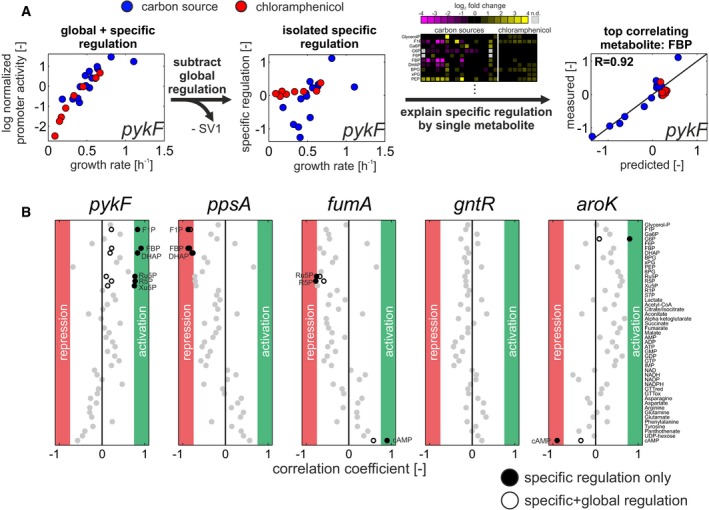
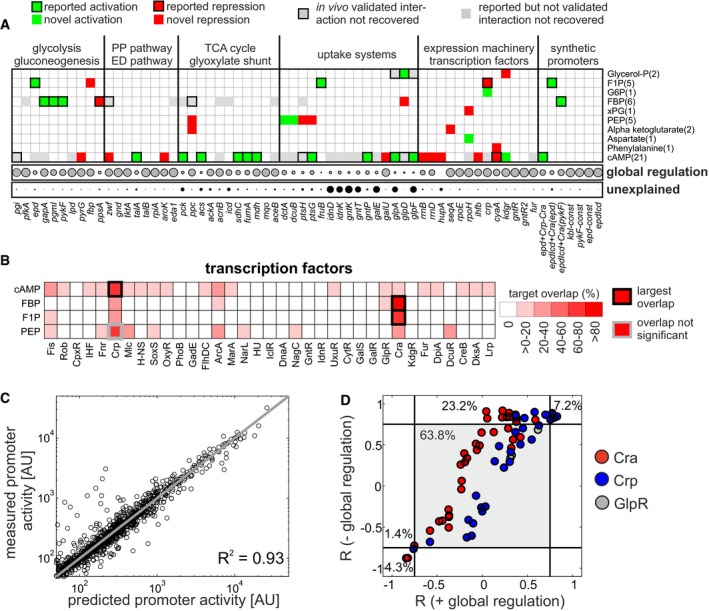
Transcription networks consist of hundreds of transcription factors with thousands of often overlapping target genes. While we can reliably measure gene expression changes, we still understand relatively little why expression changes the way it does. How does a coordinated response emerge in such complex networks and how many input signals are necessary to achieve it? Here, we unravel the regulatory program of gene expression in Escherichia coli central carbon metabolism with more than 30 known transcription factors. Using a library of fluorescent transcriptional reporters, we comprehensively quantify the activity of central metabolic promoters in 26 environmental conditions. The expression patterns were dominated by growth rate-dependent global regulation for most central metabolic promoters in concert with highly condition-specific activation for only few promoters. Using an approximate mathematical description of promoter activity, we dissect the contribution of global and specific transcriptional regulation. About 70% of the total variance in promoter activity across conditions was explained by global transcriptional regulation. Correlating the remaining specific transcriptional regulation of each promoter with the cell's metabolome response across the same conditions identified potential regulatory metabolites. Remarkably, cyclic AMP, fructose-1,6-bisphosphate, and fructose-1-phosphate alone explained most of the specific transcriptional regulation through their interaction with the two major transcription factors Crp and Cra. Thus, a surprisingly simple regulatory program that relies on global transcriptional regulation and input from few intracellular metabolites appears to be sufficient to coordinate E. coli central metabolism and explain about 90% of the experimentally observed transcription changes in 100 genes.
转录网络由数百种转录因子和数千个常常重叠的靶基因组成。虽然我们能够可靠地测量基因表达变化,但我们对表达为何以这种方式变化的理解仍然相对较少。在如此复杂的网络中,协调的反应是如何出现的,实现这一反应需要多少输入信号?在这里,我们利用30多种已知的转录因子揭示了大肠杆菌中心碳代谢中基因表达的调控程序。我们使用荧光转录报告基因文库,全面量化了26种环境条件下中心代谢启动子的活性。对于大多数中心代谢启动子来说,表达模式主要由依赖生长速率的全局调控主导,同时只有少数启动子具有高度条件特异性的激活。通过对启动子活性进行近似的数学描述,我们剖析了全局和特异性转录调控的贡献。跨条件下启动子活性的总方差中约70%可由全局转录调控解释。将每个启动子剩余的特异性转录调控与同一条件下细胞的代谢组反应相关联,确定了潜在的调控代谢物。值得注意的是,仅环磷酸腺苷、1,6-二磷酸果糖和1-磷酸果糖通过与两个主要转录因子Crp和Cra的相互作用就解释了大部分特异性转录调控。因此,一个依赖全局转录调控和少量细胞内代谢物输入的惊人简单的调控程序似乎足以协调大肠杆菌的中心代谢,并解释100个基因中约90%的实验观察到的转录变化。