Aidelberg Guy, Towbin Benjamin D, Rothschild Daphna, Dekel Erez, Bren Anat, Alon Uri
BMC Syst Biol. 2014 Dec 24;8:133. doi: 10.1186/s12918-014-0133-z.
Understanding how cells make decisions, and why they make the decisions they make, is of fundamental interest in systems biology. To address this, we study the decisions made by E. coli on which genes to express when presented with two different sugars. It is well-known that glucose, E. coli's preferred carbon source, represses the uptake of other sugars by means of global and gene-specific mechanisms. However, less is known about the utilization of glucose-free sugar mixtures which are found in the natural environment of E. coli and in biotechnology.
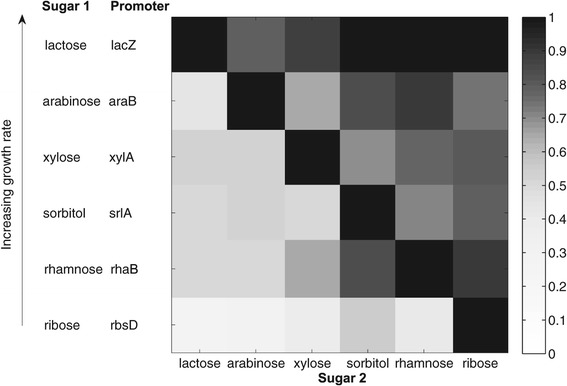
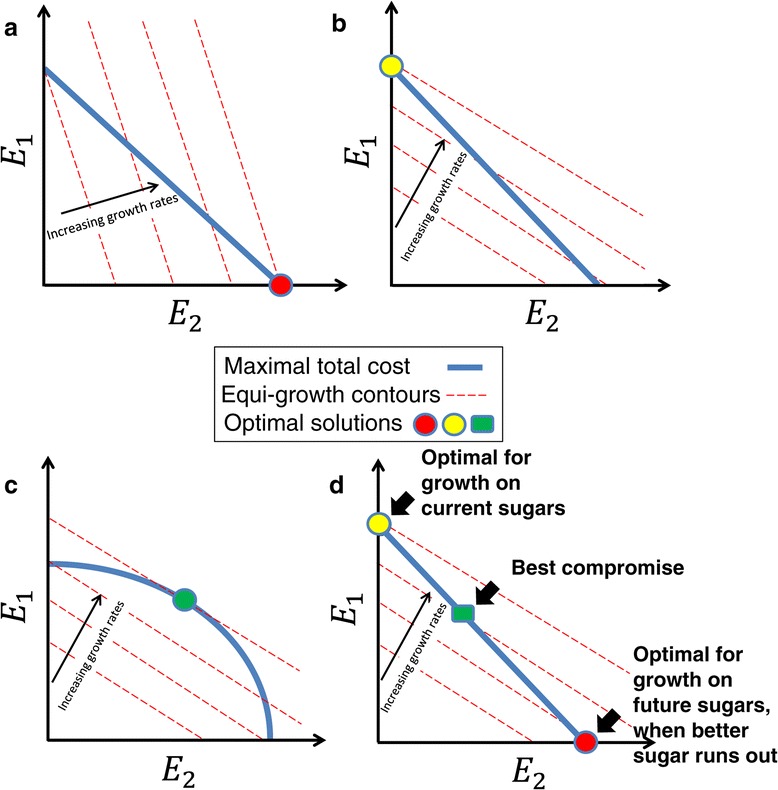
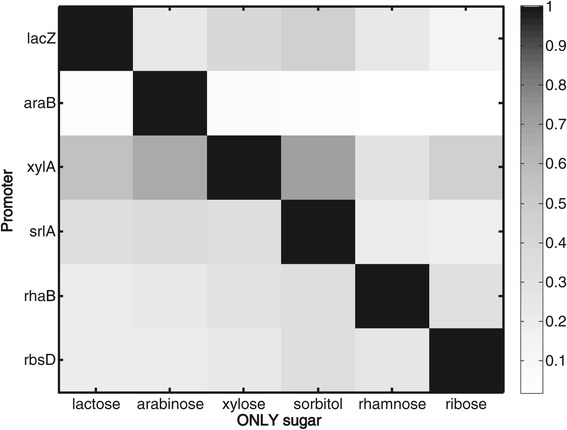
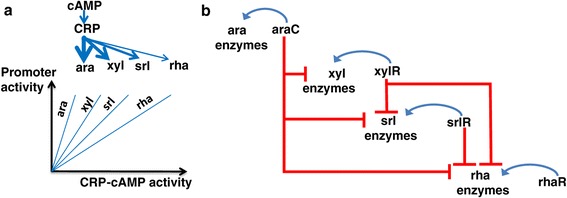
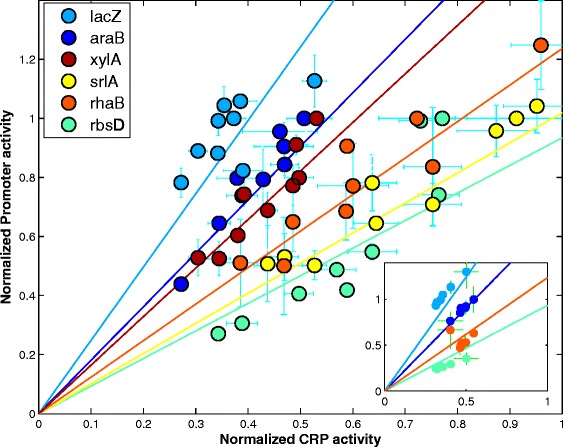
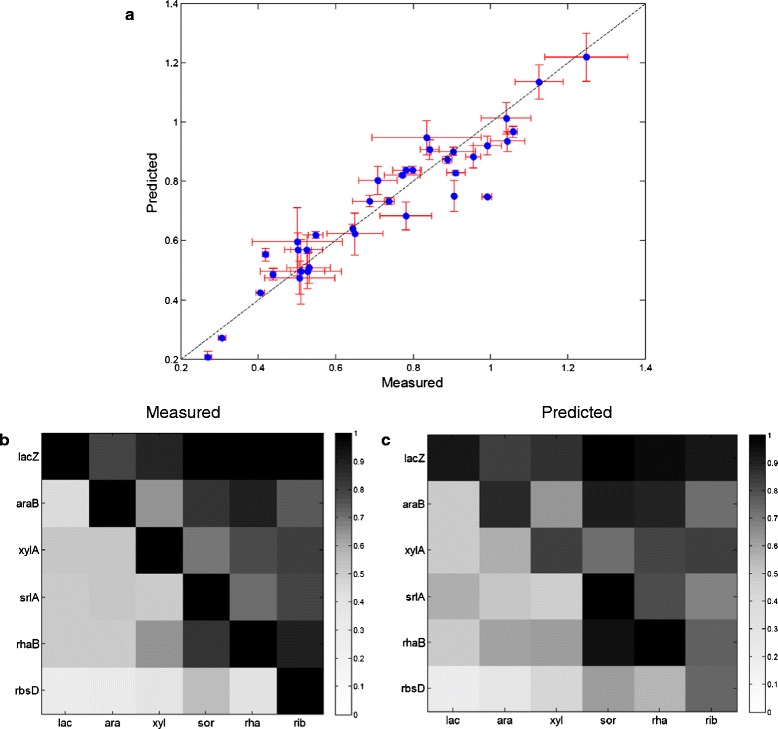
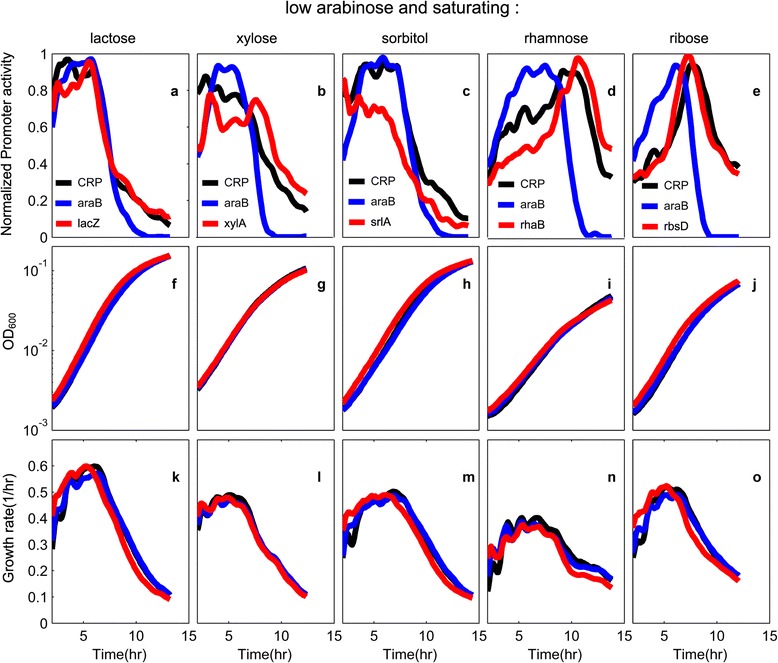
Here, we combine experiment and theory to map the choices of E. coli among 6 different non-glucose carbon sources. We used robotic assays and fluorescence reporter strains to make precise measurements of promoter activity and growth rate in all pairs of these sugars. We find that the sugars can be ranked in a hierarchy: in a mixture of a higher and a lower sugar, the lower sugar system shows reduced promoter activity. The hierarchy corresponds to the growth rate supported by each sugar- the faster the growth rate, the higher the sugar on the hierarchy. The hierarchy is 'soft' in the sense that the lower sugar promoters are not completely repressed. Measurement of the activity of the master regulator CRP-cAMP shows that the hierarchy can be quantitatively explained based on differential activation of the promoters by CRP-cAMP. Comparing sugar system activation as a function of time in sugar pair mixtures at sub-saturating concentrations, we find cases of sequential activation, and also cases of simultaneous expression of both systems. Such simultaneous expression is not predicted by simple models of growth rate optimization, which predict only sequential activation. We extend these models by suggesting multi-objective optimization for both growing rapidly now and preparing the cell for future growth on the poorer sugar.
We find a defined hierarchy of sugar utilization, which can be quantitatively explained by differential activation by the master regulator cAMP-CRP. The present approach can be used to understand cell decisions when presented with mixtures of conditions.
了解细胞如何做出决策以及为何做出这些决策,是系统生物学的根本兴趣所在。为解决这一问题,我们研究了大肠杆菌在面对两种不同糖类时关于表达哪些基因的决策。众所周知,葡萄糖是大肠杆菌偏爱的碳源,它通过全局和基因特异性机制抑制其他糖类的摄取。然而,对于在大肠杆菌的自然环境和生物技术中发现的不含葡萄糖的糖混合物的利用,人们了解较少。
在这里,我们结合实验和理论来描绘大肠杆菌在6种不同的非葡萄糖碳源之间的选择。我们使用机器人检测和荧光报告菌株对所有这些糖类组合中的启动子活性和生长速率进行精确测量。我们发现这些糖类可以按等级排列:在一种较高等级糖和一种较低等级糖的混合物中,较低等级糖的系统显示出启动子活性降低。这种等级与每种糖所支持的生长速率相对应——生长速率越快,在等级中该糖的等级越高。这种等级是“软性的”,因为较低等级糖的启动子并未被完全抑制。对主要调节因子CRP - cAMP活性的测量表明,这种等级可以基于CRP - cAMP对启动子的差异激活进行定量解释。比较亚饱和浓度下糖对混合物中糖系统激活随时间的变化,我们发现了顺序激活的情况,也发现了两个系统同时表达的情况。这种同时表达是简单的生长速率优化模型所无法预测的,这些模型仅预测顺序激活。我们通过提出多目标优化来扩展这些模型,即既要现在快速生长,又要使细胞为未来在较差糖类上的生长做好准备。
我们发现了一个确定的糖利用等级,它可以通过主要调节因子cAMP - CRP的差异激活进行定量解释。当前的方法可用于理解细胞在面对条件混合物时的决策。