Fazli Ghazal S, Creatore Maria I, Matheson Flora I, Guilcher Sara, Kaufman-Shriqui Vered, Manson Heather, Johns Ashley, Booth Gillian L
Centre for Urban Health Solutions, The Keenan Research Centre, Li Ka Shing Knowledge Institute, St. Michael's Hospital, 209 Victoria Street, M5B 1T8, Toronto, ON, Canada.
Institute of Health Policy, Management and Evaluation, University of Toronto, Toronto, ON, Canada.
BMC Public Health. 2017 Jan 3;17(1):1. doi: 10.1186/s12889-016-3954-4.
In recent years, obesity-related diseases have been on the rise globally resulting in major challenges for health systems and society as a whole. Emerging research in population health suggests that interventions targeting the built environment may help reduce the burden of obesity and type 2 diabetes. However, translation of the evidence on the built environment into effective policy and planning changes requires engagement and collaboration between multiple sectors and government agencies for designing neighborhoods that are more conducive to healthy and active living. In this study, we identified knowledge gaps and other barriers to evidence-based decision-making and policy development related to the built environment; as well as the infrastructure, processes, and mechanisms needed to drive policy changes in this area.
We conducted a qualitative thematic analysis of data collected through consultations with a broad group of stakeholders (N = 42) from Southern Ontario, Canada, within various sectors (public health, urban planning, and transportation) and levels of government (federal, provincial, and municipalities). Relevant themes were classified based on the specific phase of the knowledge-to-action cycle (research, translation, and implementation) in which they were most closely aligned.
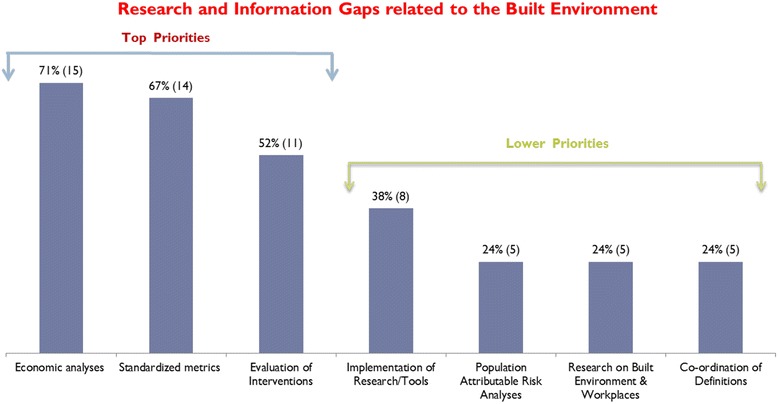
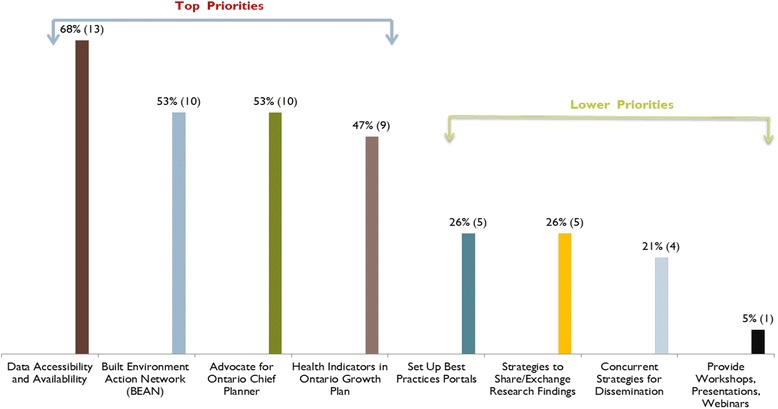
We identified 5 themes including: 1) the need for policy-informed and actionable research (e.g. health economic analyses and policy evaluations); 2) impactful messaging that targets all relevant sectors to create the political will necessary to drive policy change; 3) common measures and tools to increase capacity for monitoring and surveillance of built environment changes; (4) intersectoral collaboration and alignment within and between levels of government to enable collective actions and provide mechanisms for sharing of resources and expertise, (5) aligning public and private sector priorities to generate public demand and support for community action; and, (6) solution-focused implementation of research that will be tailored to meet the needs of policymakers and planners. Additional research priorities and key policy and planning actions were also noted.
Our research highlights the necessity of involving stakeholders in identifying inter-sectoral solutions to develop and translate actionable research on the built environment into effective policy and planning initiatives.
近年来,全球范围内与肥胖相关的疾病呈上升趋势,给卫生系统乃至整个社会带来了重大挑战。人群健康领域的新兴研究表明,针对建筑环境的干预措施可能有助于减轻肥胖和2型糖尿病的负担。然而,要将有关建筑环境的证据转化为有效的政策和规划变革,需要多个部门和政府机构参与并合作,以设计出更有利于健康和积极生活的社区。在本研究中,我们确定了与建筑环境相关的循证决策和政策制定方面的知识差距及其他障碍;以及推动该领域政策变革所需的基础设施、流程和机制。
我们对通过与来自加拿大安大略省南部各部门(公共卫生、城市规划和交通)及各级政府(联邦、省和市)的广泛利益相关者群体(N = 42)进行磋商收集的数据进行了定性主题分析。相关主题根据其最紧密对应的知识转化为行动周期的特定阶段(研究、转化和实施)进行分类。
我们确定了5个主题,包括:1)开展基于政策且可付诸行动的研究(如健康经济分析和政策评估)的必要性;2)针对所有相关部门的有影响力的信息传递,以创造推动政策变革所需的政治意愿;3)用于增强对建筑环境变化进行监测和监督能力的通用措施和工具;4)政府各级内部和之间的跨部门协作与协调,以促成集体行动,并提供资源和专业知识共享机制;5)使公共和私营部门的优先事项保持一致,以产生公众对社区行动的需求和支持;以及6)以解决方案为重点实施研究,以满足政策制定者和规划者的需求。还指出了其他研究重点以及关键的政策和规划行动。
我们的研究强调了让利益相关者参与确定跨部门解决方案的必要性,以便开展关于建筑环境的可付诸行动的研究,并将其转化为有效的政策和规划举措。