Hartveit Miriam, Vanhaecht Kris, Thorsen Olav, Biringer Eva, Haug Kjell, Aslaksen Aslak
Research Network on Integrated Health Care in Western Norway, Helse Fonna Local Health Authority, Helse Fonna HF, Box 2170, 5504, Haugesund, Norway.
Department of Global Public Health and Primary Care, Faculty of Medicine and Dentistry, University of Bergen, Bergen, Norway.
BMC Health Serv Res. 2017 Jan 3;17(1):4. doi: 10.1186/s12913-016-1941-1.
Communication between involved parties is essential to ensure coordinated and safe health care delivery. However, existing literature reveals that the information relayed in the referral process is seen as insufficient by the receivers. It is unknown how this insufficiency affects the quality of care, and valid performance measures to explore it are lacking. The aim of the present study was to develop quality indicators to detect the impact that the quality of referral letters from primary care to specialised mental health care has on the quality of mental health services.
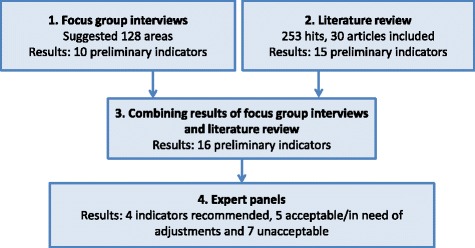
Using a modified version of the RAND/UCLA appropriateness method, a systematic literature review and focus group interviews were conducted to define quality indicators for mental health care expected to be affected by the quality of referral information. Focus group participants included psychiatrists, psychologists, general practitioners, patient representatives and managers. The existing evidence and suggested indicators were presented to expert panels, who assessed the indicators by their validity, reliability, sensitivity and feasibility.
Sixteen preliminary indicators emerged during the focus group interviews and literature review. The expert panels recommended four of the 16 indicators. The recommended indicators measure a) timely access, b) delay in the process of assessing the referral, c) delay in the onset of care and d) the appropriateness of the referral. Adjustment was necessary for five other indicators, and seven indicators were rejected because of expected confounding factors reducing their validity and sensitivity.
The quality of information relayed in the referral process from primary care to specialised mental health care is expected to affect a wide range of dimensions defining high quality care. The expected importance of the referral process for ensuring 'timely access'-one of the six aims of high-quality health care defined by the Institute of Medicine-is highlighted. Exploring the underlying mechanisms for the potential impact of referral information on patient outcomes is recommended to enhance quality of care.
ClinicalTrials.gov: NCT01374035 (28 April 2011).
相关各方之间的沟通对于确保医疗服务的协调与安全至关重要。然而,现有文献表明,转诊过程中传递的信息被接收方认为是不足的。目前尚不清楚这种不足如何影响医疗质量,并且缺乏用于探究这一问题的有效绩效指标。本研究的目的是制定质量指标,以检测从初级保健机构转诊至专业心理健康服务机构的转诊信质量对心理健康服务质量的影响。
采用兰德/加州大学洛杉矶分校适宜性方法的修改版,进行了系统的文献综述和焦点小组访谈,以确定预期会受到转诊信息质量影响的心理健康护理质量指标。焦点小组参与者包括精神科医生、心理学家、全科医生、患者代表和管理人员。将现有证据和建议的指标提交给专家小组,专家小组通过指标的有效性、可靠性、敏感性和可行性对其进行评估。
在焦点小组访谈和文献综述过程中出现了16个初步指标。专家小组推荐了其中4个指标。推荐的指标衡量:a)及时就诊,b)评估转诊过程中的延迟,c)开始治疗的延迟,以及d)转诊的适宜性。另外5个指标需要调整,7个指标因预期的混杂因素会降低其有效性和敏感性而被否决。
从初级保健机构转诊至专业心理健康服务机构的过程中所传递信息的质量,预计会影响定义高质量护理的多个方面。强调了转诊过程对于确保“及时就诊”(医学研究所定义的高质量医疗六大目标之一)的预期重要性。建议探索转诊信息对患者结局潜在影响的潜在机制,以提高护理质量。
ClinicalTrials.gov:NCT01374035(2011年4月28日)