Tukei Betty Bawuba, Beke Andy, Lamadrid-Figueroa Héctor
School of Health Systems and Public Health, University of Pretoria, Pretoria, South Africa.
Division of Reproductive Health, Research Center for Population Health, National Institute of Public Health (INSP), Cuernavaca, Mexico.
Malar J. 2017 Jan 3;16(1):4. doi: 10.1186/s12936-016-1652-4.
Indoor residual spraying (IRS) is known to reduce malaria transmission. In northern Uganda, a high endemic area, IRS has been implemented since 2006. Limited data however, exists on the effect of IRS on the malaria burden. This study sought to assess the effect of IRS on malaria morbidity in the high intensity area of northern Uganda. Retrospective routine data from ten health facilities in three districts which had received at least five rounds of IRS in northern Uganda was analysed. The primary outcome of interest was malaria morbidity, measured by the slide positivity rate (SPR). Descriptive statistics were used to describe the malaria morbidity stratified by age and sex. The average change in the malaria morbidity, measured by the SPR was assessed according to time, measured as calendar months. A fixed-effects linear regression model was used which included a polynomial function of time and controlled for malaria seasonality and variations between districts/facilities.
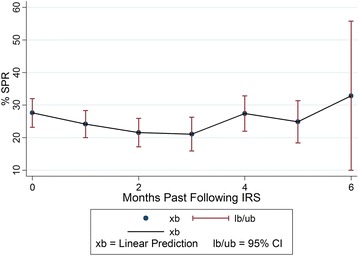
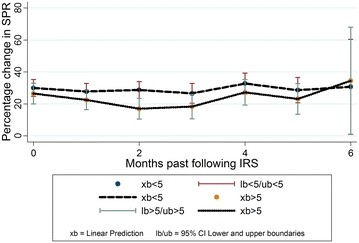
The total out-patient department attendance in the ten health facilities for the study period was 2,779,246, of which 736,034 (26.5%) malaria cases were diagnosed with 374,826 (50.9%) cases of under 5 years and an overall SPR of 37.5%. The percentage point (p.p.) changes in SPR according to time measured as calendar months following IRS, revealed a decreasing trend in malaria morbidity in the first 3 months following each round of IRS. The highest percentage point decrease in the SPR was observed in the second month following IRS (9.5 p.p., CI -17.85 to -1.16, p = 0.026), among patients above 5 years. The SPR decline however waned by the fourth month following IRS, with an increase in the SPR of 8.4 p.p. at district level by the sixth month, p = 0.510.
The study results show that IRS was associated with a significant reduction in malaria morbidity in northern Uganda in the first 3 months following IRS. The malaria reduction however waned by the fourth month following IRS.
室内残留喷洒(IRS)已知可减少疟疾传播。在乌干达北部这个高流行地区,自2006年以来一直在实施室内残留喷洒。然而,关于室内残留喷洒对疟疾负担影响的数据有限。本研究旨在评估室内残留喷洒对乌干达北部高强度地区疟疾发病率的影响。分析了来自乌干达北部三个区的十个卫生设施的回顾性常规数据,这些卫生设施至少接受了五轮室内残留喷洒。主要关注的结果是疟疾发病率,通过玻片阳性率(SPR)来衡量。描述性统计用于描述按年龄和性别分层的疟疾发病率。根据时间(以日历月衡量)评估了通过玻片阳性率衡量的疟疾发病率的平均变化。使用了固定效应线性回归模型,该模型包括时间的多项式函数,并控制了疟疾季节性以及各地区/设施之间的差异。
在研究期间,十个卫生设施的门诊总就诊人数为2,779,246人,其中736,034例(26.5%)被诊断为疟疾病例,374,826例(50.9%)为5岁以下儿童,总体玻片阳性率为37.5%。根据室内残留喷洒后以日历月衡量的时间,玻片阳性率的百分点(p.p.)变化显示,在每轮室内残留喷洒后的前3个月,疟疾发病率呈下降趋势。在5岁以上患者中,在室内残留喷洒后的第二个月观察到玻片阳性率下降的百分点最高(9.5个百分点,CI -17.85至-1.16,p = 0.026)。然而,室内残留喷洒后第四个月,玻片阳性率下降趋势减弱,到第六个月,地区层面的玻片阳性率增加了8.4个百分点,p = 0.510。
研究结果表明,室内残留喷洒与乌干达北部室内残留喷洒后的前3个月疟疾发病率显著降低有关。然而,室内残留喷洒后第四个月,疟疾减少趋势减弱。