Huang Miaomaio, Li Xuqing, Guo Peipei, Yu Zhaojuan, Xu Yuting, Wei Zhaolian
Department of Gynecology and Obstetrics, First Affiliated Hospital of Anhui Medical University, Meishan Road, Hefei, 230000, China.
Assisted Reproductive Center, First Affiliated Hospital of Anhui Medical University, Meishan Road, Hefei, 230000, China.
Reprod Biol Endocrinol. 2017 Jan 3;15(1):1. doi: 10.1186/s12958-016-0220-7.
The junctional zone (JZ), also called as the endometrial-myometrial junction, is related to peristaltic-like movements in the non-pregnant uterus. Hyperperistalsis and dysperistalsis of uterus constructions might underlie many important disorders such as dysmenorrhea, infertility, endometriosis, implantation failure. The major proteins for uterine contraction of the non-pregnant uterus may be Oxytocin (OT) and oxytocin receptor (OTR). The objective of this study was to inspect the expression of OTR in isthmic and mid-fundal parts of the uterine junctional zone at different stages of the follicular cycle in patients with and without endometriosis.
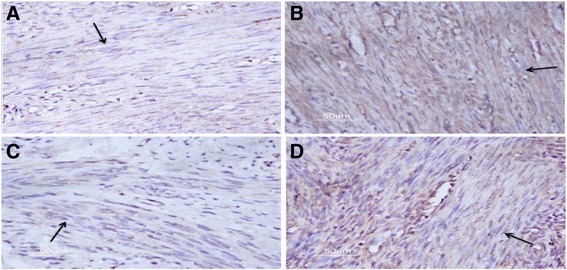
Uterine biopsies containing endometrium and junctional zone were collected from the isthmic and mid-fundal parts of the anterior wall after hysterectomy. The OTR expression was evaluated by immunohistochemistry.
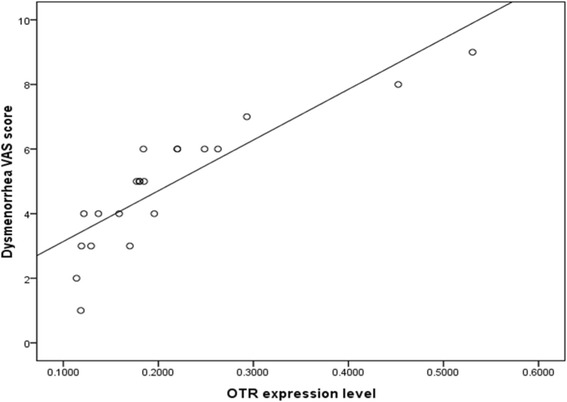
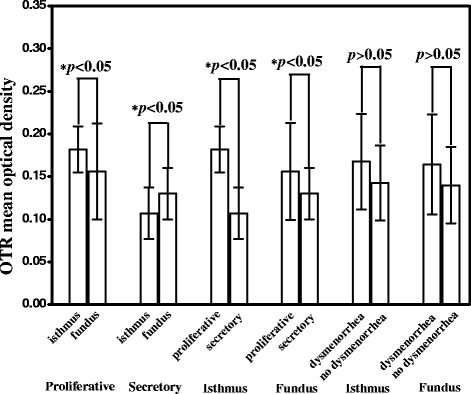
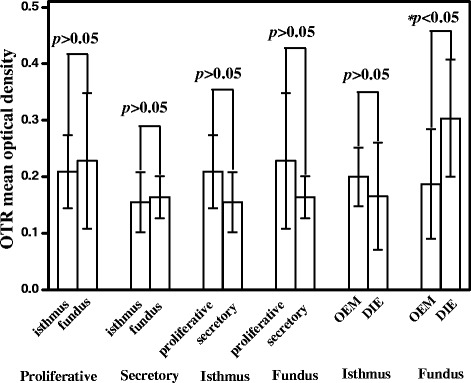
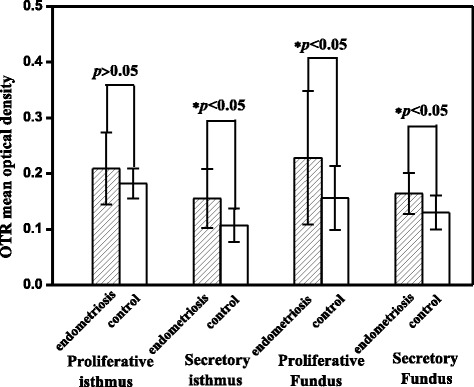
In the control uterus, OTR expression in the isthmic region was significantly higher than in the fundal region in the proliferative phase (p < 0.05) but significantly lower in the secretory phase (p < 0.05). And the expression of OTR in the proliferative phase was significantly higher than that in the secretory phase in both isthmic and fundal regions (p = 0.000 and 0.049, respectively). However, in endometriosis uteri, OTR expression in the isthmic region showed no significant difference with that in the fundal region in both proliferative and secretory phases (p = 0.597 and 0.736, respectively). In both isthmic and fundal regions, OTR expression was not significantly different between the proliferative phase and secretory phase (p = 0.084 and 0.222, respectively). OTR expression in fundal regions of revised ASRM I and II endometriosis were lower than that of revised ASRM III and IV (p = 0.049). In the fundal region of JZ, the expression of OTR in ovarian endometriosis was significantly lower than that in deep infiltrating endometriosis (p = 0.046). The expression level of OTR in the funds region is positively associated with the severity of dysmenorrhea in endometriosis group (r = 0.870, p < 0.05). Comparing to normal uteri, the expression of OTR in the secretory phase was significantly higher in the endometriosis uteri (p < 0.05). In the fundus of endometriosis uteri, OTR expression was significantly higher in both the proliferative and secretory phases (p = 0.045 and 0.028, respectively).
OTR expression in the JZ of women with endometriosis changes significantly, which may result in abnormal uterine contractile activity, reducing the endometriosis-related fertility and dysmenorrhea.
结合带(JZ),也称为子宫内膜 - 肌层交界处,与非妊娠子宫的蠕动样运动有关。子宫结构的蠕动亢进和蠕动障碍可能是痛经、不孕、子宫内膜异位症、着床失败等许多重要疾病的潜在原因。非妊娠子宫收缩的主要蛋白质可能是催产素(OT)和催产素受体(OTR)。本研究的目的是检查有和没有子宫内膜异位症的患者在卵泡周期不同阶段子宫结合带峡部和宫底中部OTR的表达。
子宫切除术后,从前壁峡部和宫底中部收集包含子宫内膜和结合带的子宫活检组织。通过免疫组织化学评估OTR表达。
在对照子宫中,增殖期峡部区域的OTR表达显著高于宫底部区域(p < 0.05),但分泌期显著低于宫底部区域(p < 0.05)。峡部和宫底部区域增殖期的OTR表达均显著高于分泌期(分别为p = 0.000和0.049)。然而,在子宫内膜异位症子宫中,增殖期和分泌期峡部区域的OTR表达与宫底部区域相比均无显著差异(分别为p = 0.597和0.736)。峡部和宫底部区域,增殖期和分泌期之间的OTR表达无显著差异(分别为p = 0.084和0.222)。修订版美国生殖医学学会(ASRM)I和II期子宫内膜异位症宫底部区域的OTR表达低于修订版ASRM III和IV期(p = 0.049)。在结合带宫底部区域,卵巢子宫内膜异位症的OTR表达显著低于深部浸润性子宫内膜异位症(p = 0.046)。子宫内膜异位症组宫底部区域OTR的表达水平与痛经严重程度呈正相关(r = 0.870,p < 0.05)。与正常子宫相比,子宫内膜异位症子宫分泌期的OTR表达显著更高(p < 0.05)。在子宫内膜异位症子宫的宫底部,增殖期和分泌期的OTR表达均显著更高(分别为p = 0.045和0.028)。
子宫内膜异位症女性结合带中OTR表达显著改变,这可能导致子宫收缩活动异常,降低与子宫内膜异位症相关的生育能力和痛经。