Toure Offianan A, Assi Serge B, N'Guessan Tiacoh L, Adji Gbessi E, Ako Aristide B, Brou Marie J, Ehouman Marie F, Gnamien Laeticia A, Coulibaly M'Lanhoro A A, Coulibaly Baba, Beourou Sylvain, Bassinka Issiaka, Soumahoro Adama, Kadjo Florence, Tano Mea A
Malariology Unit, Institut Pasteur de Côte d'Ivoire, PO Box 490, Abidjan 01, Côte d'Ivoire.
Malar J. 2014 Nov 19;13:439. doi: 10.1186/1475-2875-13-439.
Emergence of artemisinin resistance has raised concerns that the most potent anti-malarial drug may be under threat. Artesunate-amodiaquine (AS-AQ) and artemether-lumefantrine (AL) are, respectively, the first- and second-line treatments for uncomplicated falciparum malaria in Côte d'Ivoire. Constant monitoring by National Malaria Control Programme (NMCP) of drug efficacy is an important tool in establishing rational anti-malarial drug policies in Côte d'Ivoire.
In an open label, randomized controlled clinical trial, children and adults were randomized to receive AS-AQ or AL. Both drug regimens were given for three days, and follow-up was for 42 days. The primary endpoint was the 42-day cure rate and was defined as proportion of patients with PCR-corrected cure rate after 42 days of follow-up.
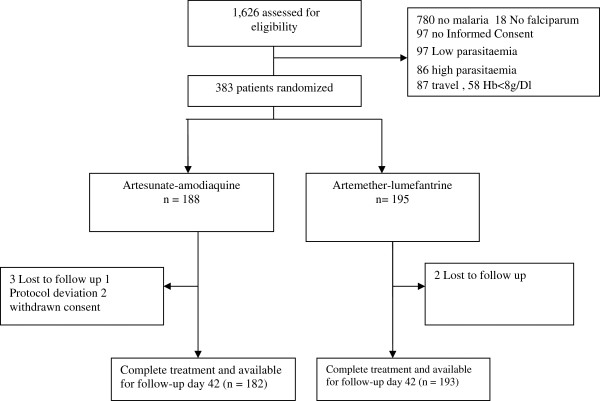
A total of 383 patients who were attending the Anonkoua-koute (Abidjan), Petit Paris (Korhogo) and Libreville (Man) hospitals and presenting with symptomatic acute uncomplicated falciparum malaria were randomized to receive AS-AQ (188) and AL (195). The intention-to-treat analysis showed effectiveness rates of 94.7% and 96.4% for AS-AQ and AL, respectively on day 42. After adjustment for PCR, these rates were 96.8% and 99%, respectively. At day 42, in per-protocol analysis, Adequate clinical and parasitological response (ACPR) PCR uncorrected was 97.8% and 97.4% for AS-AQ and AL, respectively. The PCR adjusted ACPR was 100% for each combination and both regimens were well tolerated.
This study has shown the high efficacy of AS-AQ in patients of all ages with acute uncomplicated falciparum malaria and AS-AQ was non-inferior to AL. Continuous efficacy monitoring is recommended.
青蒿素耐药性的出现引发了人们对这种最有效的抗疟药物可能受到威胁的担忧。青蒿琥酯-阿莫地喹(AS-AQ)和蒿甲醚-本芴醇(AL)分别是科特迪瓦单纯性恶性疟的一线和二线治疗药物。国家疟疾控制项目(NMCP)对药物疗效进行持续监测是科特迪瓦制定合理抗疟药物政策的重要工具。
在一项开放标签、随机对照临床试验中,儿童和成人被随机分配接受AS-AQ或AL。两种药物方案均给药三天,随访42天。主要终点是42天治愈率,定义为随访42天后经PCR校正的治愈率的患者比例。
共有383名在阿农夸库特(阿比让)、小巴黎(科霍戈)和利伯维尔(马恩)医院就诊、表现为有症状的急性单纯性恶性疟的患者被随机分配接受AS-AQ(188例)和AL(195例)。意向性分析显示,在第42天,AS-AQ和AL的有效率分别为94.7%和96.4%。经PCR校正后,这些率分别为96.8%和99%。在第42天,按符合方案分析,AS-AQ和AL未经PCR校正的充分临床和寄生虫学反应(ACPR)分别为97.8%和97.4%。每种组合经PCR调整后的ACPR均为100%,两种方案耐受性良好。
本研究表明AS-AQ对所有年龄的急性单纯性恶性疟患者均具有高效,且AS-AQ不劣于AL。建议持续监测疗效。