Jayewardene Wasantha P, Lohrmann David K, Erbe Ryan G, Torabi Mohammad R
Applied Health Science, School of Public Health Bloomington, Indiana University, United States.
Prev Med Rep. 2016 Nov 14;5:150-159. doi: 10.1016/j.pmedr.2016.11.013. eCollection 2017 Mar.
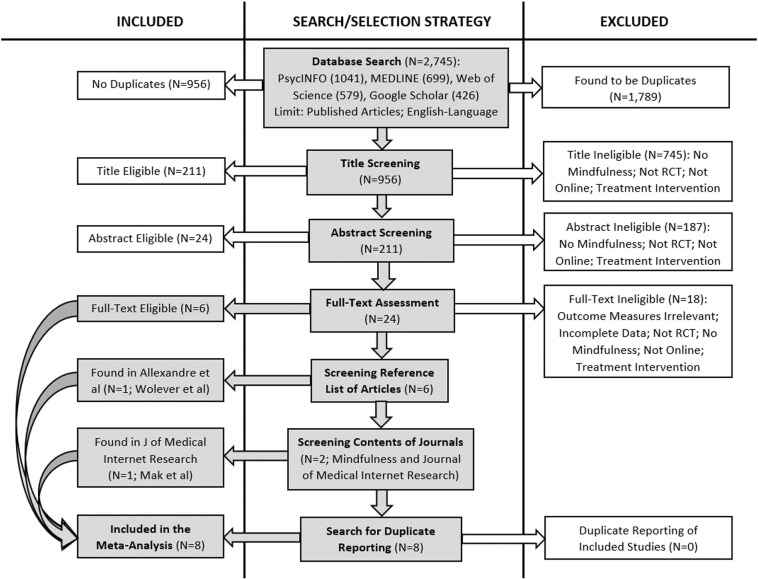
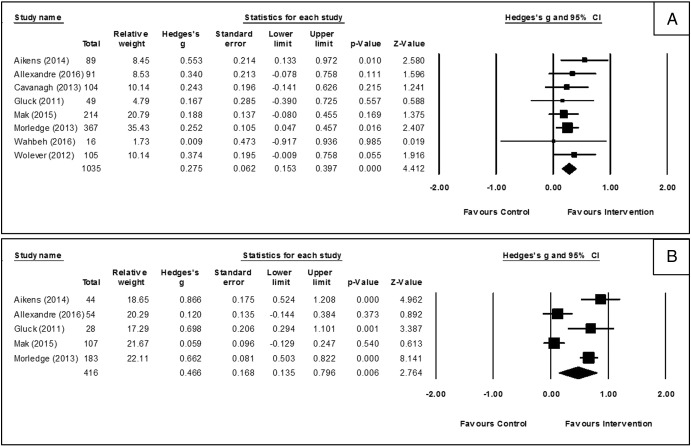
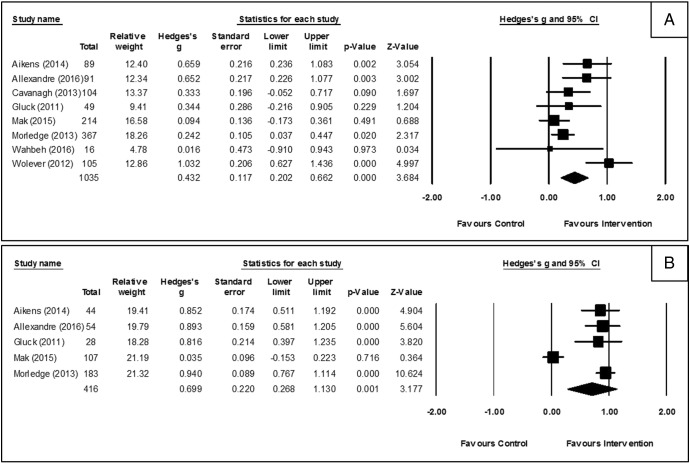
Empirical evidence suggested that mind-body interventions can be effectively delivered online. This study aimed to examine whether preventive online mindfulness interventions (POMI) for non-clinical populations improve short- and long-term outcomes for perceived-stress (primary) and mindfulness (secondary). Systematic search of four electronic databases, manuscript reference lists, and journal content lists was conducted in 2016, using 21 search-terms. Eight randomized controlled trials (RCTs) evaluating effects of POMI in non-clinical populations with adequately reported perceived-stress and mindfulness measures pre- and post-intervention were included. Random-effects models utilized for all effect-size estimations with meta-regression performed for mean age and %females. Participants were volunteers (adults; predominantly female) from academic, workplace, or community settings. Most interventions utilized simplified Mindfulness-Based Stress Reduction protocols over 2-12 week periods. Post-intervention, significant medium effect found for perceived-stress (g = 0.432), with moderate heterogeneity and significant, but small, effect size for mindfulness (g = 0.275) with low heterogeneity; highest effects were for middle-aged individuals. At follow-up, significant large effect found for perceived-stress (g = 0.699) with low heterogeneity and significant medium effect (g = 0.466) for mindfulness with high heterogeneity. No publication bias was found for perceived-stress; publication bias found for mindfulness outcomes led to underestimation of effects, not overestimation. Number of eligible RCTs was low with inadequate data reporting in some studies. POMI had substantial stress reduction effects and some mindfulness improvement effects. POMI can be a more convenient and cost-effective strategy, compared to traditional face-to-face interventions, especially in the context of busy, hard-to-reach, but digitally-accessible populations.
实证证据表明,身心干预可以有效地通过网络进行。本研究旨在探讨针对非临床人群的预防性在线正念干预(POMI)是否能改善感知压力(主要指标)和正念(次要指标)的短期和长期结果。2016年,使用21个搜索词对四个电子数据库、手稿参考文献列表和期刊内容列表进行了系统检索。纳入了八项随机对照试验(RCT),这些试验评估了POMI对非临床人群的影响,干预前后均充分报告了感知压力和正念测量指标。所有效应量估计均采用随机效应模型,并对平均年龄和女性百分比进行了元回归分析。参与者是来自学术、工作场所或社区环境的志愿者(成年人;主要为女性)。大多数干预措施在2至12周的时间内采用了简化的基于正念减压方案。干预后,发现感知压力有显著的中等效应(g = 0.432),异质性中等,正念有显著但较小的效应量(g = 0.275),异质性较低;中年个体的效果最为显著。随访时,发现感知压力有显著的大效应(g = 0.699),异质性较低,正念有显著的中等效应(g = 0.466),异质性较高。在感知压力方面未发现发表偏倚;在正念结果方面发现的发表偏倚导致效应被低估,而非高估。符合条件的RCT数量较少,一些研究的数据报告不充分。POMI有显著的减压效果和一些正念改善效果。与传统的面对面干预相比,POMI可能是一种更方便且具有成本效益的策略,尤其是在忙碌、难以接触但可通过数字方式接触的人群中。