Institute of Physics, Polish Academy of Sciences, Al. Lotników 32/46, 02-668 Warsaw, Poland.
Sci Rep. 2017 Jan 4;7:39851. doi: 10.1038/srep39851.
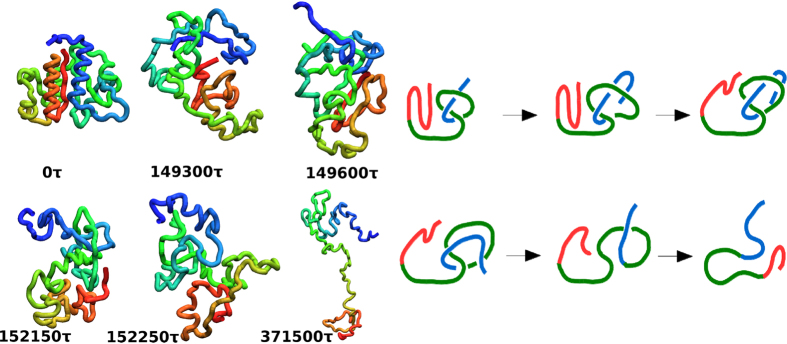
Using a structure-based coarse-grained model of proteins, we study the mechanism of unfolding of knotted proteins through heating. We find that the dominant mechanisms of unfolding depend on the temperature applied and are generally distinct from those identified for folding at its optimal temperature. In particular, for shallowly knotted proteins, folding usually involves formation of two loops whereas unfolding through high-temperature heating is dominated by untying of single loops. Untying the knots is found to generally precede unfolding unless the protein is deeply knotted and the heating temperature exceeds a threshold value. We then use a phenomenological model of the air-water interface to show that such an interface can untie shallow knots, but it can also make knots in proteins that are natively unknotted.
利用蛋白质的基于结构的粗粒度模型,我们研究了通过加热使打结蛋白展开的机制。我们发现,展开的主要机制取决于施加的温度,并且通常与在最佳温度下折叠时确定的机制不同。特别地,对于浅打结蛋白,折叠通常涉及形成两个环,而通过高温加热展开则主要由单个环的解开主导。解开结通常先于展开,除非蛋白质是深打结的并且加热温度超过阈值。然后,我们使用空气-水界面的唯象模型表明,这样的界面可以解开浅结,但也可以使原本没有结的蛋白质打结。