Zhang Rujun, Persaud Navindra
Department of Family and Community Medicine, University of Toronto, Toronto, Ontario, Canada.
Keenan Research Centre of the Li Ka Shing Knowledge Institute, St. Michael's Hospital, Toronto, Ontario, Canada.
PLoS One. 2017 Jan 4;12(1):e0167609. doi: 10.1371/journal.pone.0167609. eCollection 2017.
We report information about an unpublished 1970s study ("8-way" Bendectin Study) that aimed to evaluate the relative therapeutic efficacy of doxylamine, pyridoxine, and dicyclomine in the management of nausea and vomiting during pregnancy. We are publishing the trial's findings according to the restoring invisible and abandoned trials (RIAT) initiative because the trial was never published.
Double blinded, multi-centred, randomized placebo-controlled study.
14 clinics in the United States.
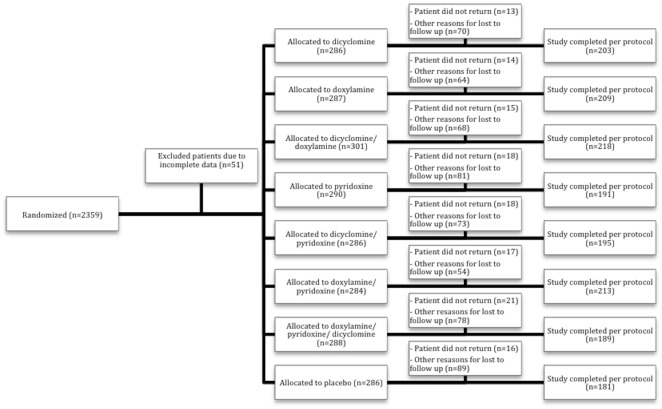
2308 patients in the first 12 weeks of pregnancy with complaints of nausea or vomiting were enrolled.
Each patient was randomized to one of eight arms: placebo, doxylamine/pyridoxine/dicylcomine, doxylamine/pyridoxine, dicylomine/pyridoxine, doxylamine, dicyclomine/pyridoxine, pyridoxine and dicyclomine. Each patient was instructed to take 2 tablets at bedtime and 1 additional tablet in the afternoon or morning if needed, for 7 nights.
Reported outcomes included the number of hours of nausea reported by patients, the frequency of vomiting reported by patients and the overall efficacy of medication as judged by physicians.
Data from 1599 (69% of those randomized) participants were analyzed. Based on the available summary data of physician evaluation of symptoms and ignoring missing data and data integrity issues, the proportion of participants who were "evaluated moderate or excellent" was greater in each of the seven active treatment groups when compared with placebo (57%): doxylamine/pyridoxine/dicylcomine (14% absolute difference versus placebo; 95% CI: 4 to 24), doxylamine/pyridoxine (21; 95% CI 11 to 30), dicylomine/pyridoxine (21; 95% CI 11 to 30), doxylamine (20; 95% CI 10 to 29), dicyclomine/pyridoxine (4; 95% CI -6 to 14), pyridoxine (9; 95% CI -1 to 19) and dicyclomine (4; 95% CI -6 to 14). Based on incomplete information, the most common adverse events were apparently drowsiness and fatigue. There is a high risk of bias in these previously unpublished results given the high attrition rate in a 7 day trial, the lack of prespecified outcomes or analyses, and the exclusion of some data because of questionable data integrity.
The available information about this "8-way Bendectin" trial indicates it should not be used to support the efficacy of doxylamine, pyridoxine or dicyclomine for the treatment of nausea and vomiting during pregnancy because of a high risk of bias.
Not registered.
我们报告一项未发表的20世纪70年代研究(“八联”苯海拉明研究)的相关信息,该研究旨在评估多西拉敏、吡哆醇和双环胺在治疗孕期恶心和呕吐方面的相对疗效。我们根据恢复不可见和被弃试验(RIAT)倡议公布该试验的结果,因为该试验从未发表过。
双盲、多中心、随机安慰剂对照研究。
美国的14家诊所。
招募了2308名怀孕前12周出现恶心或呕吐症状的患者。
每位患者被随机分配到八个组之一:安慰剂、多西拉敏/吡哆醇/双环胺、多西拉敏/吡哆醇、双环胺/吡哆醇、多西拉敏、双环胺/吡哆醇、吡哆醇和双环胺。每位患者被指示在睡前服用2片,如有需要,下午或上午再额外服用1片,共服用7晚。
报告的结果包括患者报告的恶心小时数、患者报告的呕吐频率以及医生判断的药物总体疗效。
分析了1599名(69%的随机分组者)参与者的数据。根据医生对症状评估的现有汇总数据,忽略缺失数据和数据完整性问题,与安慰剂组(57%)相比,七个活性治疗组中每个组“评估为中度或优秀”的参与者比例更高:多西拉敏/吡哆醇/双环胺(与安慰剂相比绝对差异为14%;95%置信区间:4%至24%)、多西拉敏/吡哆醇(21%;95%置信区间11%至30%)、双环胺/吡哆醇(21%;95%置信区间11%至30%)、多西拉敏(20%;95%置信区间10%至29%)、双环胺/吡哆醇(4%;95%置信区间 -6%至14%)、吡哆醇(9%;95%置信区间 -1%至19%)和双环胺(4%;95%置信区间 -6%至14%)。根据不完整信息,最常见的不良事件显然是嗜睡和疲劳。鉴于7天试验中的高脱落率、缺乏预先指定的结果或分析以及因数据完整性存疑而排除一些数据,这些先前未发表的结果存在很高的偏倚风险。
关于这项“八联苯海拉明”试验的现有信息表明,由于存在很高的偏倚风险,该试验结果不应被用于支持多西拉敏、吡哆醇或双环胺治疗孕期恶心和呕吐的疗效。
未注册。