Division of Hematology-Oncology, Department of Medicine, Samsung Medical Center, Sungkyunkwan University School of Medicine, Seoul, Korea.
Samsung Biomedical Research Institute, Seoul, Korea.
Cancer Res Treat. 2017 Oct;49(4):906-914. doi: 10.4143/crt.2016.424. Epub 2016 Dec 26.
Papillary thyroid carcinomas (PTCs) frequently involve genetic alterations. The objective of this study was to investigate genetic alterations and further explore the relationships between these genetic alterations and clinicopathological characteristics in a high-recurrence risk (node positive, N1) PTC group.
Tumor tissue blocks were obtained from 240 surgically resected patients with histologically confirmed stage III/IV (pT3/4 or N1) PTCs. We screened gene fusions using NanoString's nCounter technology and mutational analysis was performed by direct DNA sequencing. Data describing the clinicopathological characteristics and clinical courses were retrospectively collected.
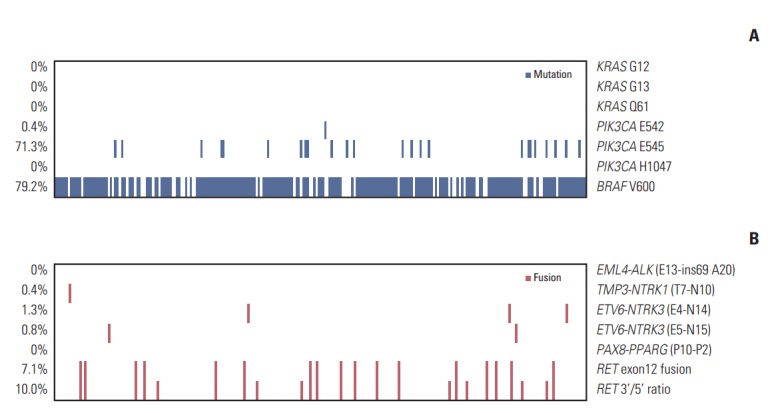
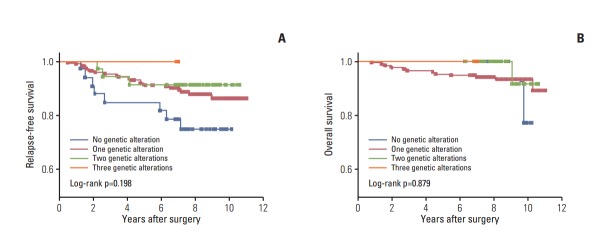
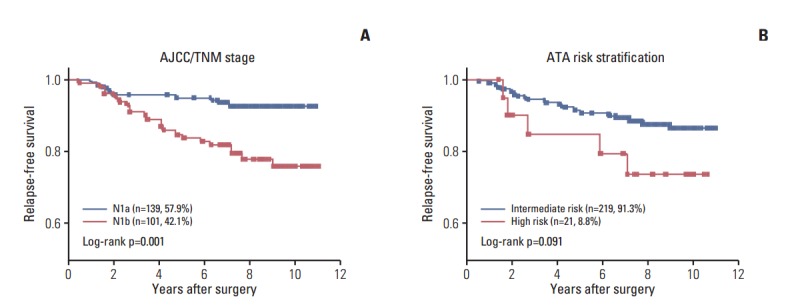
Of the 240 PTC patients, 207 (86.3%) had at least one genetic alteration, including BRAF mutation in 190 patients (79.2%), PIK3CA mutation in 25 patients (10.4%), NTRK1/3 fusion in six patients (2.5%), and RET fusion in 24 patients (10.0%). Concomitant presence of more than two genetic alterations was seen in 36 patients (15%). PTCs harboring BRAF mutation were associated with RET wild-type expression (p=0.001). RET fusion genes have been found to occur with significantly higher frequency in N1b stage patients (p=0.003) or groups of patients aged 45 years or older (p=0.031); however, no significant correlation was found between other genetic alterations. There was no trend toward favorable recurrence-free survival or overall survival among patients lacking genetic alterations.
In the selected high-recurrence risk PTC group, most patients had more than one genetic alteration. However, these known alterations could not entirely account for clinicopathological features of high-recurrence risk PTC.
甲状腺乳头状癌(PTC)常涉及基因改变。本研究旨在探讨高复发风险(淋巴结阳性,N1)PTC 患者中基因改变,并进一步探讨这些基因改变与临床病理特征之间的关系。
收集 240 例经组织学证实为 III/IV 期(pT3/4 或 N1)PTC 患者的手术切除肿瘤组织块。我们使用 NanoString 的 nCounter 技术筛选基因融合,直接 DNA 测序进行突变分析。回顾性收集描述临床病理特征和临床过程的数据。
在 240 例 PTC 患者中,有 207 例(86.3%)至少存在一种基因改变,包括 190 例(79.2%)患者的 BRAF 突变、25 例(10.4%)患者的 PIK3CA 突变、6 例(2.5%)患者的 NTRK1/3 融合和 24 例(10.0%)患者的 RET 融合。36 例(15%)患者同时存在两种以上基因改变。携带 BRAF 突变的 PTC 与 RET 野生型表达相关(p=0.001)。在 N1b 期患者(p=0.003)或 45 岁或以上患者组(p=0.031)中,发现 RET 融合基因的发生率显著较高;然而,其他基因改变之间无显著相关性。在缺乏基因改变的患者中,无复发生存率或总生存率呈有利趋势。
在选定的高复发风险 PTC 患者组中,大多数患者存在一种以上的基因改变。然而,这些已知的改变不能完全解释高复发风险 PTC 的临床病理特征。