Department of Health and Social Sciences, University of the West of England, Bristol Frenchay Campus, Coldharbour Lane, Bristol, BS16 1QY, England .
McMaster University, Hamilton, Canada .
Bull World Health Organ. 2017 Jan 1;95(1):36-48. doi: 10.2471/BLT.16.172965. Epub 2016 Oct 20.
To establish global research priorities for interpersonal violence prevention using a systematic approach.
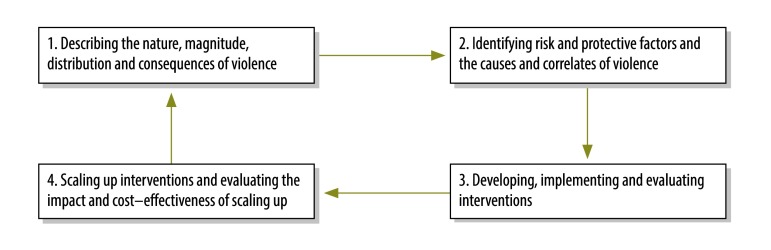
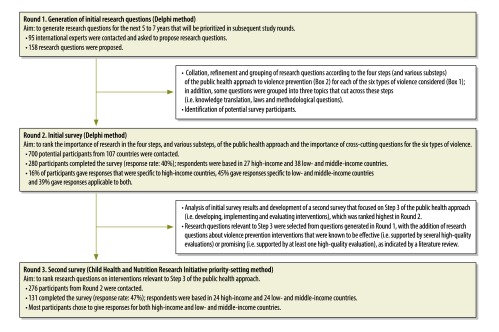
Research priorities were identified in a three-round process involving two surveys. In round 1, 95 global experts in violence prevention proposed research questions to be ranked in round 2. Questions were collated and organized according to the four-step public health approach to violence prevention. In round 2, 280 international experts ranked the importance of research in the four steps, and the various substeps, of the public health approach. In round 3, 131 international experts ranked the importance of detailed research questions on the public health step awarded the highest priority in round 2.
In round 2, "developing, implementing and evaluating interventions" was the step of the public health approach awarded the highest priority for four of the six types of violence considered (i.e. child maltreatment, intimate partner violence, armed violence and sexual violence) but not for youth violence or elder abuse. In contrast, "scaling up interventions and evaluating their cost-effectiveness" was ranked lowest for all types of violence. In round 3, research into "developing, implementing and evaluating interventions" that addressed parenting or laws to regulate the use of firearms was awarded the highest priority. The key limitations of the study were response and attrition rates among survey respondents. However, these rates were in line with similar priority-setting exercises.
These findings suggest it is premature to scale up violence prevention interventions. Developing and evaluating smaller-scale interventions should be the funding priority.
采用系统方法为预防人际暴力制定全球研究重点。
在三轮包括两项调查的过程中确定了研究重点。在第一轮中,95 名预防暴力方面的全球专家提出了要在第二轮中进行排名的研究问题。将问题根据预防暴力的四步公共卫生方法进行整理和组织。在第二轮中,280 名国际专家对预防暴力四步法以及公共卫生方法的各个子步骤中的研究重要性进行了排名。在第三轮中,131 名国际专家对第二轮中获得最高优先级的公共卫生步骤的详细研究问题的重要性进行了排名。
在第二轮中,对于所考虑的六种暴力类型中的四种(即儿童虐待、亲密伴侣暴力、武装暴力和性暴力),“制定、实施和评估干预措施”是公共卫生方法步骤中获得最高优先级的,但对于青年暴力或虐待老年人则不是。相比之下,对于所有类型的暴力,“扩大干预措施并评估其成本效益”的排名最低。在第三轮中,对解决育儿或监管枪支使用法律的“制定、实施和评估干预措施”的研究被评为优先级最高。该研究的主要局限性在于调查受访者的回应率和流失率。然而,这些比率与类似的重点制定工作一致。
这些发现表明扩大暴力预防干预措施还为时过早。应优先考虑制定和评估规模较小的干预措施。