Nagayama Daiji, Imamura Haruki, Sato Yuta, Yamaguchi Takashi, Ban Noriko, Kawana Hidetoshi, Ohira Masahiro, Saiki Atsuhito, Shirai Kohji, Tatsuno Ichiro
Center of Endocrinology and Metabolism, Shin-Oyama City Hospital, Oyama-City; Center of Diabetes, Endocrinology and Metabolism.
Center of Diabetes, Endocrinology and Metabolism.
Vasc Health Risk Manag. 2016 Dec 21;13:1-9. doi: 10.2147/VHRM.S119646. eCollection 2017.
The objective of this study is to investigate the association of body mass index (BMI) with arterial stiffness assessed by cardioankle vascular index (CAVI).
A retrospective cross-sectional study was conducted in 23,257 healthy Japanese subjects (12,729 men and 10,528 women, aged 47.1 ± 12.5 years, BMI 22.9 ± 3.4 kg/m) who underwent health screening between 2004 and 2006 in Japan. Exclusion criteria were current medication use and a past history of cardiovascular disease, hypertension, stroke, diabetes, and nephritis.
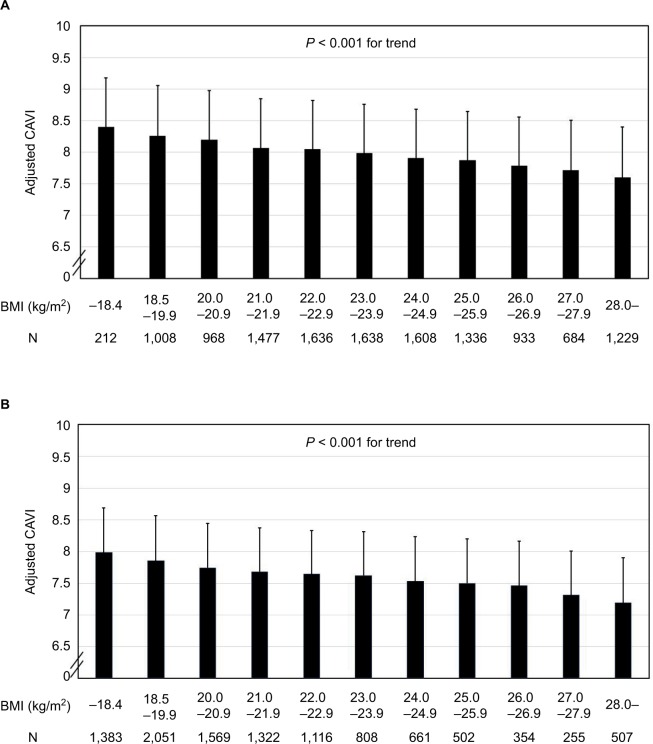
Male subjects showed significantly higher BMI, CAVI, and triglycerides and lower high-density lipoprotein (HDL)-cholesterol compared with female subjects. Next, the subjects were divided into tertiles of BMI: lower, middle, and upper, in a gender-specific manner. After adjusting for confounders including age, systolic blood pressure, and HDL-cholesterol identified by multiple regression analysis, the mean CAVI decreased progressively as BMI tertile increased in both genders. Furthermore, a negative inverse relationship between BMI and adjusted CAVI was observed throughout the BMI distribution. Multivariate logistic regression model for contributors of high CAVI (≥90th percentile) identified obesity (odds ratios (95% confidence interval): 0.804 (0.720-0.899)], older age [15.6 (14.0-17.4)], male gender [2.26 (2.03-2.51)], hypertension [2.28 (2.06-2.54)], impaired fasting glucose [1.17 (1.01-1.37)], and low HDL-cholesterol [0.843 (0.669-1.06)] as independent factors.
We demonstrated an inverse relationship between CAVI and BMI in healthy Japanese subjects, suggesting that systemic accumulation of adipose tissue per se may lead to a linear decrease of arterial stiffness in nonobese and obese subjects without metabolic disorders.
本研究旨在探讨体重指数(BMI)与通过心踝血管指数(CAVI)评估的动脉僵硬度之间的关联。
对2004年至2006年期间在日本接受健康筛查的23257名健康日本受试者(12729名男性和10528名女性,年龄47.1±12.5岁,BMI 22.9±3.4kg/m²)进行了一项回顾性横断面研究。排除标准为当前正在使用药物以及有心血管疾病、高血压、中风、糖尿病和肾炎的既往史。
与女性受试者相比,男性受试者的BMI、CAVI和甘油三酯显著更高,而高密度脂蛋白(HDL)胆固醇更低。接下来,按性别将受试者分为BMI三分位数:低、中、高。在通过多元回归分析确定对年龄、收缩压和HDL胆固醇等混杂因素进行校正后,男女两性的平均CAVI均随着BMI三分位数的增加而逐渐降低。此外,在整个BMI分布范围内均观察到BMI与校正后的CAVI之间存在负向反比关系。针对高CAVI(≥第90百分位数)的影响因素的多变量逻辑回归模型确定肥胖(优势比(95%置信区间):0.804(0.720 - 0.899))、老年[15.6(14.0 - 17.4)]、男性性别[2.26(2.03 - 2.51)]、高血压[2.28(2.06 - 2.54)]、空腹血糖受损[1.17(1.01 - 1.37)]和低HDL胆固醇[0.843(0.669 - 1.06)]为独立因素。
我们在健康日本受试者中证实了CAVI与BMI之间存在反比关系,表明脂肪组织的全身蓄积本身可能导致无代谢紊乱的非肥胖和肥胖受试者的动脉僵硬度呈线性降低。