Villanueva-Garcia Claudia, Gordillo-Chavez Elias Jose, Lopez-Escamilla Eduardo, Rendon-Franco Emilio, Muñoz-Garcia Claudia Irais, Gama Lilia, Martinez-Flores Williams Arony, Gonzalez-Rodriguez Nayeli, Romero-Valdovinos Mirza, Diaz-Lopez Hilda, Galian Jose, Villalobos Guiehdani, Maravilla Pablo, Martinez-Hernandez Fernando
Departamento de Zoologia y Antropologia Fisica, Facultad de Veterinaria, Universidad de Murcia, Murcia, España.
Departamento de Ecologia del Paisaje y Cambio Global, Centro de Investigacion para la Conservacion y Aprovechamiento de Recursos Tropicales, Universidad Juarez Autonoma de Tabasco, Villahermosa, Tabasco, Mexico.
PLoS One. 2017 Jan 5;12(1):e0169637. doi: 10.1371/journal.pone.0169637. eCollection 2017.
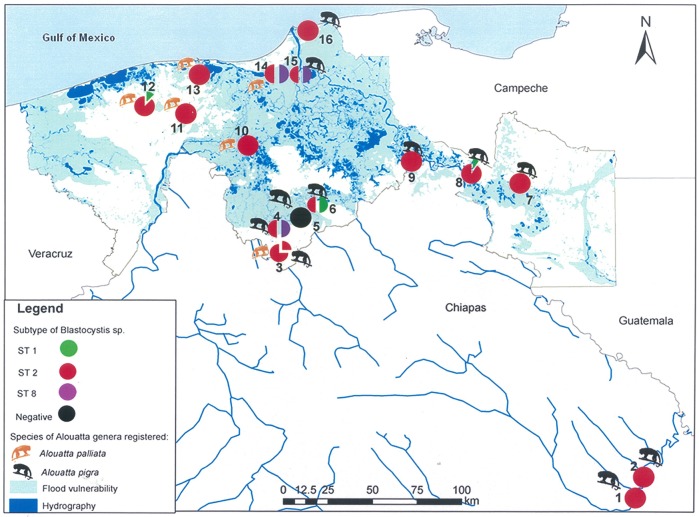
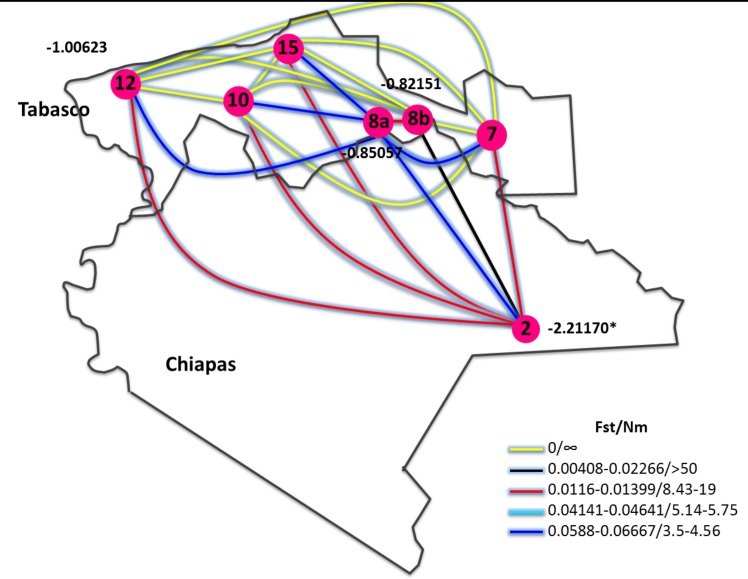
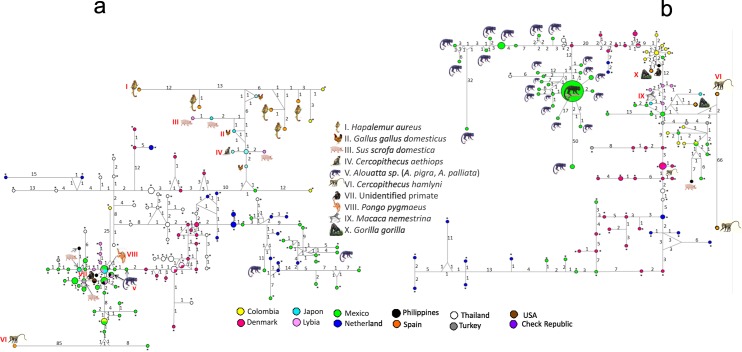
Although the presence of cryptic host specificity has been documented in Blastocystis, differences in infection rates and high genetic polymorphism within and between populations of some subtypes (ST) have impeded the clarification of the generalist or specialist specificity of this parasite. We assessed the genetic variability and host specificity of Blastocystis spp. in wild howler monkeys from two rainforest areas in the southeastern region of Mexico. Fecal samples of 225 Alouatta palliata (59) and A. pigra (166) monkeys, belonging to 16 sylvatic sites, were analyzed for infection with Blastocystis ST using a region of the small subunit rDNA (SSUrDNA) gene as a marker. Phylogenetic and genetic diversity analyses were performed according to the geographic areas where the monkeys were found. Blastocystis ST2 was the most abundant (91.9%), followed by ST1 and ST8 with 4.6% and 3.5%, respectively; no association between Blastocystis ST and Alouatta species was observed. SSUrDNA sequences in GenBank from human and non-human primates (NHP) were used as ST references and included in population analyses. The haplotype network trees exhibited different distributions: ST1 showed a generalist profile since several haplotypes from different animals were homogeneously distributed with few mutational changes. For ST2, a major dispersion center grouped the Mexican samples, and high mutational differences were observed between NHP. Furthermore, nucleotide and haplotype diversity values, as well as migration and genetic differentiation indexes, showed contrasting values for ST1 and ST2. These data suggest that ST1 populations are only minimally differentiated, while ST2 populations in humans are highly differentiated from those of NHP. The host generalist and specialist specificities exhibited by ST1 and ST2 Blastocystis populations indicate distinct adaptation processes. Because ST1 exhibits a generalist profile, this haplotype can be considered a metapopulation; in contrast, ST2 exists as a set of local populations with preferences for either humans or NHP.
尽管在芽囊原虫中已记录到隐性宿主特异性的存在,但某些亚型(ST)群体内部和之间的感染率差异以及高遗传多态性阻碍了对这种寄生虫的泛化或特化特异性的阐明。我们评估了来自墨西哥东南部两个雨林地区的野生吼猴中芽囊原虫的遗传变异性和宿主特异性。对来自16个野生地点的225只白喉卷尾猴(59只)和中美卷尾猴(166只)的粪便样本进行分析,以小亚基核糖体DNA(SSUrDNA)基因区域为标记,检测芽囊原虫ST的感染情况。根据发现猴子的地理区域进行系统发育和遗传多样性分析。芽囊原虫ST2最为常见(91.9%),其次是ST1和ST8,分别为4.6%和3.5%;未观察到芽囊原虫ST与卷尾猴物种之间的关联。来自人类和非人类灵长类动物(NHP)的GenBank中的SSUrDNA序列用作ST参考,并纳入群体分析。单倍型网络图显示出不同的分布:ST1呈现泛化特征,因为来自不同动物的几种单倍型均匀分布,突变变化很少。对于ST2,一个主要的分散中心聚集了墨西哥的样本,并且在NHP之间观察到高度的突变差异。此外,核苷酸和单倍型多样性值以及迁移和遗传分化指数在ST1和ST2之间显示出对比值。这些数据表明,ST1群体的分化程度最小,而人类中的ST2群体与NHP的群体高度分化。芽囊原虫ST1和ST2群体表现出的宿主泛化和特化特异性表明了不同的适应过程。由于ST1呈现泛化特征,这种单倍型可被视为一个集合种群;相比之下,ST2作为一组对人类或NHP有偏好的当地种群存在。