Rothermund Eva, Kilian Reinhold, Rottler Edit, Mayer Dorothea, Hölzer Michael, Rieger Monika A, Gündel Harald
Department of Psychosomatic Medicine and Psychotherapy, University Hospital Ulm, Ulm, Germany.
Department of Psychiatry II, University Hospital Ulm, BKH Günzburg, Germany.
PLoS One. 2017 Jan 5;12(1):e0169559. doi: 10.1371/journal.pone.0169559. eCollection 2017.
Common mental disorders like mood and anxiety disorders and somatoform disorders have high costs, yet under-treatment is still frequent. Many people with common mental disorders are employed, so the workplace is potentially a suitable context in which to provide early treatment. Our study investigates whether a change of setting (workplace versus standard care) improves access to treatment for common mental disorders.
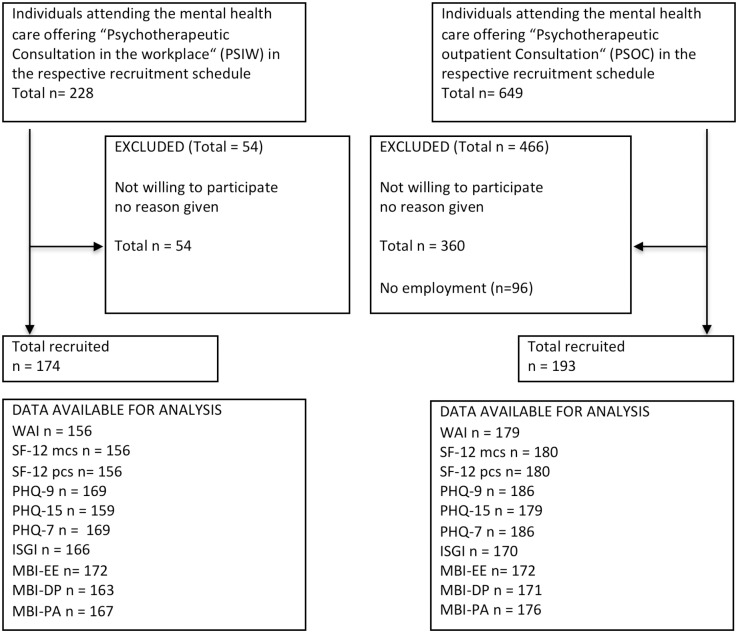
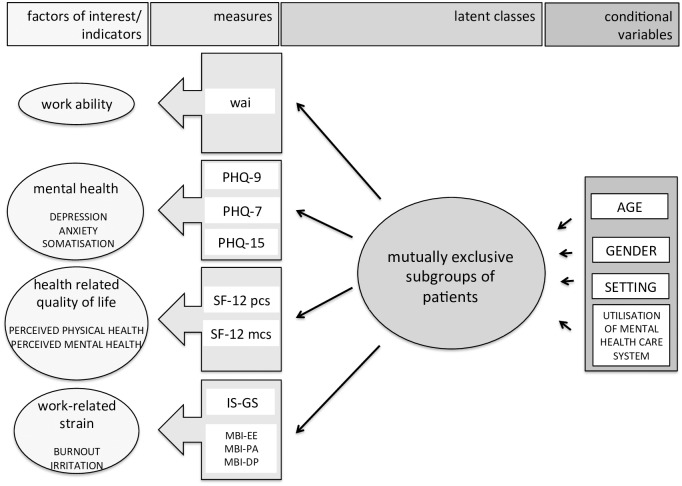
Conditional latent profile analysis was applied to identify user profiles for work ability (WAI), clinical symptoms like depression (patient health questionnaire depression, PHQ-9), health-related quality of life (QoL, SF-12), and work-related stress (Maslach Burnout Inventory, irritation scale). Patients were recruited consecutively, via psychotherapeutic consultation in the workplace (n = 174) or psychotherapeutic consultation in outpatient care (n = 193).
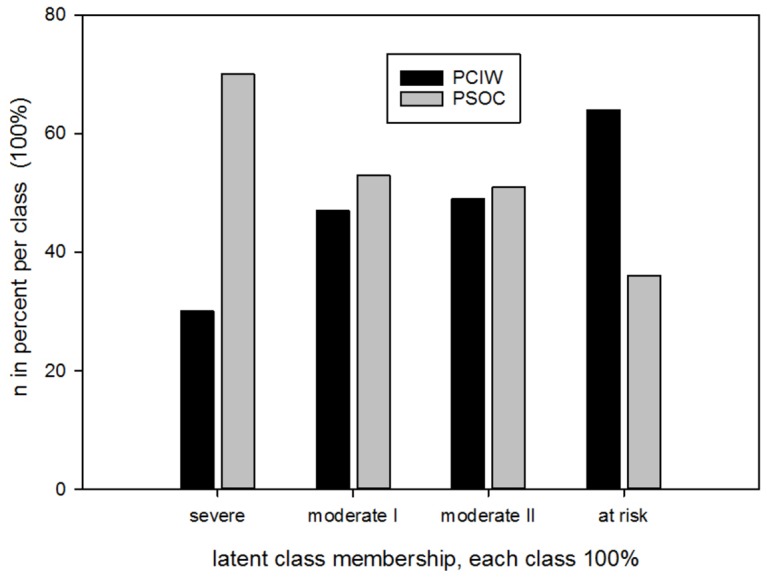
We identified four user profiles in our model: 'severe' (n = 99), 'moderate I-low QoL' (n = 88), 'moderate II-low work ability' (n = 83), and 'at risk' (n = 97). The 'at risk' profile encompassed individuals with reduced work ability (36.0, 34.73 to 37.37), only mild clinical symptoms (PHQ-9 5.7, 4.92 to 6.53), no signs of work-related stress and good quality of life. A higher proportion of the 'at risk' group than of the 'severe' group sought help via the psychotherapeutic consultation in the workplace (OR 0.287, P < 0.01); this effect remained after controlling for gender.
Offering secondary mental health care in the workplace is feasible and accepted by users. Offering treatment in the workplace as an alternative to standard outpatient settings is a viable strategy for improving access to treatment for common mental disorders.
常见精神障碍,如情绪和焦虑障碍以及躯体形式障碍,成本高昂,但治疗不足的情况仍然很常见。许多患有常见精神障碍的人都有工作,因此工作场所可能是提供早期治疗的合适环境。我们的研究调查了治疗环境的改变(工作场所与标准护理)是否能改善常见精神障碍的治疗可及性。
应用条件潜在剖面分析来确定工作能力(工作能力指数,WAI)、抑郁等临床症状(患者健康问卷抑郁量表,PHQ - 9)、健康相关生活质量(QoL,SF - 12)以及工作相关压力(马氏工作倦怠量表,激惹量表)的用户概况。通过工作场所的心理治疗咨询(n = 174)或门诊护理的心理治疗咨询(n = 193)连续招募患者。
我们在模型中确定了四种用户概况:“严重”(n = 99)、“中度I - 低生活质量”(n = 88)、“中度II - 低工作能力”(n = 83)和“有风险”(n = 97)。“有风险”概况包括工作能力下降(36.0,34.73至37.37)、仅有轻度临床症状(PHQ - 9为5.7,4.92至6.53)、无工作相关压力迹象且生活质量良好的个体。“有风险”组通过工作场所心理治疗咨询寻求帮助的比例高于“严重”组(比值比0.287,P < 0.01);在控制性别后,这种效应仍然存在。
在工作场所提供二级心理健康护理是可行的,并且为用户所接受。在工作场所提供治疗作为标准门诊环境的替代方案,是改善常见精神障碍治疗可及性的可行策略。