Sun Ye, Wei Yue-Hong, Yang Yang, Ma Yu, de Vlas Sake J, Yao Hong-Wu, Huang Yong, Ma Mai-Juan, Liu Kun, Li Xiao-Ning, Li Xin-Lou, Zhang Wen-Hui, Fang Li-Qun, Yang Zhi-Cong, Cao Wu-Chun
The State Key Laboratory of Pathogen and Biosecurity, Beijing Institute of Microbiology and Epidemiology, 20 Dong-Da Street, Fengtai District, Beijing, 100071, People's Republic of China.
Center for Disease Control and Prevention of Jinan Military Region, Shandong Province, Jinan, 250014, People's Republic of China.
BMC Infect Dis. 2017 Jan 5;17(1):13. doi: 10.1186/s12879-016-2153-3.
In the last decade, scrub typhus (ST) has been emerging or re-emerging in some areas of Asia, including Guangzhou, one of the most affected endemic areas of ST in China.
Based on the data on all cases reported in Guangzhou from 2006 to 2014, we characterized the epidemiological features, and identified environmental determinants for the spatial distribution of ST using a panel negative binomial model.
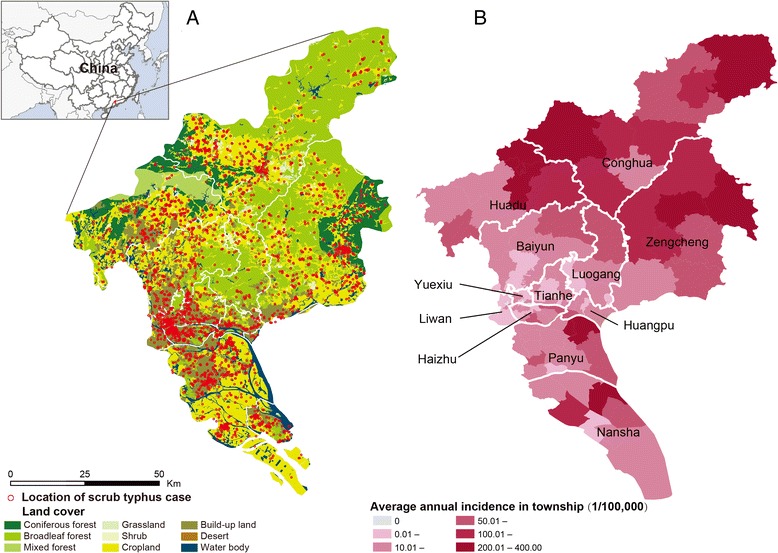
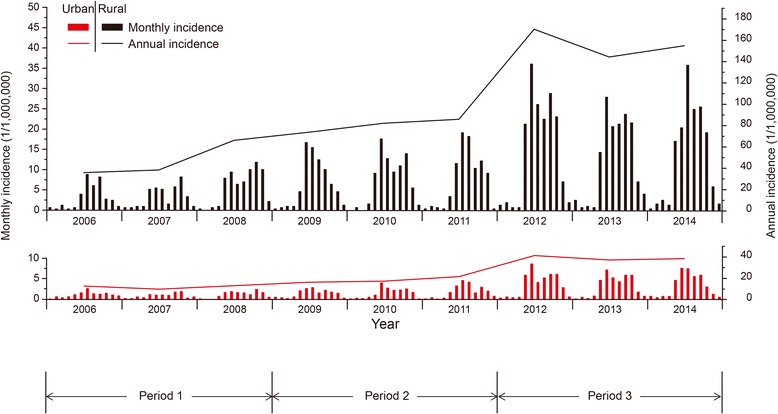
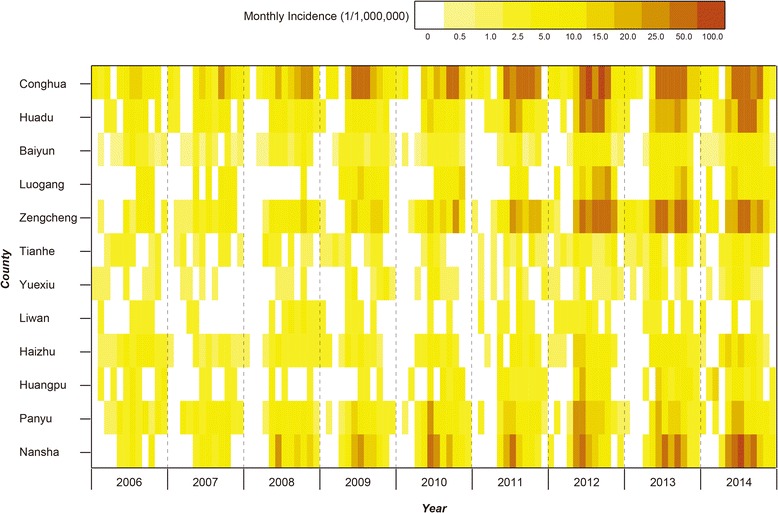
A total of 4821 scrub typhus cases were reported in Guangzhou during 2006-2014. The annual incidence increased noticeably and the increase was relatively high and rapid in rural townships and among elderly females. The majority of cases (86.8%) occurred during May-October, and farmers constituted the majority of the cases, accounting for 33.9% in urban and 61.6% in rural areas. The number of housekeeper patients had a rapid increment in both rural and urban areas during the study period. Atmospheric pressure and relative humidity with lags of 1 or 2 months, distributions of broadleaved forest and rural township were identified as determinants for the spatiotemporal distribution of scrub typhus.
Our results indicate that surveillance and public education need to be focused on the elderly farmers in rural areas covered with broadleaf forest in southern China.
在过去十年中,恙虫病在亚洲一些地区不断出现或再次出现,包括广州,中国恙虫病疫情最严重的流行地区之一。
基于2006年至2014年广州报告的所有病例数据,我们描述了流行病学特征,并使用面板负二项式模型确定了恙虫病空间分布的环境决定因素。
2006 - 2014年期间,广州共报告4821例恙虫病病例。年发病率显著上升,农村乡镇以及老年女性中的发病率上升相对较高且迅速。大多数病例(86.8%)发生在5月至10月,农民占病例的大多数,在城市地区占33.9%,在农村地区占61.6%。在研究期间,城乡家庭主妇患者数量均迅速增加。滞后1或2个月的大气压和相对湿度、阔叶林分布和农村乡镇被确定为恙虫病时空分布的决定因素。
我们的结果表明,监测和公众教育需要聚焦于中国南方阔叶林覆盖农村地区的老年农民。