
壳聚糖稳定的硒纳米颗粒的抗氧化能力。
Antioxidant capacities of the selenium nanoparticles stabilized by chitosan.
作者信息
Zhai Xiaona, Zhang Chunyue, Zhao Guanghua, Stoll Serge, Ren Fazheng, Leng Xiaojing
机构信息
Beijing Advanced Innovation Center for Food Nutrition and Human Health, Beijing Laboratory for Food Quality and Safety, Beijing Dairy Industry Innovation Team, College of Food Science & Nutritional Engineering, China Agricultural University, Beijing, 100083, China.
Group of Environmental Physical Chemistry, F.-A. Forel Institute, University of Geneva, Geneva, Switzerland.
出版信息
J Nanobiotechnology. 2017 Jan 5;15(1):4. doi: 10.1186/s12951-016-0243-4.
BACKGROUNDS
Selenium (Se) as one of the essential trace elements for human plays an important role in the oxidation reduction system. But the high toxicity of Se limits its application. In this case, the element Se with zero oxidation state (Se) has captured our attention because of its low toxicity and excellent bioavailability. However, Se is very unstable and easily changes into the inactive form. By now many efforts have been done to protect its stability. And this work was conducted to explore the antioxidant capacities of the stable Se nanoparticles (SeNPs) stabilized using chitosan (CS) with different molecular weights (Mws) (CS-SeNPs).
RESULTS
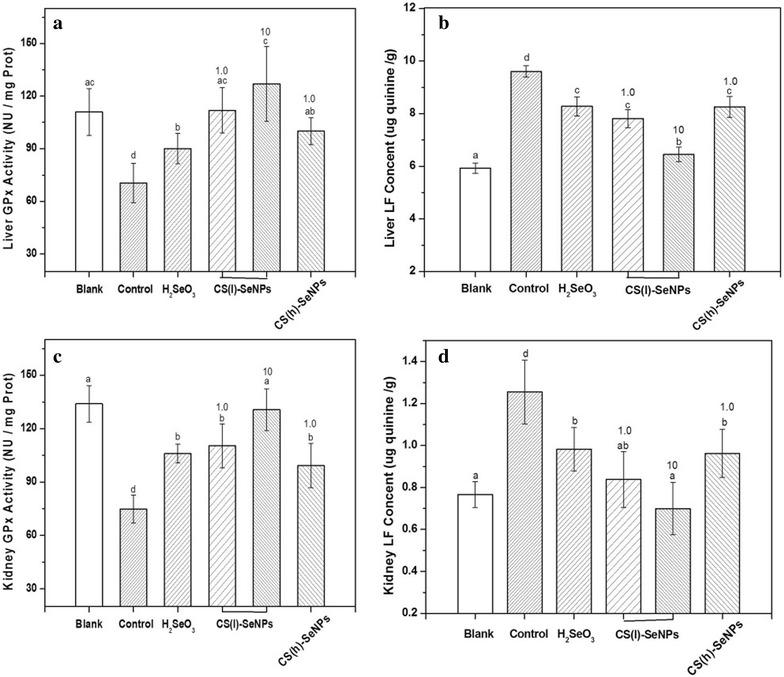
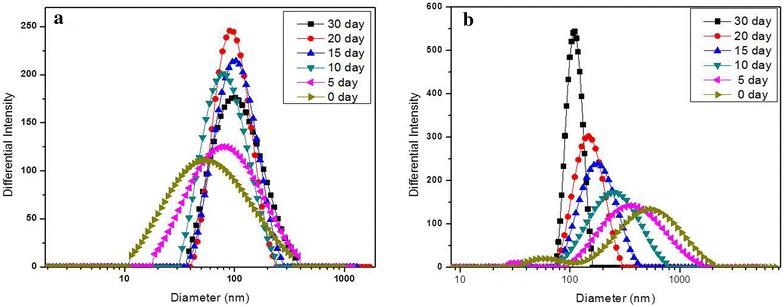
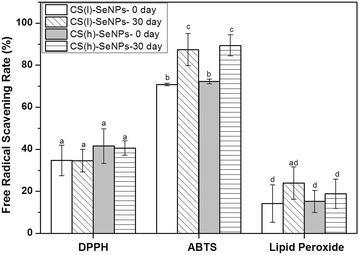
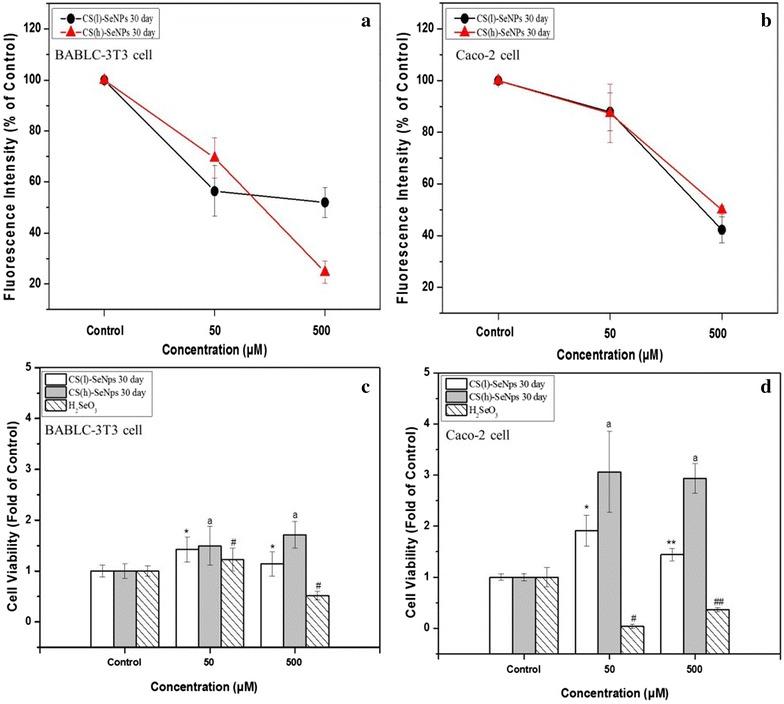
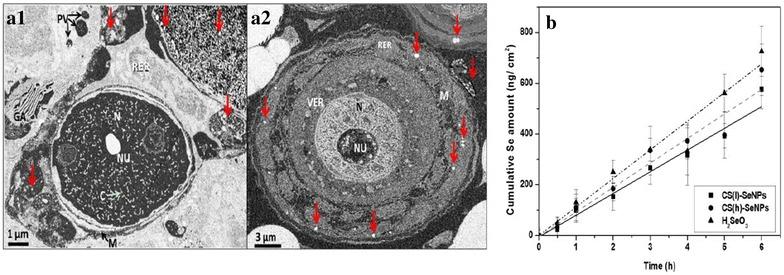
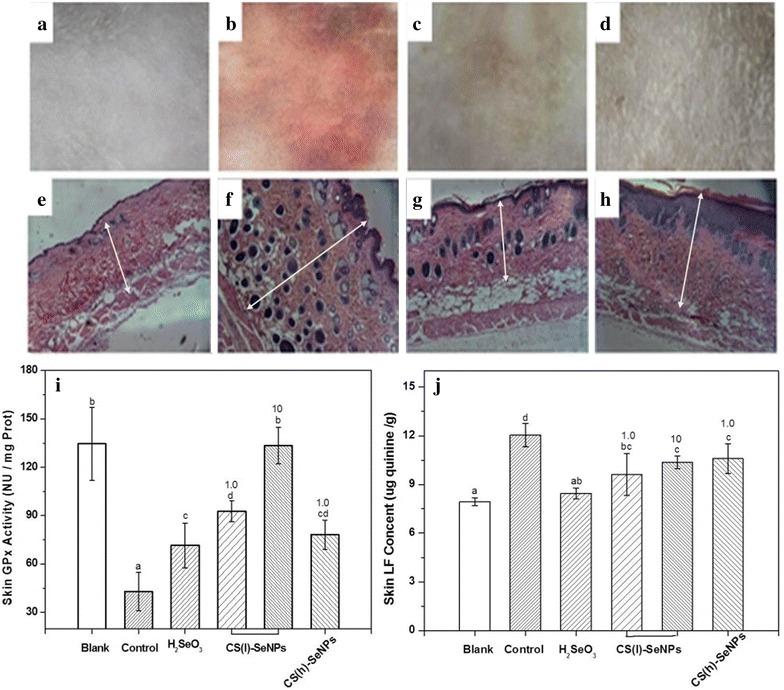
The different Mws CS-SeNPs could form uniform sphere particles with a size of about 103 nm after 30 days. The antioxidant tests of the DPPH, ABTS, and lipid peroxide models showed that these CS-SeNPs could scavenge free radicals at different levels. And the 1 month old SeNPs held the higher ABTS scavenging ability that the value could reach up to 87.45 ± 7.63% and 89.44 ± 5.03% of CS(l)-SeNPs and CS(h)-SeNPs, respectively. In the cell test using BABLC-3T3 or Caco-2, the production of the intracellular reactive oxygen species (ROS) could be inhibited in a Se concentration-dependent manner. The topical or oral administration of CS-SeNPs, particularly the Se nanoparticles stabilized with low molecular weight CS, CS(l)-SeNPs, and treated with a 30-day storage process, could efficiently protect glutathione peroxidase (GPx) activity and prevent the lipofusin formation induced by UV-radiation or D-galactose in mice, respectively. Such effects were more evident in viscera than in skin. The acute toxicity of CS(l)-SeNPs was tenfold lower than that of HSeO.
CONCLUSIONS
Our work could demonstrate the CS-SeNPs hold a lower toxicity and a 30-day storage process could enhance the antioxidant capacities. All CS-SeNPs could penetrate the tissues and perform their antioxidant effects, especially the CS(l)-SeNPs in mice models. What's more, the antioxidant capacities of CS-SeNPs were more evident in viscera than in skin.
背景
硒(Se)作为人体必需的微量元素之一,在氧化还原系统中发挥着重要作用。但硒的高毒性限制了其应用。在这种情况下,零价态的硒元素(Se⁰)因其低毒性和优异的生物利用度而引起了我们的关注。然而,Se⁰非常不稳定,容易转变为无活性形式。到目前为止,人们已经做了很多努力来保护其稳定性。本研究旨在探讨用不同分子量(Mw)的壳聚糖(CS)稳定的稳定硒纳米颗粒(CS-SeNPs)的抗氧化能力。
结果
不同Mw的CS-SeNPs在30天后可形成大小约为103 nm的均匀球形颗粒。DPPH、ABTS和脂质过氧化物模型的抗氧化试验表明,这些CS-SeNPs能在不同水平清除自由基。1个月龄的SeNPs具有较高的ABTS清除能力,CS(l)-SeNPs和CS(h)-SeNPs的值分别可达87.45±7.63%和89.44±5.03%。在使用BABLC-3T3或Caco-2的细胞试验中,细胞内活性氧(ROS)的产生可呈硒浓度依赖性受到抑制。局部或口服CS-SeNPs,特别是用低分子量CS稳定的硒纳米颗粒CS(l)-SeNPs,并经过30天的储存处理,可分别有效保护小鼠体内谷胱甘肽过氧化物酶(GPx)活性,并预防紫外线辐射或D-半乳糖诱导的脂褐素形成。这种作用在内脏比在皮肤中更明显。CS(l)-SeNPs的急性毒性比HSeO低10倍。
结论
我们的研究表明CS-SeNPs毒性较低,30天的储存过程可增强其抗氧化能力。所有CS-SeNPs均可穿透组织并发挥抗氧化作用,尤其是在小鼠模型中的CS(l)-SeNPs。此外,CS-SeNPs的抗氧化能力在内脏比在皮肤中更明显。
 Zotero 插件