Department of Molecular Cardiology, Cleveland Clinic, Cleveland, OH, USA.
Mol Cancer. 2012 Jan 30;11:5. doi: 10.1186/1476-4598-11-5.
microRNAs have been established as powerful regulators of gene expression in normal physiological as well as in pathological conditions, including cancer progression and metastasis. Recent studies have demonstrated a key role of miR-31 in the progression and metastasis of breast cancer. Downregulation of miR-31 enhances several steps of the invasion-metastasis cascade in breast cancer, i.e., local invasion, extravasation and survival in the circulation system, and metastatic colonization of distant sites. miR-31 exerts its metastasis-suppressor activity by targeting a cohort of pro-metastatic genes, including RhoA and WAVE3. The molecular mechanisms that lead to the loss of miR-31 and the activation of its pro-metastatic target genes during these specific steps of the invasion-metastasis cascade are however unknown.
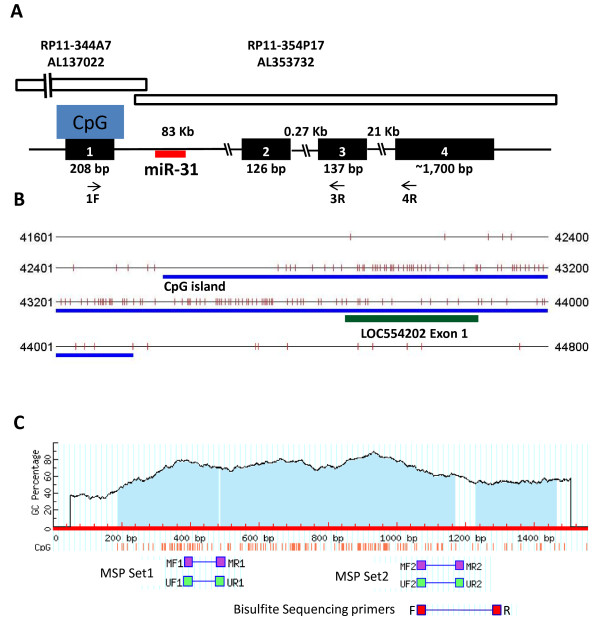
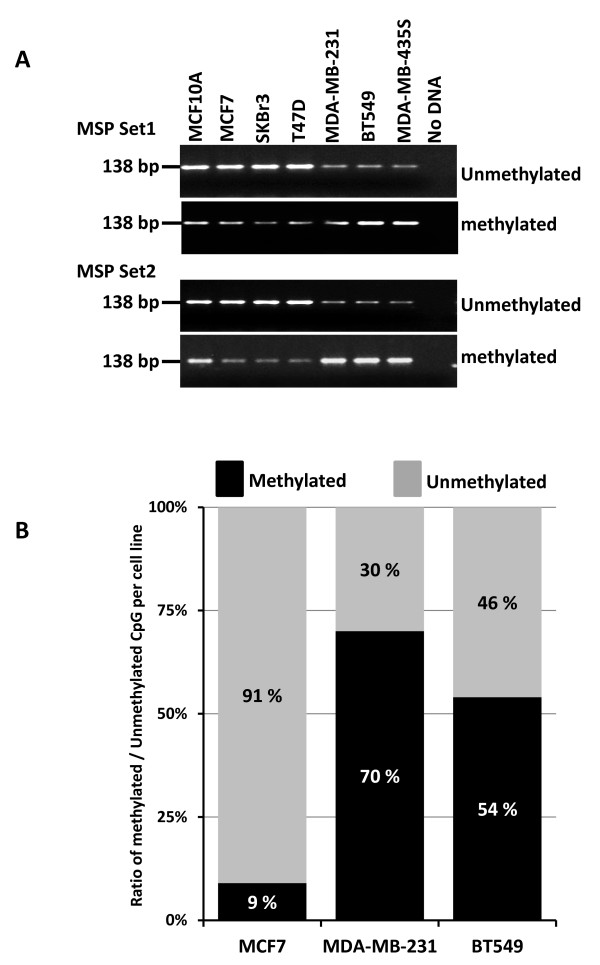
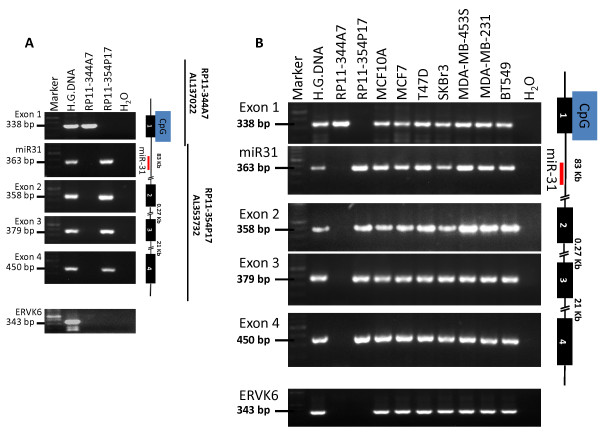
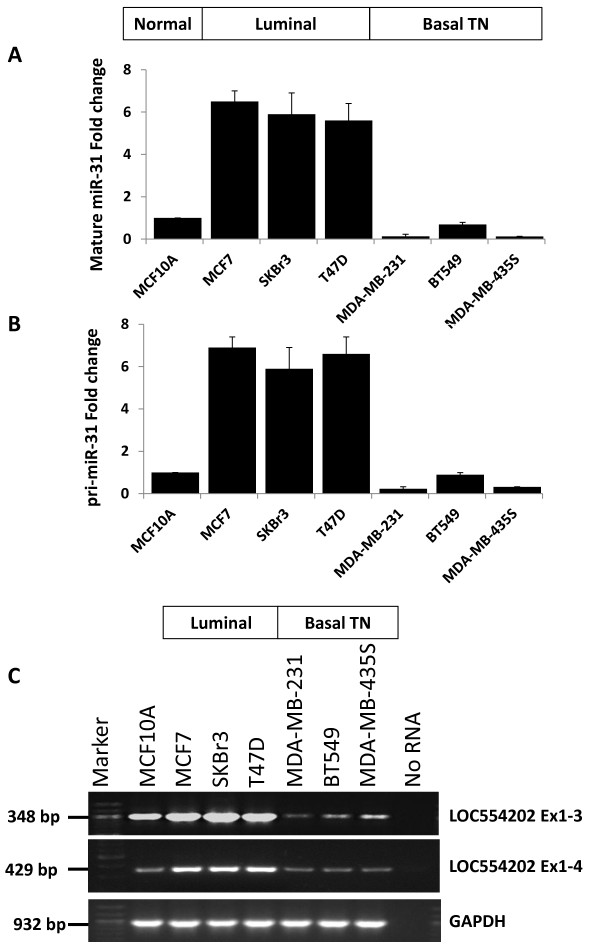
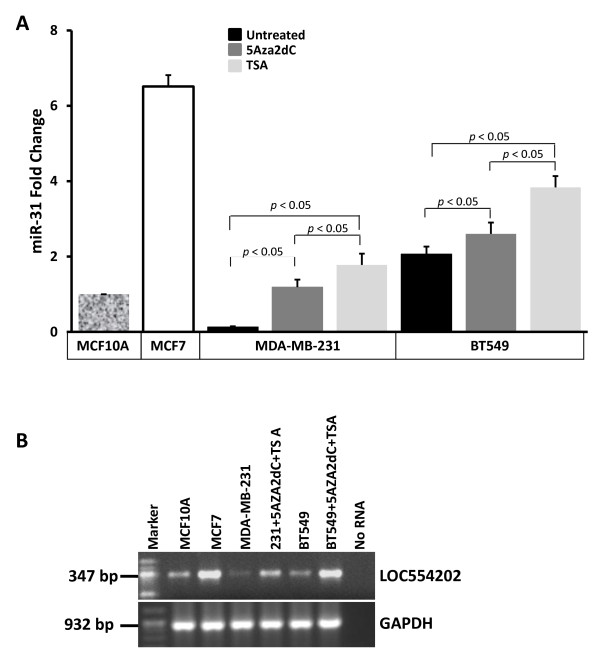
In the present report, we identify promoter hypermethylation as one of the major mechanisms for silencing miR-31 in breast cancer, and in the triple-negative breast cancer (TNBC) cell lines of basal subtype, in particular. miR-31 maps to the intronic sequence of a novel long non-coding (lnc)RNA, LOC554202 and the regulation of its transcriptional activity is under control of LOC554202. Both miR-31 and the host gene LOC554202 are down-regulated in the TNBC cell lines of basal subtype and over-expressed in the luminal counterparts. Treatment of the TNBC cell lines with either a de-methylating agent alone or in combination with a de-acetylating agent resulted in a significant increase of both miR-31 and its host gene, suggesting an epigenetic mechanism for the silencing of these two genes by promoter hypermethylation. Finally, both methylation-specific PCR and sequencing of bisulfite-converted DNA demonstrated that the LOC554202 promoter-associated CpG island is heavily methylated in the TNBC cell lines and hypomethylated in the luminal subtypes.
Loss of miR-31 expression in TNBC cell lines is attributed to hypermethylation of its promoter-associated CpG island. Together, our results provide the initial evidence for a mechanism by which miR-31, an important determinant of the invasion metastasis cascade, is regulated in breast cancer.
microRNAs 已被证实为在正常生理和病理条件下(包括癌症进展和转移)基因表达的强大调控因子。最近的研究表明 miR-31 在乳腺癌的进展和转移中起关键作用。miR-31 的下调增强了乳腺癌侵袭转移级联反应的多个步骤,即局部侵袭、血管外渗和循环系统中的存活以及远处部位的转移性定植。miR-31 通过靶向一组促转移基因,包括 RhoA 和 WAVE3,发挥其转移抑制活性。然而,在侵袭转移级联反应的这些特定步骤中,导致 miR-31 丢失及其促转移靶基因激活的分子机制尚不清楚。
在本报告中,我们发现启动子超甲基化是 miR-31 在乳腺癌中失活的主要机制之一,特别是在三阴性乳腺癌(TNBC)基底样细胞系中。miR-31 位于新型长非编码(lnc)RNA LOC554202 的内含子序列中,其转录活性的调节受 LOC554202 的控制。miR-31 和其宿主基因 LOC554202 在 TNBC 基底样细胞系中均下调,在腔细胞系中则上调。单独或联合使用去甲基化剂和去乙酰化剂处理 TNBC 细胞系,可显著增加 miR-31 和其宿主基因的表达,提示这些基因的沉默是通过启动子超甲基化的表观遗传机制。最后,甲基化特异性 PCR 和亚硫酸氢盐测序均表明,TNBC 细胞系中 LOC554202 启动子相关的 CpG 岛高度甲基化,而在腔细胞系中则低甲基化。
TNBC 细胞系中 miR-31 表达的缺失归因于其启动子相关 CpG 岛的超甲基化。总之,我们的结果为 miR-31 这一侵袭转移级联反应的重要决定因素在乳腺癌中的调控机制提供了初步证据。