Kantae Vasudev, Krekels Elke H J, Esdonk Michiel J Van, Lindenburg Peter, Harms Amy C, Knibbe Catherijne A J, Van der Graaf Piet H, Hankemeier Thomas
Division of Analytical Biosciences, Systems Pharmacology Cluster, Leiden Academic Centre for Drug Research, Leiden University, Einsteinweg 55, 2333 CC Leiden, The Netherlands.
Division of Pharmacology, Systems Pharmacology Cluster, Leiden Academic Centre for Drug Research, Leiden University, Leiden, The Netherlands.
Metabolomics. 2017;13(1):9. doi: 10.1007/s11306-016-1143-1. Epub 2016 Dec 19.
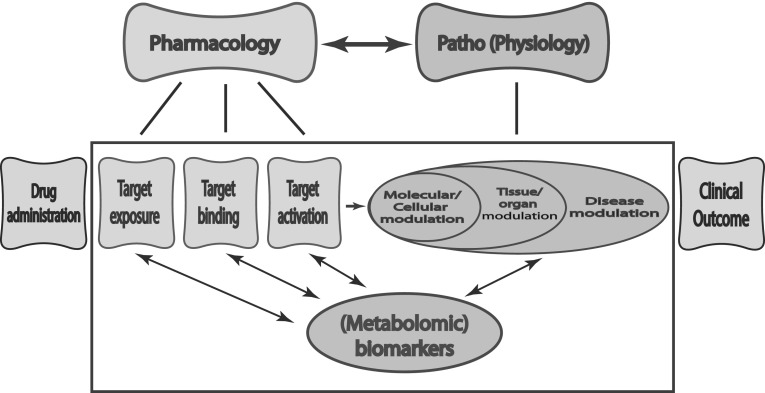
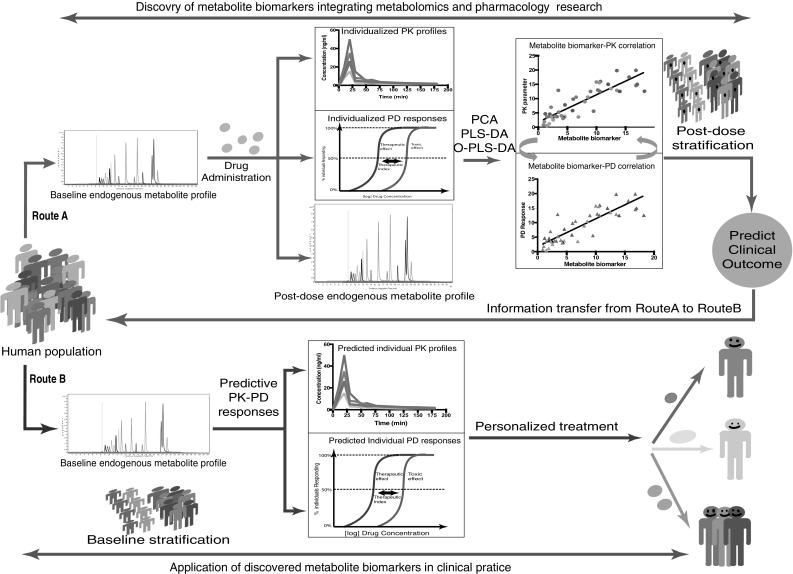
Personalized medicine, in modern drug therapy, aims at a tailored drug treatment accounting for inter-individual variations in drug pharmacology to treat individuals effectively and safely. The inter-individual variability in drug response upon drug administration is caused by the interplay between drug pharmacology and the patients' (patho)physiological status. Individual variations in (patho)physiological status may result from genetic polymorphisms, environmental factors (including current/past treatments), demographic characteristics, and disease related factors. Identification and quantification of predictors of inter-individual variability in drug pharmacology is necessary to achieve personalized medicine. Here, we highlight the potential of pharmacometabolomics in prospectively informing on the inter-individual differences in drug pharmacology, including both pharmacokinetic (PK) and pharmacodynamic (PD) processes, and thereby guiding drug selection and drug dosing. This review focusses on the pharmacometabolomics studies that have additional value on top of the conventional covariates in predicting drug PK. Additionally, employing pharmacometabolomics to predict drug PD is highlighted, and we suggest not only considering the endogenous metabolites as static variables but to include also drug dose and temporal changes in drug concentration in these studies. Although there are many endogenous metabolite biomarkers identified to predict PK and more often to predict PD, validation of these biomarkers in terms of specificity, sensitivity, reproducibility and clinical relevance is highly important. Furthermore, the application of these identified biomarkers in routine clinical practice deserves notable attention to truly personalize drug treatment in the near future.
在现代药物治疗中,个性化医疗旨在根据药物药理学的个体差异进行量身定制的药物治疗,以有效且安全地治疗个体。药物给药后个体对药物反应的变异性是由药物药理学与患者(病理)生理状态之间的相互作用引起的。(病理)生理状态的个体差异可能源于基因多态性、环境因素(包括当前/过去的治疗)、人口统计学特征以及疾病相关因素。识别和量化药物药理学个体变异性的预测因子对于实现个性化医疗至关重要。在此,我们强调药物代谢组学在前瞻性了解药物药理学个体差异方面的潜力,包括药代动力学(PK)和药效动力学(PD)过程,从而指导药物选择和给药剂量。本综述重点关注在预测药物PK方面比传统协变量具有额外价值的药物代谢组学研究。此外,还强调利用药物代谢组学预测药物PD,并且我们建议在这些研究中不仅将内源性代谢物视为静态变量,还应纳入药物剂量和药物浓度的时间变化。尽管已鉴定出许多内源性代谢物生物标志物来预测PK,且更常用于预测PD,但在特异性、敏感性、可重复性和临床相关性方面对这些生物标志物进行验证非常重要。此外,这些已鉴定生物标志物在常规临床实践中的应用值得显著关注,以便在不久的将来真正实现药物治疗的个性化。