Department of Electrical Engineering, Viterbi School of Engineering, University of Southern California, Los Angeles, California 90089, USA.
Department of Electrical Engineering and Computer Sciences, University of California, Berkeley, Berkeley, California 94720, USA.
Nat Commun. 2017 Jan 6;8:13825. doi: 10.1038/ncomms13825.
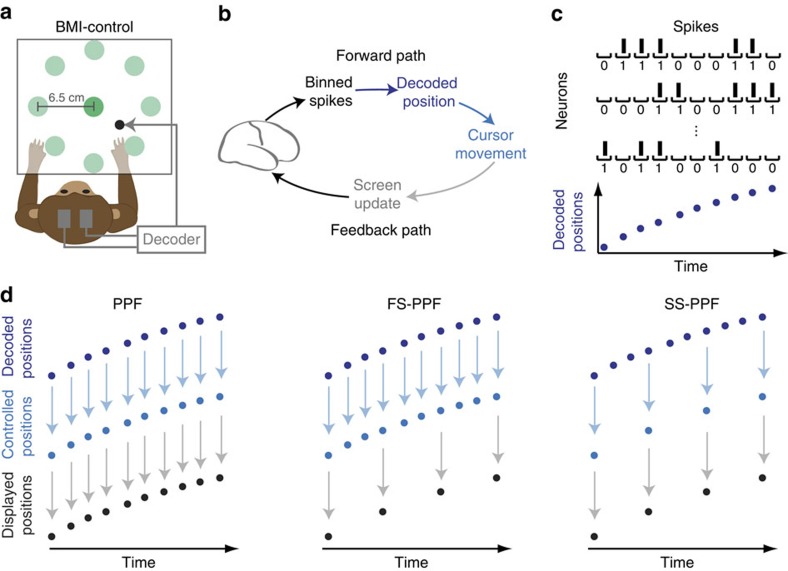
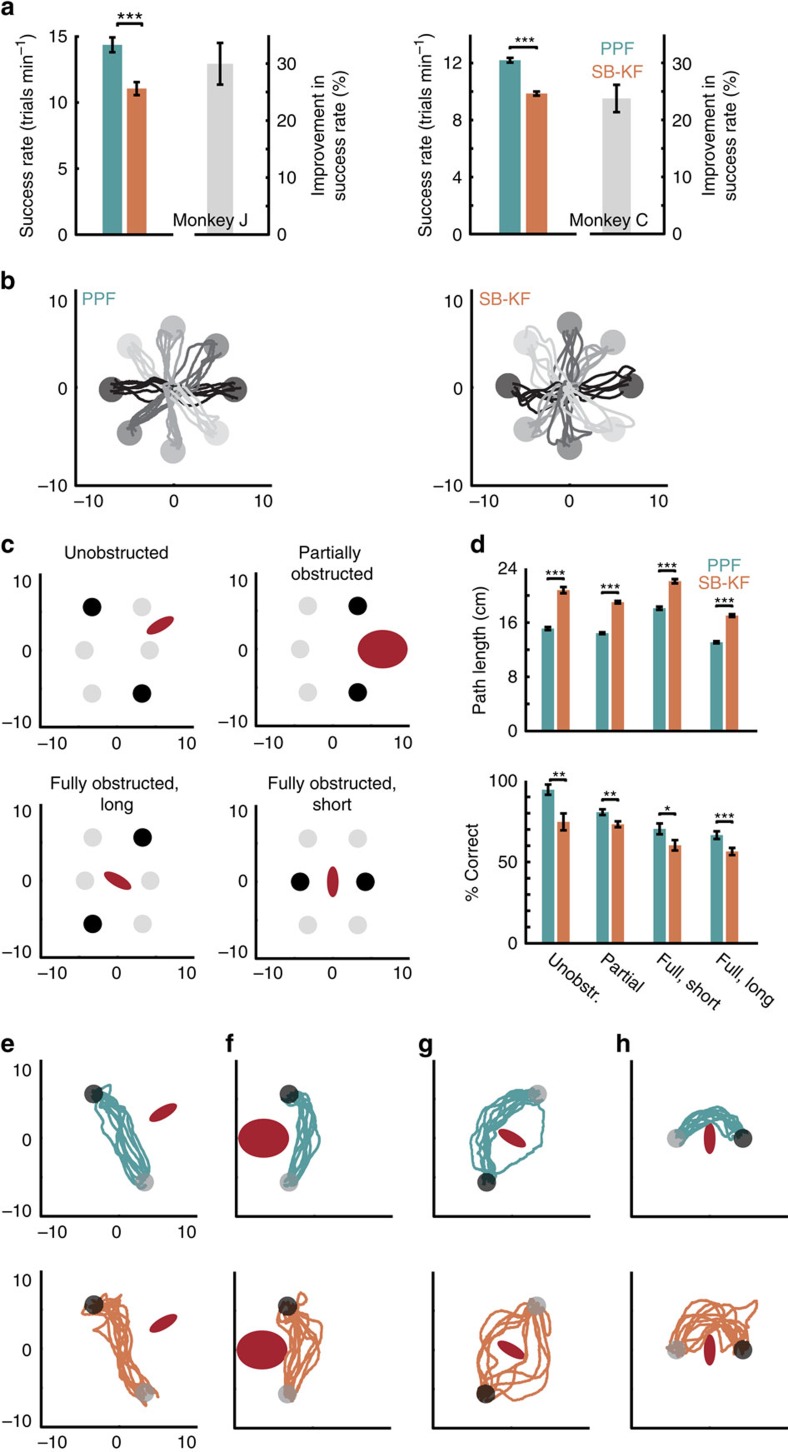
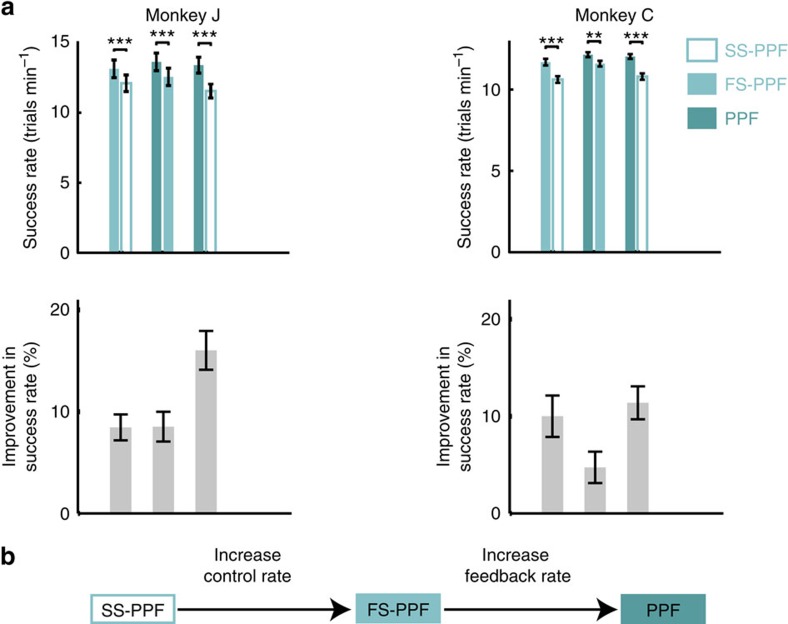
Brain-machine interfaces (BMI) create novel sensorimotor pathways for action. Much as the sensorimotor apparatus shapes natural motor control, the BMI pathway characteristics may also influence neuroprosthetic control. Here, we explore the influence of control and feedback rates, where control rate indicates how often motor commands are sent from the brain to the prosthetic, and feedback rate indicates how often visual feedback of the prosthetic is provided to the subject. We developed a new BMI that allows arbitrarily fast control and feedback rates, and used it to dissociate the effects of each rate in two monkeys. Increasing the control rate significantly improved control even when feedback rate was unchanged. Increasing the feedback rate further facilitated control. We also show that our high-rate BMI significantly outperformed state-of-the-art methods due to higher control and feedback rates, combined with a different point process mathematical encoding model. Our BMI paradigm can dissect the contribution of different elements in the sensorimotor pathway, providing a unique tool for studying neuroprosthetic control mechanisms.
脑机接口 (BMI) 为行动创造了新的感觉运动途径。就像感觉运动器官塑造自然运动控制一样,BMI 途径的特征也可能影响神经假肢控制。在这里,我们探索了控制和反馈率的影响,其中控制率表示大脑向假肢发送运动命令的频率,而反馈率表示假肢向受试者提供视觉反馈的频率。我们开发了一种新的 BMI,可以任意快速地控制和反馈率,并使用它在两只猴子身上分离每个率的影响。即使反馈率保持不变,增加控制率也能显著提高控制效果。增加反馈率也进一步促进了控制。我们还表明,由于更高的控制和反馈率,以及不同的点过程数学编码模型,我们的高速 BMI 明显优于最先进的方法。我们的 BMI 范式可以剖析感觉运动途径中不同元素的贡献,为研究神经假肢控制机制提供了独特的工具。