Hsu Hsiang-Chi, Liu Liang-Chih, Wang Hao-Yu, Hung Chao-Ming, Lin Ying-Chao, Ho Chi-Tang, Way Tzong-Der
Department of Biological Science and Technology, College of Biopharmaceutical and Food Sciences, China Medical University, Taichung, Taiwan.
Department of Surgery, China Medical University Hospital, Taichung, Taiwan.
PLoS One. 2017 Jan 6;12(1):e0164661. doi: 10.1371/journal.pone.0164661. eCollection 2017.
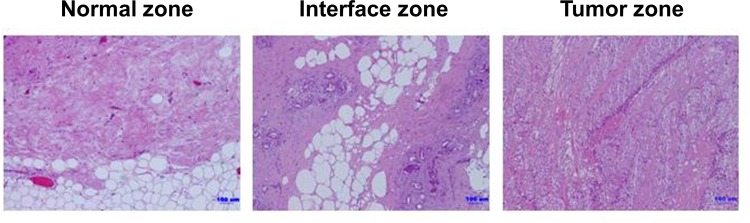
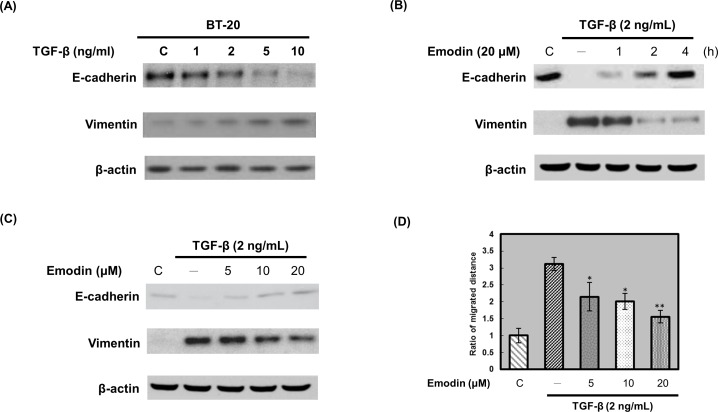
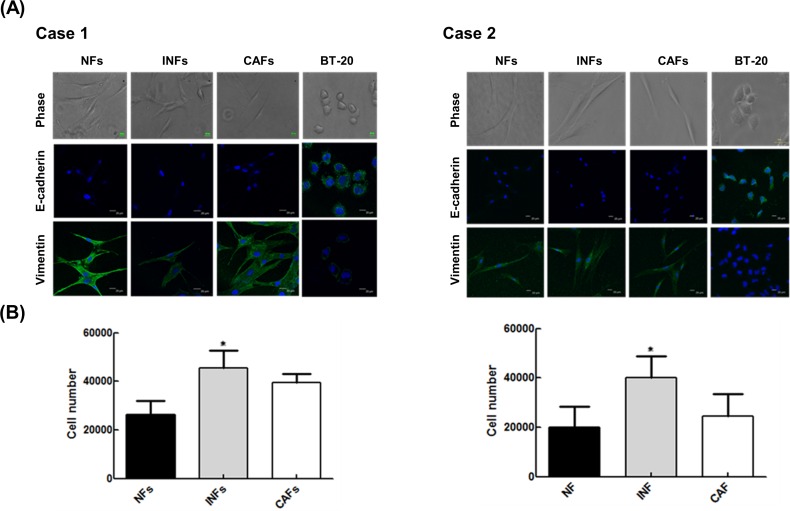
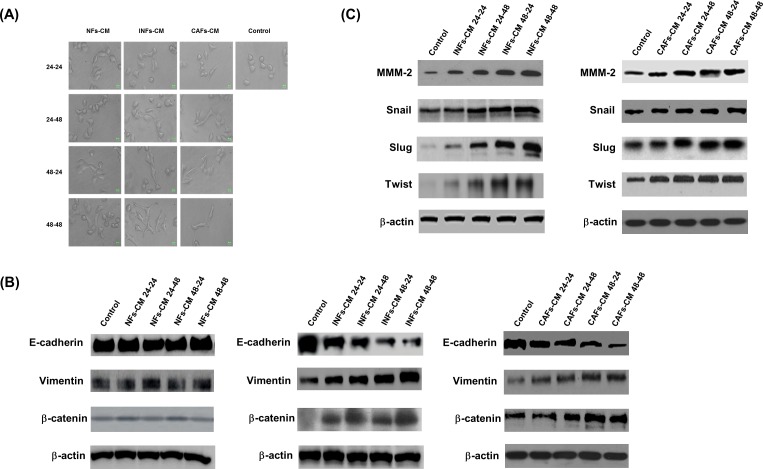
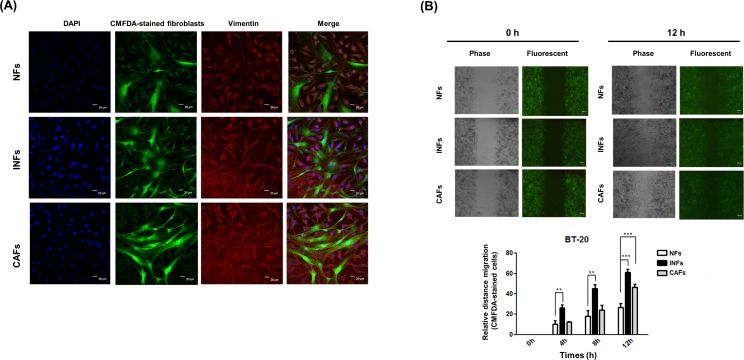
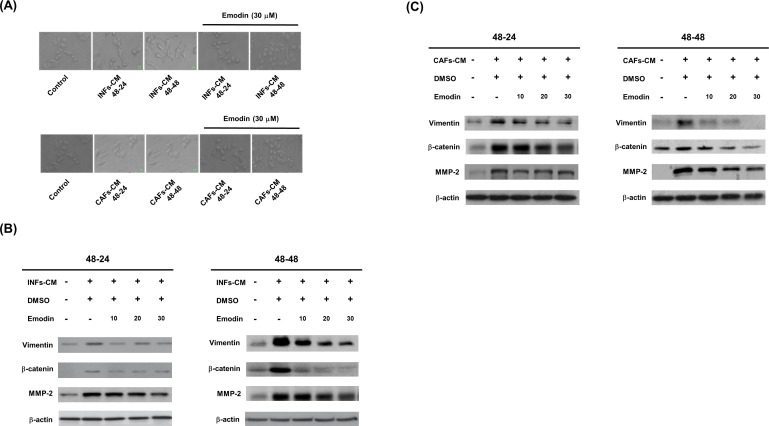
"Triple negative breast cancer" (TNBC) is associated with a higher rate and earlier time of recurrence and worse prognosis after recurrence. In this study, we aimed to examine the crosstalk between fibroblasts and TNBC cells. The fibroblasts were isolated from TNBC patients' tissue in tumor burden zones, distal normal zones and interface zones. The fibroblasts were indicated as cancer-associated fibroblasts (CAFs), normal zone fibroblasts (NFs) and interface zone fibroblasts (INFs). Our study found that INFs grew significantly faster than NFs and CAFs in vitro. The epithelial BT20 cells cultured with the conditioned medium of INFs (INFs-CM) and CAFs (CAFs-CM) showed more spindle-like shape and cell scattering than cultured with the conditioned medium of NFs (NFs-CM). These results indicated that factors secreted by INFs-CM or CAFs-CM could induce the epithelial-mesenchymal transition (EMT) phenotype in BT20 cells. Using an in vitro co-culture model, INFs or CAFs induced EMT and promoted cancer cell migration in BT20 cells. Interestingly, we found that emodin inhibited INFs-CM or CAFs-CM-induced EMT programming and phenotype in BT20 cells. Previous studies reported that CAFs and INFs-secreted TGF-β promoted human breast cancer cell proliferation, here; our results indicated that TGF-β initiated EMT in BT20 cells. Pretreatment with emodin significantly suppressed the TGF-β-induced EMT and cell migration in BT20 cells. These results suggest that emodin may be used as a novel agent for the treatment of TNBC.
“三阴性乳腺癌”(TNBC)与更高的复发率、更早的复发时间以及复发后更差的预后相关。在本研究中,我们旨在研究成纤维细胞与TNBC细胞之间的相互作用。从TNBC患者肿瘤负荷区、远端正常区和界面区的组织中分离出成纤维细胞。这些成纤维细胞分别被标记为癌相关成纤维细胞(CAFs)、正常区成纤维细胞(NFs)和界面区成纤维细胞(INFs)。我们的研究发现,INFs在体外的生长速度明显快于NFs和CAFs。用INFs条件培养基(INFs-CM)和CAFs条件培养基(CAFs-CM)培养的上皮性BT20细胞比用NFs条件培养基(NFs-CM)培养的细胞呈现出更多的纺锤样形态和细胞散射。这些结果表明,INFs-CM或CAFs-CM分泌的因子可诱导BT20细胞发生上皮-间质转化(EMT)表型。使用体外共培养模型,INFs或CAFs可诱导BT20细胞发生EMT并促进癌细胞迁移。有趣的是,我们发现大黄素可抑制INFs-CM或CAFs-CM诱导的BT20细胞EMT编程和表型。先前的研究报道,CAFs和INFs分泌的TGF-β可促进人乳腺癌细胞增殖,在此我们的结果表明,TGF-β可启动BT20细胞的EMT。大黄素预处理可显著抑制TGF-β诱导的BT20细胞EMT和细胞迁移。这些结果提示,大黄素可能作为一种新型药物用于TNBC的治疗。