Lin Huiyan, Mueller-Bardorff Miriam, Mothes-Lasch Martin, Buff Christine, Brinkmann Leonie, Miltner Wolfgang H R, Straube Thomas
Institute of Applied Psychology, Guangdong University of FinanceGuangzhou, China; Laboratory for Behavioral and Regional Finance, Guangdong University of Finance, GuangzhouGuangdong, China; Institute of Medical Psychology and Systems Neuroscience, University of MuensterMuenster, Germany.
Institute of Medical Psychology and Systems Neuroscience, University of Muenster Muenster, Germany.
Front Hum Neurosci. 2016 Dec 20;10:646. doi: 10.3389/fnhum.2016.00646. eCollection 2016.
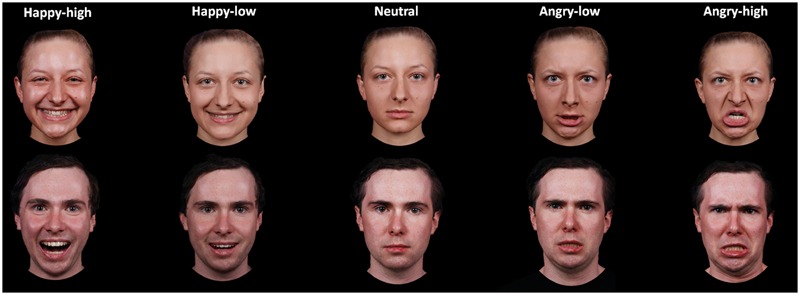
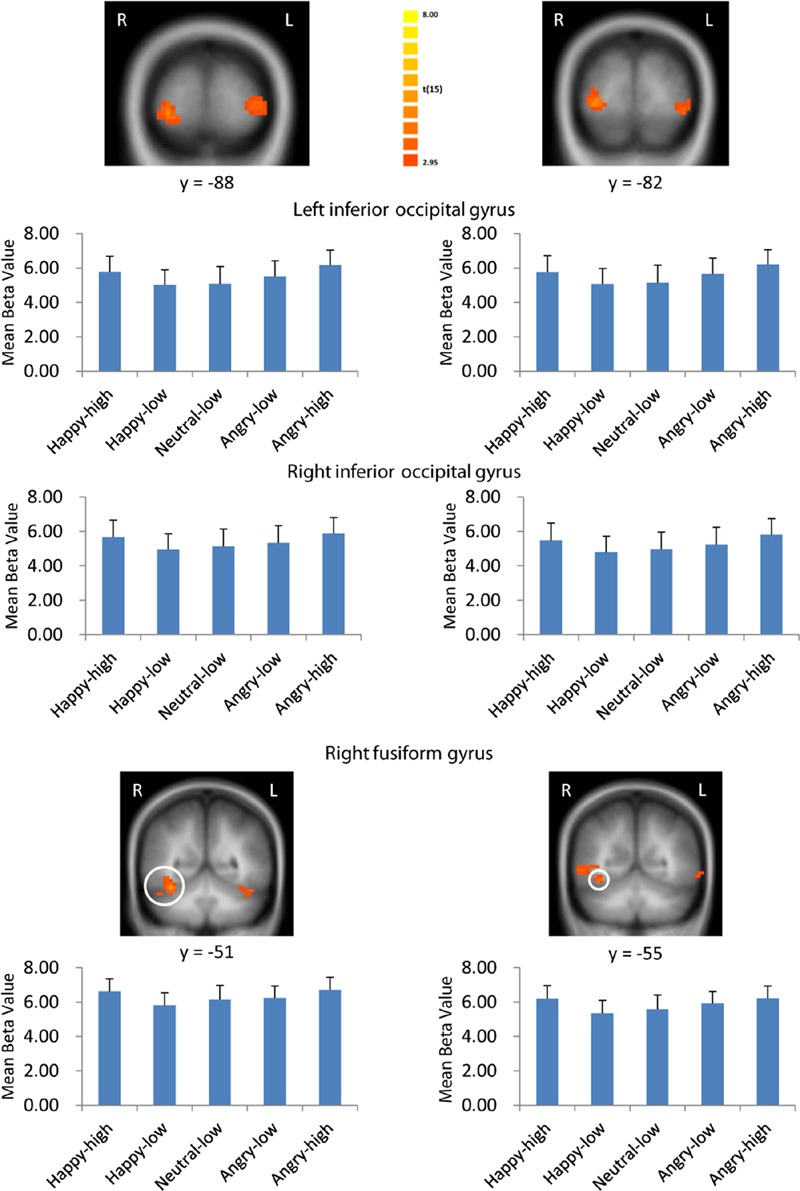
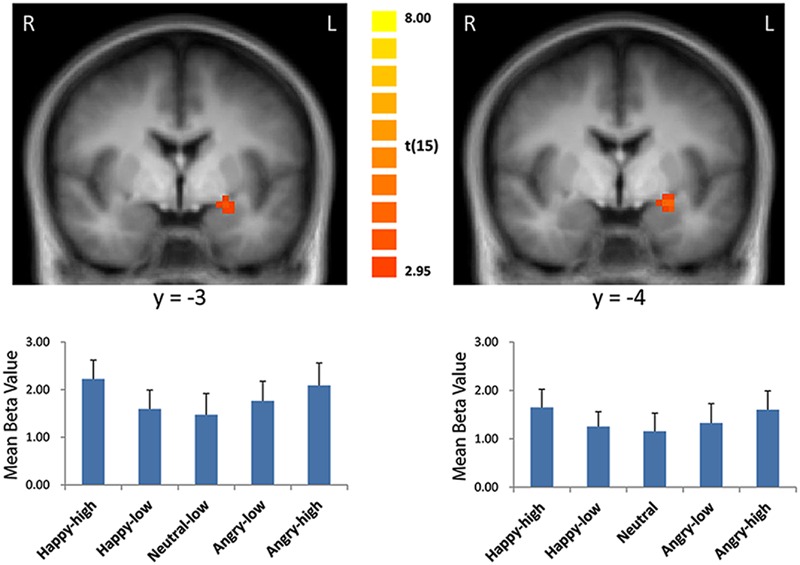
For several stimulus categories (e.g., pictures, odors, and words), the arousal of both negative and positive stimuli has been shown to modulate amygdalar activation. In contrast, previous studies did not observe similar amygdalar effects in response to negative and positive facial expressions with varying intensity of facial expressions. Reasons for this discrepancy may be related to analytical strategies, experimental design and stimuli. Therefore, the present study aimed at re-investigating whether the intensity of facial expressions modulates amygdalar activation by circumventing limitations of previous research. Event-related functional magnetic resonance imaging was used to assess brain activation while participants observed a static neutral expression and positive (happy) and negative (angry) expressions of either high or low intensity from an ecologically valid, novel stimulus set. The ratings of arousal and intensity were highly correlated. We found that amygdalar activation followed a u-shaped activation pattern with highest activation to high intense facial expressions as compared to low intensity facial expressions and to the neutral expression irrespective of valence, suggesting a critical role of the amygdala in valence-independent arousal processing of facial expressions. Additionally, consistent with previous studies, intensity effects were also found in visual areas and generally increased activation to angry versus happy faces were found in visual cortex and insula, indicating enhanced visual representations of high arousing facial expressions and increased visual and somatosensory representations of threat.
对于几种刺激类别(例如图片、气味和单词),已表明负面和正面刺激的唤起都会调节杏仁核的激活。相比之下,先前的研究并未观察到杏仁核对不同强度面部表情的负面和正面表情有类似的反应。这种差异的原因可能与分析策略、实验设计和刺激有关。因此,本研究旨在通过规避先前研究的局限性,重新调查面部表情的强度是否会调节杏仁核的激活。当参与者观察来自生态有效、新颖刺激集的静态中性表情以及高强度和低强度的正面(快乐)和负面(愤怒)表情时,使用事件相关功能磁共振成像来评估大脑激活。唤醒和强度评分高度相关。我们发现,杏仁核激活呈现出一种U形激活模式,与低强度面部表情和中性表情相比,对高强度面部表情的激活最高,无论效价如何,这表明杏仁核在面部表情的与效价无关的唤醒处理中起关键作用。此外,与先前的研究一致,在视觉区域也发现了强度效应,并且在视觉皮层和脑岛中普遍发现对愤怒面孔的激活比对快乐面孔的激活增加,这表明高唤醒面部表情的视觉表征增强,以及威胁的视觉和体感表征增加。