Quandt Fanny, Bönstrup Marlene, Schulz Robert, Timmermann Jan E, Zimerman Maximo, Nolte Guido, Hummel Friedhelm C
BrainImaging and NeuroStimulation Laboratory, Department of Neurology, University Medical Center Hamburg-Eppendorf Hamburg, Germany.
Institute of Neuroscience, Favaloro UniversityBuenos Aires, Argentina; Institute of Cognitive NeurologyBuenos Aires, Argentina.
Front Aging Neurosci. 2016 Dec 21;8:305. doi: 10.3389/fnagi.2016.00305. eCollection 2016.
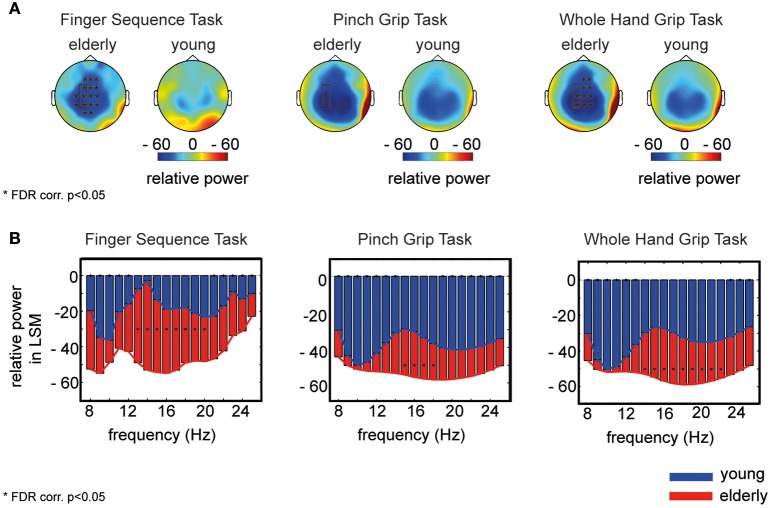
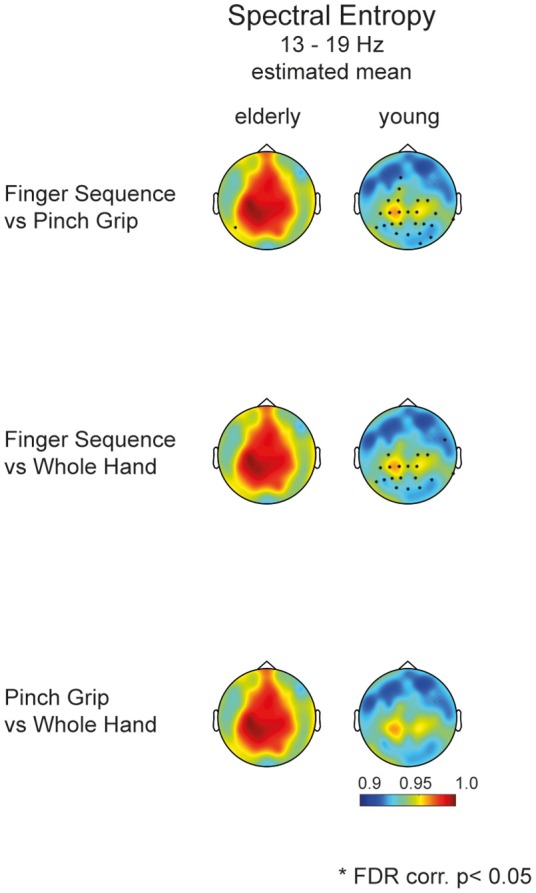
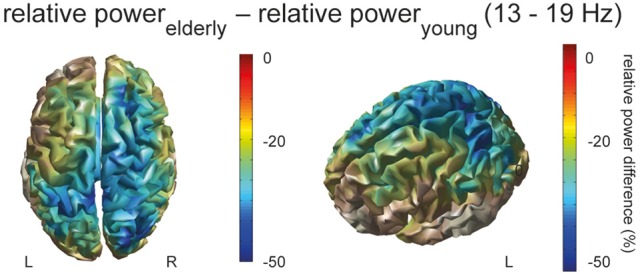
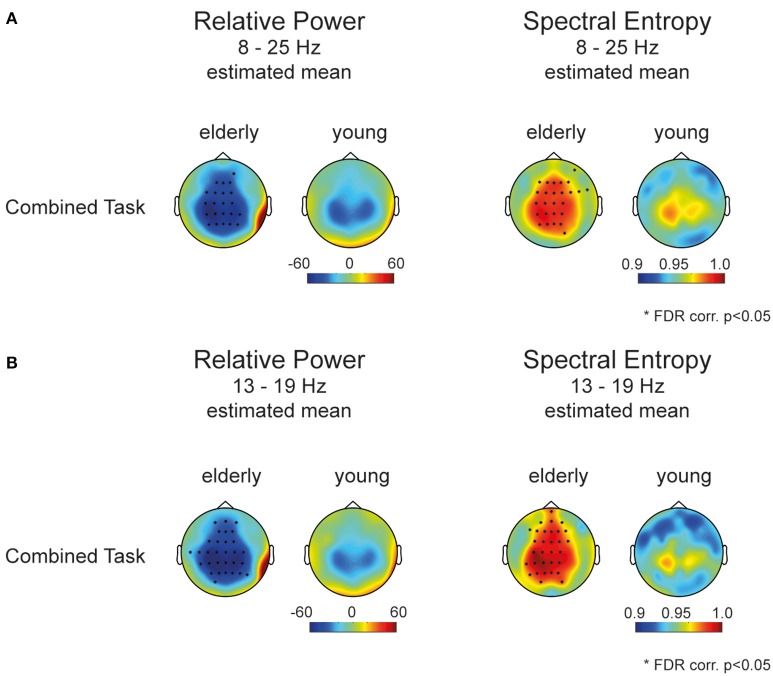
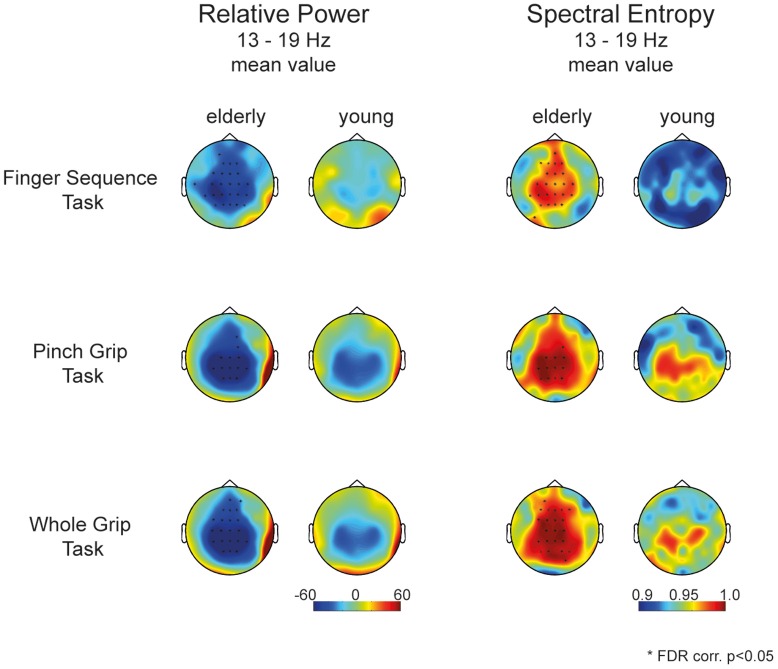
Physiological aging is paralleled by a decline of fine motor skills accompanied by structural and functional alterations of the underlying brain network. Here, we aim to investigate age-related changes in the spectral distribution of neuronal oscillations during fine skilled motor function. We employ the concept of spectral entropy in order to describe the flatness and peaked-ness of a frequency spectrum to quantify changes in the spectral distribution of the oscillatory motor response in the aged brain. Electroencephalogram was recorded in elderly ( = 32) and young ( = 34) participants who performed either a cued finger movement or a pinch or a whole hand grip task with their dominant right hand. Whereas young participant showed distinct, well-defined movement-related power decreases in the alpha and upper beta band, elderly participants exhibited a flat broadband, frequency-unspecific power desynchronization. This broadband response was reflected by an increase of spectral entropy over sensorimotor and frontal areas in the aged brain. Neuronal activation patterns differed between motor tasks in the young brain, while the aged brain showed a similar activation pattern in all tasks. Moreover, we found a wider recruitment of the cortical motor network in the aged brain. The present study adds to the understanding of age-related changes of neural coding during skilled motor behavior, revealing a less predictable signal with great variability across frequencies in a wide cortical motor network in the aged brain. The increase in entropy in the aged brain could be a reflection of random noise-like activity or could represent a compensatory mechanism that serves a functional role.
生理衰老伴随着精细运动技能的下降,同时潜在脑网络也发生结构和功能改变。在此,我们旨在研究精细熟练运动功能期间神经元振荡频谱分布的年龄相关变化。我们采用频谱熵的概念来描述频谱的平坦度和峰值度,以量化老年大脑中振荡运动反应频谱分布的变化。对32名老年参与者和34名年轻参与者进行脑电图记录,他们用优势右手执行提示手指运动、捏或全手握任务。年轻参与者在α和上β频段表现出明显的、明确的与运动相关的功率下降,而老年参与者则表现出平坦的宽带、频率非特异性功率去同步化。这种宽带反应在老年大脑的感觉运动和额叶区域表现为频谱熵增加。年轻大脑中不同运动任务的神经元激活模式不同,而老年大脑在所有任务中表现出相似的激活模式。此外,我们发现老年大脑中皮质运动网络的募集范围更广。本研究有助于理解熟练运动行为期间神经编码的年龄相关变化,揭示老年大脑中一个更不可预测的信号,其在广泛的皮质运动网络中跨频率具有很大变异性。老年大脑中熵的增加可能反映了类似随机噪声的活动,也可能代表一种具有功能作用的补偿机制。