Sheng Lili, Kovács Katalin, Winzer Klaus, Zhang Ying, Minton Nigel Peter
Clostridia Research Group, BBSRC/EPSRC Synthetic Biology Research Centre (SBRC), School of Life Sciences, University of Nottingham, University Park, Nottingham, NG7 2RD UK.
Biotechnol Biofuels. 2017 Jan 3;10:5. doi: 10.1186/s13068-016-0692-x. eCollection 2017.
The thermophile has considerable attraction as a chassis for the production of chemicals and fuels. It utilises a wide range of sugars and oligosaccharides typical of those derived from lignocellulose and grows at elevated temperatures. The latter improves the rate of feed conversion, reduces fermentation cooling costs and minimises the risks of contamination. Full exploitation of its potential has been hindered by a dearth of effective gene tools.
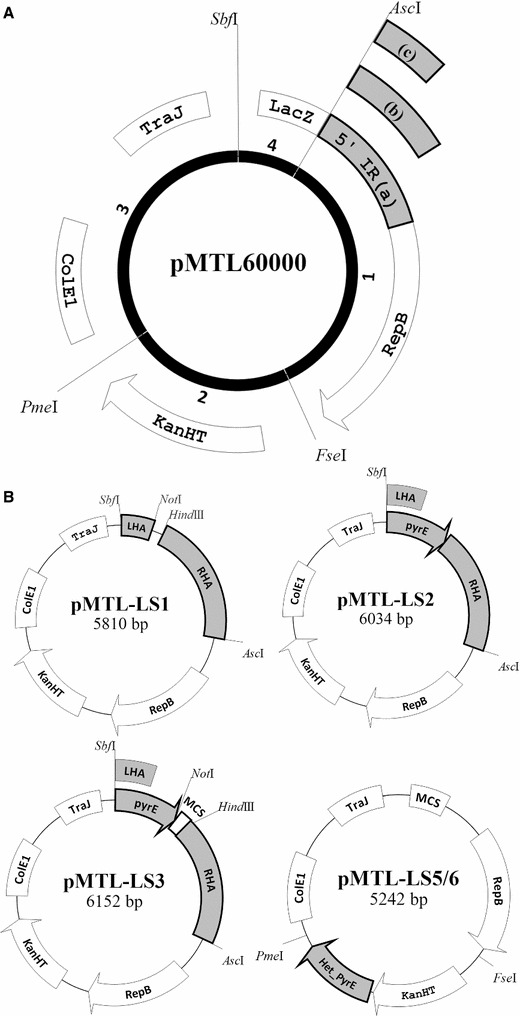
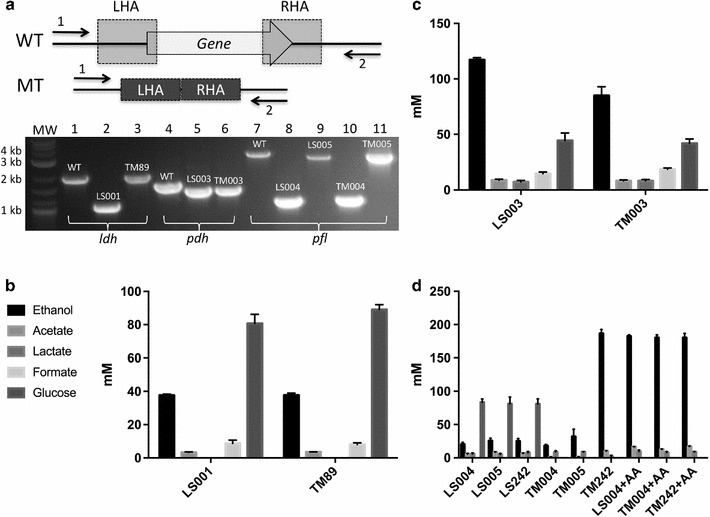
Here we designed and tested a collection of vectors (pMTL60000 series) in NCIMB 11955 equivalent to the widely used clostridial pMTL80000 modular plasmid series. By combining a temperature-sensitive replicon and a heterologous gene from as a counter-selection marker, a highly effective and rapid gene knock-out/knock-in system was established. Its use required the initial creation of uracil auxotroph through deletion of using allele-coupled exchange (ACE) and selection for resistance to 5-fluoroorotic acid. The turnaround time for the construction of further mutants in this minus strain was typically 5 days. Following the creation of the desired mutant, the allele was restored to wild type, within 3 days, using ACE and selection for uracil prototrophy. Concomitant with this process, cargo DNA () could be readily integrated at the locus. The system's utility was demonstrated through the generation in just 30 days of three independently engineered strains equivalent to a previously constructed ethanol production strain, TM242. This involved the creation of two in-frame deletions ( and ) and the replacement of a promoter region of a third gene () with an up-regulated variant. In no case did the production of ethanol match that of TM242. Genome sequencing of the parental strain, TM242, and constructed mutant derivatives suggested that NCIMB 11955 is prone to the emergence of random mutations which can dramatically affect phenotype.
The procedures and principles developed for clostridia, based on the use of alleles and ACE, may be readily deployed in . Marker-less, in-frame deletion mutants can be rapidly generated in 5 days. However, ancillary mutations frequently arise, which can influence phenotype. This observation emphasises the need for improved screening and selection procedures at each step of the engineering processes, based on the generation of multiple, independent strains and whole-genome sequencing.
嗜热菌作为生产化学品和燃料的底盘细胞具有相当大的吸引力。它能利用多种典型的源自木质纤维素的糖和寡糖,并在高温下生长。后者提高了饲料转化率,降低了发酵冷却成本,并将污染风险降至最低。有效基因工具的匮乏阻碍了对其潜力的充分开发。
在此,我们设计并测试了一系列载体(pMTL60000系列),用于与广泛使用的梭菌pMTL80000模块化质粒系列等效的NCIMB 11955。通过结合温度敏感复制子和来自[具体内容缺失]的异源基因作为反选择标记,建立了一种高效快速的基因敲除/敲入系统。其使用需要通过等位基因偶联交换(ACE)缺失[具体内容缺失]并选择对5-氟乳清酸的抗性来初步创建尿嘧啶营养缺陷型。在这个[具体内容缺失]缺失菌株中构建进一步突变体的周转时间通常为5天。在创建所需突变体后,使用ACE并选择尿嘧啶原养型,在3天内将[具体内容缺失]等位基因恢复为野生型。与此同时,货物DNA([具体内容缺失])可以很容易地整合到[具体内容缺失]位点。通过在短短30天内生成三个与先前构建的乙醇生产菌株TM242等效的独立工程菌株,证明了该系统的实用性。这涉及创建两个框内缺失([具体内容缺失]和[具体内容缺失])以及用上调变体替换第三个基因([具体内容缺失])的启动子区域。在任何情况下,乙醇产量都无法与TM242相匹配。亲本菌株TM242和构建的突变衍生物的基因组测序表明,NCIMB 11955容易出现随机突变从而显著影响表型。
基于使用[具体内容缺失]等位基因和ACE为梭菌开发的程序和原理,可能很容易应用于[具体内容缺失]。无标记的框内缺失突变体可以在5天内快速产生。然而,辅助突变经常出现,这可能会影响表型。这一观察结果强调了在工程过程的每个步骤都需要改进筛选和选择程序,基于生成多个独立菌株和全基因组测序。