Bashir Zeenat, Sheng Lili, Anil Annamma, Lali Arvind, Minton Nigel P, Zhang Ying
1Clostridia Research Group, BBSRC/EPSRC Synthetic Biology Research Centre (SBRC), School of Life Sciences, University of Nottingham, University Park, Nottingham, NG7 2RD UK.
2DBT-ICT Centre for Energy Biosciences, Institute of Chemical Technology, Nathalal Parikh Marg, Mumbai, 400019 India.
Biotechnol Biofuels. 2019 Aug 20;12:199. doi: 10.1186/s13068-019-1540-6. eCollection 2019.
A consolidated bioprocessing (CBP), where lignocellulose is converted into the desired product(s) in a single fermentative step without the addition of expensive degradative enzymes, represents the ideal solution of renewable routes to chemicals and fuels. Members of the genus are able to grow at elevated temperatures and are able to utilise a wide range of oligosaccharides derived from lignocellulose. This makes them ideally suited to the development of CBP.
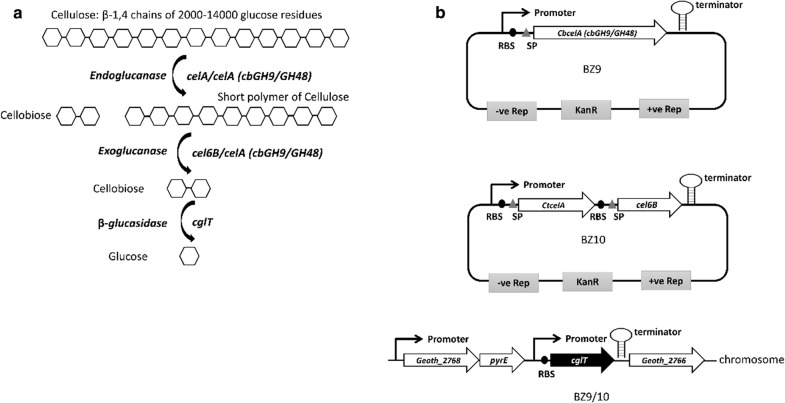
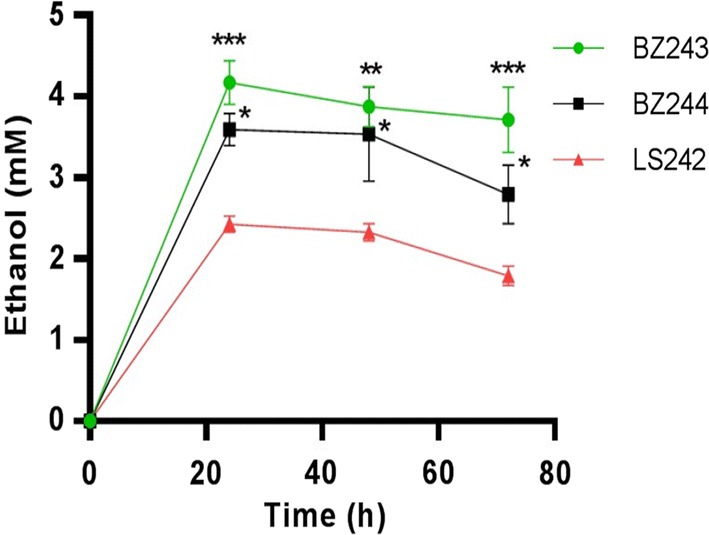
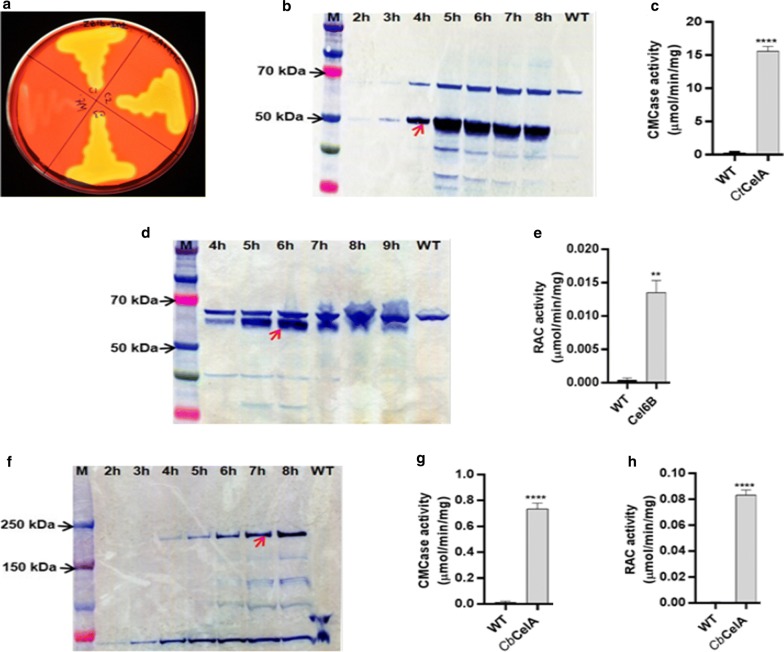
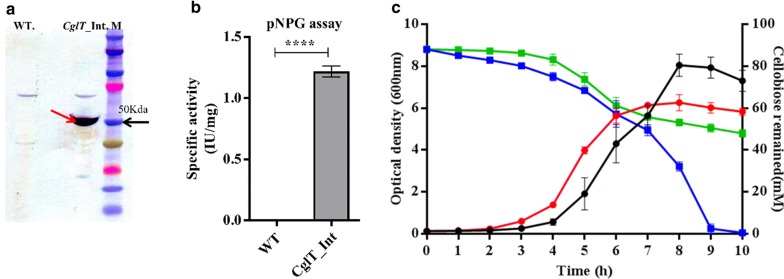
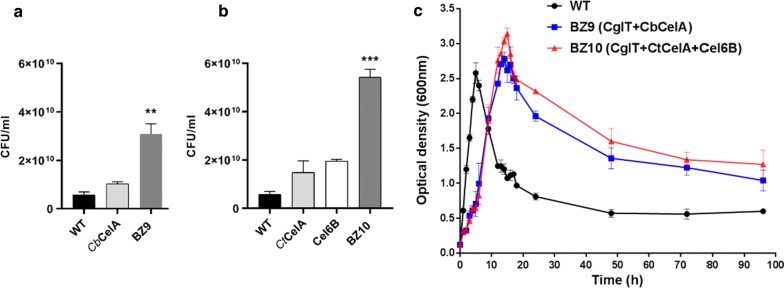
In this study, we engineered NCIMB 11955 to utilise lignocellulosic biomass, in the form of nitric acid/ammonia treated wheat straw to which expensive hydrolytic enzymes had not been added. Two different strains, BZ9 and BZ10, were generated by integrating the (β-1,4-glucosidase) gene from into the genome, and localising genes encoding different cellulolytic enzymes on autonomous plasmids. The plasmid of strain BZ10 carried a synthetic cellulosomal operon comprising the (Endoglucanase A) gene from and (Exoglucanase) from ; whereas, strain BZ9 contained a plasmid encoding the (multidomain cellulase) gene from . All of the genes were successfully expressed, and their encoded products secreted in a functionally active form, as evidenced by their detection in culture supernatants by Western blotting and enzymatic assay. In the case of the CelA enzyme, this is one of the first times that the heterologous production of this multi-functional enzyme has been achieved in a heterologous host. Both strains (BZ9 and BZ10) exhibited improved growth on pre-treated wheat straw, achieving a higher final OD600 and producing greater numbers of viable cells. To demonstrate that cellulosic ethanol can be produced directly from lignocellulosic biomass by a single organism, we established our consortium of hydrolytic enzymes in a previously engineered ethanologenic strain, LS242. We observed approximately twofold and 1.6-fold increase in ethanol production in the recombinant equivalent to BZ9 and BZ10, respectively, compared to LS242 strain at 24 h of growth.
We engineered to utilise a real-world lignocellulosic biomass substrate and demonstrated that cellulosic ethanol can be produced directly from lignocellulosic biomass in one step. Direct conversion of biomass into desired products represents a new paradigm for CBP, offering the potential for carbon neutral, cost-effective production of sustainable chemicals and fuels.
整合生物加工(CBP)是指在不添加昂贵降解酶的单一发酵步骤中将木质纤维素转化为所需产物,它是可再生的化学品和燃料生产途径的理想解决方案。 属的成员能够在高温下生长,并能够利用多种源自木质纤维素的寡糖。这使其非常适合用于开发CBP。
在本研究中,我们对嗜热栖热放线菌NCIMB 11955进行了工程改造,使其能够利用硝酸/氨处理过的小麦秸秆形式的木质纤维素生物质,且未添加昂贵的水解酶。通过将来自嗜热栖热放线菌的bglA(β-1,4-葡糖苷酶)基因整合到基因组中,并将编码不同纤维素分解酶的基因定位在自主质粒上,产生了两种不同的菌株BZ9和BZ10。菌株BZ10的质粒携带一个合成的纤维小体操纵子,该操纵子包含来自嗜热栖热放线菌的celA(内切葡聚糖酶A)基因和来自嗜热栖热放线菌的exgS(外切葡聚糖酶);而菌株BZ9含有一个编码来自嗜热栖热放线菌的cel6A(多结构域纤维素酶)基因的质粒。所有基因均成功表达,其编码产物以功能活性形式分泌,这通过蛋白质免疫印迹和酶活性测定在培养上清液中检测到得以证明。就CelA酶而言,这是该多功能酶首次在异源宿主中实现异源生产。两种菌株(BZ9和BZ10)在预处理的小麦秸秆上均表现出更好的生长,最终OD600更高,且产生的活细胞数量更多。为了证明纤维素乙醇可以由单一生物体直接从木质纤维素生物质中产生,我们在先前工程改造的产乙醇嗜热栖热放线菌菌株LS242中建立了水解酶联合体。我们观察到,与LS242菌株在生长24小时时相比,重组嗜热栖热放线菌中相当于BZ9和BZ10的菌株的乙醇产量分别增加了约两倍和1.6倍。
我们对嗜热栖热放线菌进行了工程改造,使其能够利用实际的木质纤维素生物质底物,并证明了纤维素乙醇可以一步直接从木质纤维素生物质中产生。将生物质直接转化为所需产物代表了CBP的一种新范例,为碳中和、具有成本效益的可持续化学品和燃料生产提供了潜力。