Jiang Zhongliang, Xia Bingzhao, McBride Ralph, Oakey John
Department of Chemical Engineering, University of Wyoming, Laramie, WY 82071.
J Mater Chem B. 2017 Jan 7;5(1):173-180. doi: 10.1039/C6TB02551J. Epub 2016 Nov 25.
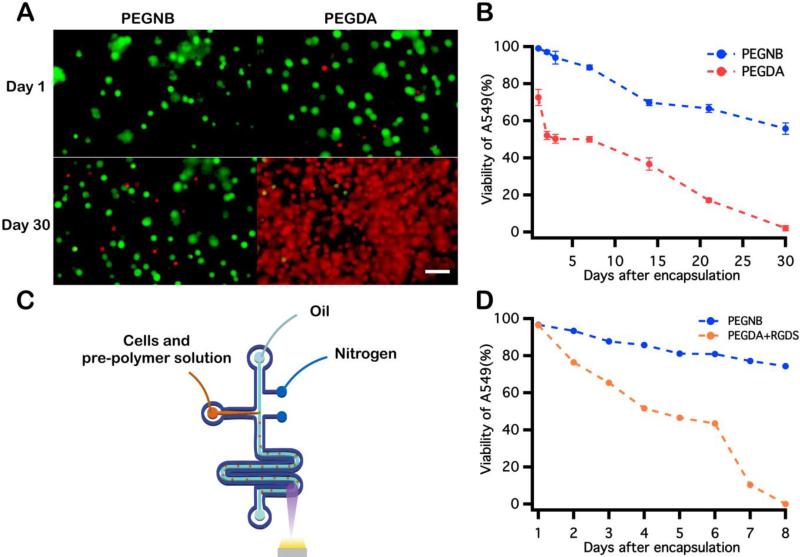
Cell encapsulation within photopolymerized polyethylene glycol (PEG)-based hydrogel scaffolds has been demonstrated as a robust strategy for cell delivery, tissue engineering, regenerative medicine, and developing in vitro platforms to study cellular behavior and fate. Strategies to achieve spatial and temporal control over PEG hydrogel mechanical properties, chemical functionalization, and cytocompatibility have advanced considerably in recent years. Recent microfluidic technologies have enabled the miniaturization of PEG hydrogels, thus enabling the fabrication of miniaturized cell-laden vehicles. However, rapid oxygen diffusive transport times on the microscale dramatically inhibit chain growth photopolymerization of polyethylene glycol diacrylate (PEGDA), thus decreasing the viability of cells encapsulated within these microstructures. Another promising PEG-based scaffold material, PEG norbornene (PEGNB), is formed by a step-growth photopolymerization and is not inhibited by oxygen. PEGNB has also been shown to be more cytocompatible than PEGDA and allows for orthogonal addition reactions. The step-growth kinetics, however, are slow and therefore challenging to fully polymerize within droplets flowing through microfluidic devices. Here, we describe a microfluidic-based droplet fabrication platform that generates consistently monodisperse cell-laden water-in-oil emulsions. Microfluidically generated PEGNB droplets are collected and photopolymerized under UV exposure in bulk emulsions. In this work, we compare this microfluidic-based cell encapsulation platform with a vortex-based method on the basis of microgel size, uniformity, post-encapsulation cell viability and long-term cell viability. Several factors that influence post-encapsulation cell viability were identified. Finally, long-term cell viability achieved by this platform was compared to a similar cell encapsulation platform using PEGDA. We show that this PEGNB microencapsulation platform is capable of generating cell-laden hydrogel microspheres at high rates with well-controlled size distributions and high long-term cell viability.
将细胞包裹于光聚合的聚乙二醇(PEG)基水凝胶支架中,已被证明是一种用于细胞递送、组织工程、再生医学以及开发体外平台以研究细胞行为和命运的有效策略。近年来,实现对PEG水凝胶机械性能、化学功能化和细胞相容性的时空控制的策略有了显著进展。最近的微流控技术实现了PEG水凝胶的小型化,从而能够制造小型化的载细胞载体。然而,微尺度上快速的氧扩散传输时间极大地抑制了聚乙二醇二丙烯酸酯(PEGDA)的链增长光聚合反应,从而降低了包裹在这些微结构中的细胞的活力。另一种有前景的基于PEG的支架材料,降冰片烯聚乙二醇(PEGNB),是通过逐步增长光聚合反应形成的,不受氧的抑制。PEGNB也已被证明比PEGDA具有更好的细胞相容性,并允许进行正交加成反应。然而,逐步增长动力学较慢,因此在流经微流控装置的液滴内完全聚合具有挑战性。在此,我们描述了一种基于微流控的液滴制造平台,该平台可生成始终单分散的载细胞水包油乳液。微流控产生的PEGNB液滴被收集并在紫外光照射下在本体乳液中进行光聚合。在这项工作中,我们基于微凝胶大小、均匀性、包裹后细胞活力和长期细胞活力,将这种基于微流控的细胞包裹平台与基于涡旋的方法进行了比较。确定了几个影响包裹后细胞活力的因素。最后,将该平台实现的长期细胞活力与使用PEGDA的类似细胞包裹平台进行了比较。我们表明,这个PEGNB微包裹平台能够以高速率生成具有良好控制的尺寸分布和高长期细胞活力的载细胞水凝胶微球。