Guan Ming
Family Issues Center at Xuchang University, School of Business, Xuchang University, Road Bayi 88, Xuchang, Henan China.
Int J Ment Health Syst. 2017 Jan 6;11:10. doi: 10.1186/s13033-016-0118-y. eCollection 2017.
Since 1978, rural-urban migrants mainly contribute Chinese urbanization. The purpose of this paper is to examine the effects of socioeconomic factors on mental health of them. Their mental health was measured by 12-item general health questionnaire (GHQ-12).
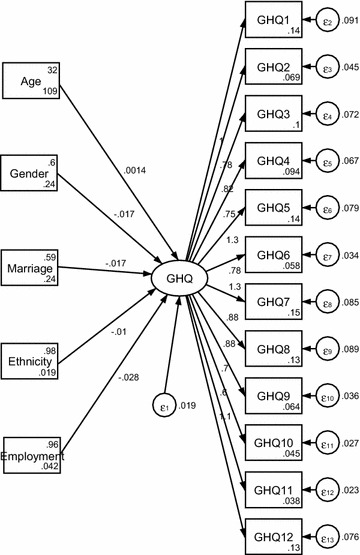
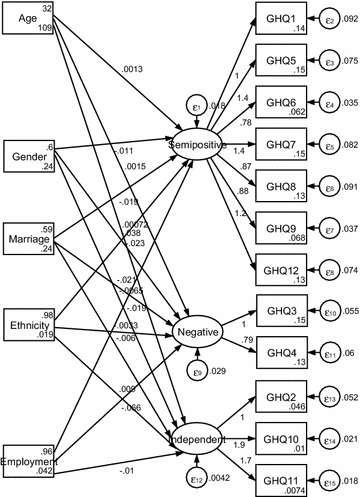
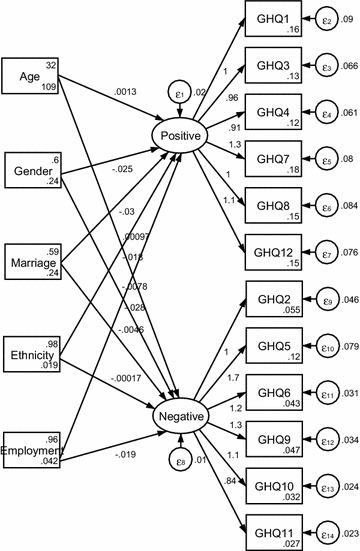
The study sample comprised 5925 migrants obtained from the 2009 rural-to-urban migrants survey (RUMiC). The relationships among the instruments were assessed by the correlation analysis. The one-factor (overall items), two-factor (positive vs. negative items), and model conducted by principal component analysis were tested in the confirmatory factor analysis (CFA). On the basis of three CFA models, the three multiple indicators multiple causes (MIMIC) models with age, gender, marriage, ethnicity, and employment were constructed to investigate the concurrent associations between socioeconomic factors and GHQ-12.
Of the sample, only 1.94% were of ethnic origin and mean age was 31.63 (SD = ±10.43) years. The one-factor, two-factor, and three-factor structure (i.e. semi-positive/negative/independent usefulness) had good model fits in the CFA analysis and gave order (i.e. 2 factor>3 factor>1 factor), which suggests that the three models can be used to assess psychological symptoms of migrants in urban China. All MIMIC models had acceptable fit and gave order (i.e. one-dimensional model>two-dimensional model>three-dimensional model).
There were weak associations of socioeconomic factors with mental health among migrants in urban China. Policy discussion suggested that improvement of socioeconomic status of rural-urban migrants and mental health systems in urban China should be highlighted and strengthened.
自1978年以来,农村到城市的移民是中国城市化的主要推动力量。本文旨在研究社会经济因素对他们心理健康的影响。他们的心理健康状况通过12项一般健康问卷(GHQ - 12)进行测量。
研究样本包括从2009年农村到城市移民调查(RUMiC)中获取的5925名移民。通过相关性分析评估各工具之间的关系。在验证性因素分析(CFA)中测试了单因素(所有项目)、双因素(正向与负向项目)以及通过主成分分析得出的模型。基于这三个CFA模型,构建了包含年龄、性别、婚姻、民族和就业情况的三个多指标多原因(MIMIC)模型,以研究社会经济因素与GHQ - 12之间的并发关联。
在样本中,只有1.94%为少数民族,平均年龄为31.63岁(标准差=±10.43)。单因素、双因素和三因素结构(即半正向/负向/独立效用)在CFA分析中具有良好的模型拟合度,并给出了顺序(即双因素>三因素>单因素),这表明这三个模型可用于评估中国城市移民的心理症状。所有MIMIC模型都具有可接受的拟合度,并给出了顺序(即一维模型>二维模型>三维模型)。
在中国城市移民中,社会经济因素与心理健康之间的关联较弱。政策讨论表明,应突出并加强改善农村到城市移民的社会经济地位以及中国城市的心理健康体系。