Meule Adrian, Platte Petra
Department of Psychology, University of Salzburg, Austria; Center for Cognitive Neuroscience, University of Salzburg, Austria.
Institute of Psychology, University of Würzburg, Germany.
Health Psychol Open. 2016 May 19;3(1):2055102916649585. doi: 10.1177/2055102916649585. eCollection 2016 Jan.
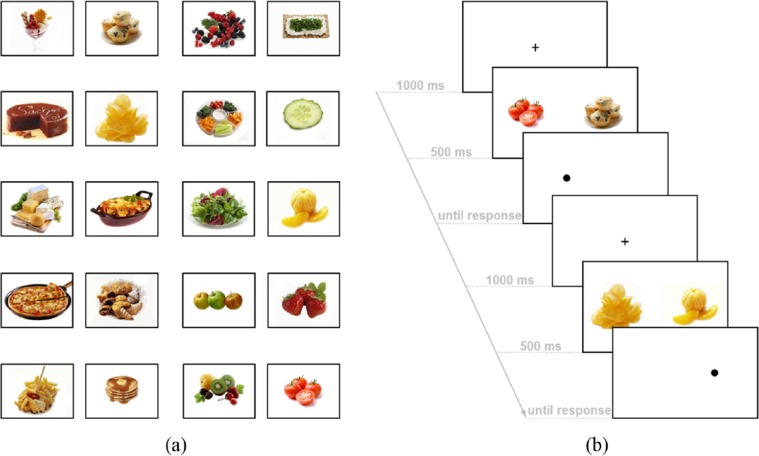
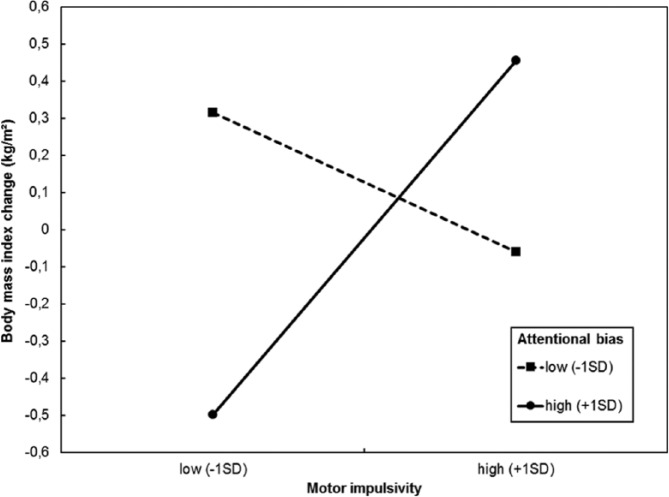
Strong bottom-up impulses and weak top-down control may interactively lead to overeating and, consequently, weight gain. In the present study, female university freshmen were tested at the start of the first semester and again at the start of the second semester. Attentional bias toward high- or low-calorie food-cues was assessed using a dot-probe paradigm and participants completed the . Attentional bias and motor impulsivity interactively predicted change in body mass index: motor impulsivity positively predicted weight gain only when participants showed an attentional bias toward high-calorie food-cues. Attentional and non-planning impulsivity were unrelated to weight change. Results support findings showing that weight gain is prospectively predicted by a combination of weak top-down control (i.e. high impulsivity) and strong bottom-up impulses (i.e. high automatic motivational drive toward high-calorie food stimuli). They also highlight the fact that only specific aspects of impulsivity are relevant in eating and weight regulation.
强烈的自下而上冲动和薄弱的自上而下控制可能相互作用导致暴饮暴食,进而导致体重增加。在本研究中,对大学新生女性在第一学期开始时进行了测试,并在第二学期开始时再次进行测试。使用点探测范式评估对高热量或低热量食物线索的注意偏向,参与者完成了……注意偏向和运动冲动性交互预测体重指数的变化:只有当参与者对高热量食物线索表现出注意偏向时,运动冲动性才正向预测体重增加。注意冲动性和非计划性冲动性与体重变化无关。结果支持了以下研究结果,即体重增加可由薄弱的自上而下控制(即高冲动性)和强烈的自下而上冲动(即对高热量食物刺激的高自动动机驱动)共同前瞻性预测。它们还突出了这样一个事实,即只有冲动性的特定方面与饮食和体重调节相关。