Asada Mariko, Morioka Tomoaki, Yamazaki Yuko, Kakutani Yoshinori, Kawarabayashi Reina, Motoyama Koka, Mori Katsuhito, Fukumoto Shinya, Shioi Atsushi, Shoji Tetsuo, Emoto Masanori, Inaba Masaaki
Department of Metabolism, Endocrinology and Molecular Medicine, Osaka City University Graduate School of Medicine, 1-4-3, Asahi-machi, Abeno-ku, Osaka 545-8585, Japan.
Department of Premier Preventive Medicine, Osaka City University Graduate School of Medicine, 1-4-3, Asahi-machi, Abeno-ku, Osaka 545-8585, Japan.
J Diabetes Res. 2016;2016:8624313. doi: 10.1155/2016/8624313. Epub 2016 Dec 14.
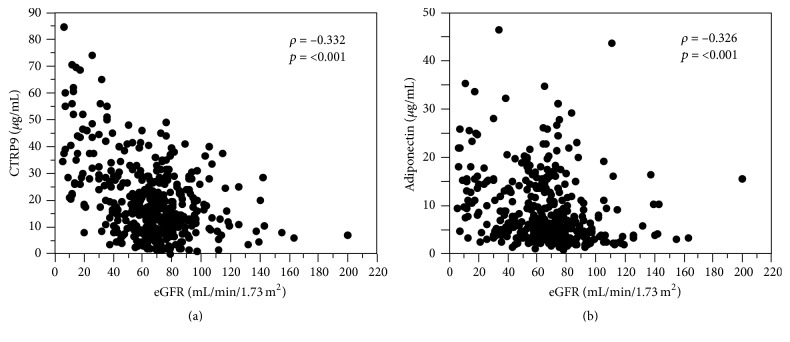
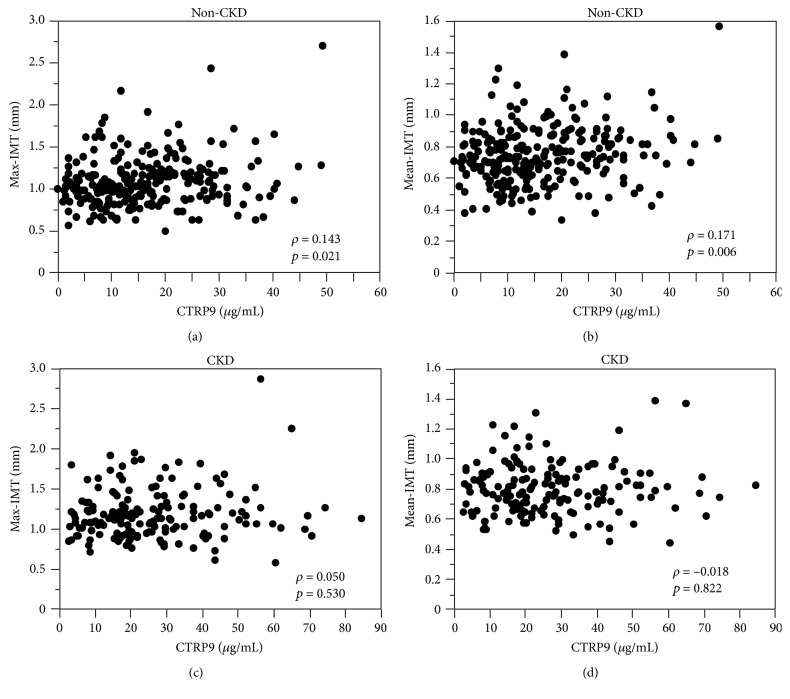
C1q/tumor necrosis factor-related protein-9 (CTRP9), a paralog of adiponectin, is expressed in adipose tissue. CTRP9 exerts protective effects against obesity and atherosclerosis in rodents. We investigated the association between plasma CTRP9 levels and atherosclerosis in patients with type 2 diabetes. We included 419 patients with type 2 diabetes, 161 of whom had chronic kidney disease (CKD). Fasting plasma CTRP9 and total adiponectin levels were measured with enzyme-linked immunosorbent assay. The intima-media thickness (IMT) of the common carotid artery was measured with ultrasonography. . Plasma CTRP9 levels were higher in the CKD group than in the non-CKD group. Plasma CTRP9 levels were positively correlated with carotid IMT in the non-CKD group. Multivariate analyses revealed that plasma CTRP9 levels were positively associated with carotid IMT in the non-CKD group, independent of age, sex, body mass index, adiponectin, and other cardiovascular risk factors. However, plasma CTRP9 levels were not associated with carotid IMT in the CKD group. Plasma CTRP9 levels are associated with atherosclerosis in diabetic patients without CKD, independently of obesity, adiponectin, and traditional cardiovascular risk factors. This study indicates a potential role of CTRP9 in atherosclerosis progression in human type 2 diabetes.
C1q/肿瘤坏死因子相关蛋白9(CTRP9)是脂联素的旁系同源物,在脂肪组织中表达。CTRP9对啮齿动物的肥胖和动脉粥样硬化具有保护作用。我们研究了2型糖尿病患者血浆CTRP9水平与动脉粥样硬化之间的关联。我们纳入了419例2型糖尿病患者,其中161例患有慢性肾脏病(CKD)。采用酶联免疫吸附测定法测量空腹血浆CTRP9和总脂联素水平。用超声测量颈总动脉的内膜中层厚度(IMT)。CKD组的血浆CTRP9水平高于非CKD组。在非CKD组中,血浆CTRP9水平与颈动脉IMT呈正相关。多变量分析显示,在非CKD组中,血浆CTRP9水平与颈动脉IMT呈正相关,独立于年龄、性别、体重指数、脂联素和其他心血管危险因素。然而,在CKD组中,血浆CTRP9水平与颈动脉IMT无关。在无CKD的糖尿病患者中,血浆CTRP9水平与动脉粥样硬化相关,独立于肥胖、脂联素和传统心血管危险因素。这项研究表明CTRP9在人类2型糖尿病动脉粥样硬化进展中具有潜在作用。