Roczniak Wojciech, Brodziak-Dopierała Barbara, Cipora Elżbieta, Jakóbik-Kolon Agata, Kluczka Joanna, Babuśka-Roczniak Magdalena
Medical Institute, The Jan Grodek Higher Vocational State School, 21 Mickiewicza Str. 38-500, Sanok, Poland.
School of Pharmacy with the Division of Laboratory Medicine, Department of Toxicology, Medical University of Silesia, 4 Jagiellonska Str. 41-200, Sosnowiec, Poland.
Biol Trace Elem Res. 2017 Aug;178(2):201-209. doi: 10.1007/s12011-016-0927-5. Epub 2017 Jan 9.
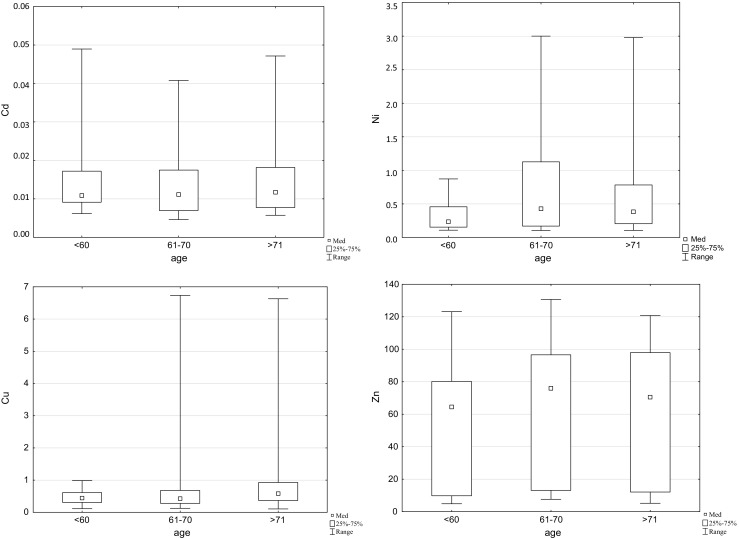
Osteoarthritis causes the degradation of the articular cartilage and periarticular bones. Trace elements influence the growth, development and condition of the bone tissue. Changes to the mineral composition of the bone tissue can cause degenerative changes and fractures. The aim of the research was to determine the content of cadmium (Cd), nickel (Ni), copper (Cu) and zinc (Zn) in the tibia, the femur and the meniscus in men and women who underwent a knee replacement surgery. Samples were collected from 50 patients, including 36 women and 14 men. The determination of trace elements content were performed by ICP-AES method, using Varian 710-ES. Average concentration in the tissues of the knee joint teeth amounted for cadmium 0.015, nickel 0.60, copper 0.89 and zinc 80.81 mg/kg wet weight. There were statistically significant differences in the content of cadmium, copper and zinc in different parts of the knee joint. There were no statistically significant differences in the content of cadmium, nickel, copper and zinc in women and men in the examined parts of the knee joint. Among the elements tested, copper and nickel showed a high content in the connective tissue (the meniscus) compared to the bone tissue (the tibia and the femur).
骨关节炎会导致关节软骨和关节周围骨骼的退化。微量元素会影响骨组织的生长、发育和状况。骨组织矿物质成分的变化会导致退行性改变和骨折。本研究的目的是测定接受膝关节置换手术的男性和女性胫骨、股骨和半月板中镉(Cd)、镍(Ni)、铜(Cu)和锌(Zn)的含量。从50名患者身上采集样本,其中包括36名女性和14名男性。使用瓦里安710-ES型电感耦合等离子体发射光谱法(ICP-AES)测定微量元素含量。膝关节组织中镉的平均浓度为0.015、镍为0.60、铜为0.89、锌为80.81毫克/千克湿重。膝关节不同部位镉、铜和锌的含量存在统计学显著差异。在所检查的膝关节部位,女性和男性镉、镍、铜和锌的含量没有统计学显著差异。在所测试的元素中,与骨组织(胫骨和股骨)相比,结缔组织(半月板)中的铜和镍含量较高。