Andersen Lars L, Persson Roger, Jakobsen Markus D, Sundstrup Emil
National Research Centre for the Working Environment, Copenhagen, Denmark Department of Psychology Department of Laboratory Medicine, Division of Occupational and Environmental Medicine, Lund University, Lund, Sweden Physical Activity and Human Performance Group, SMI, Department of Health Science and Technology, Aalborg University, Aalborg, Denmark.
Medicine (Baltimore). 2017 Jan;96(1):e5709. doi: 10.1097/MD.0000000000005709.
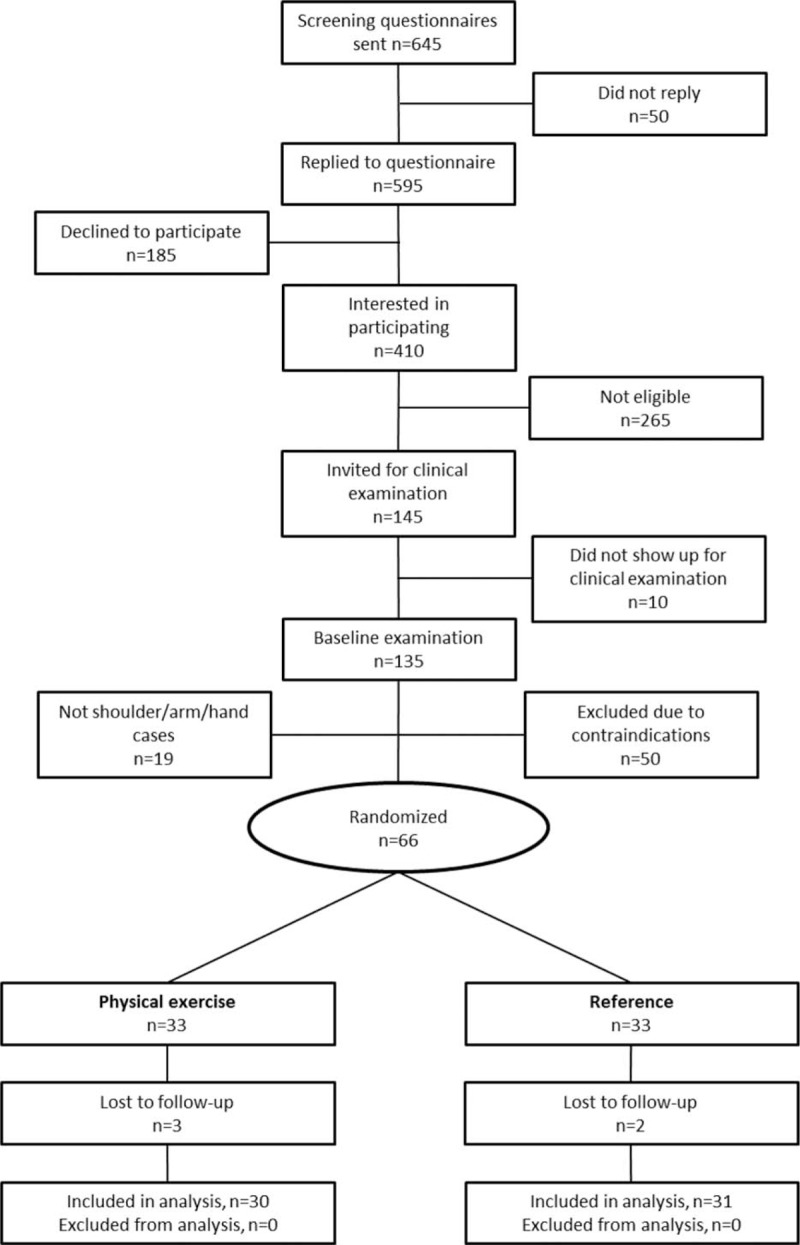
While workplace physical exercise can help manage musculoskeletal disorders, less is known about psychosocial effects of such interventions. This aim of this study was to investigate the effect of workplace physical exercise on psychosocial factors among workers with chronic musculoskeletal pain.The trial design was a 2-armed parallel-group randomized controlled trial with allocation concealment. A total of 66 slaughterhouse workers (51 men and 15 women, mean age 45 years [standard deviation (SD) 10]) with upper limb chronic musculoskeletal pain were randomly allocated to group-based strength training (physical exercise group) or individual ergonomic training and education (reference group) for 10 weeks. Social climate was assessed with the General Nordic Questionnaire for Psychological and Social Factors at Work, and vitality and mental health were assessed with the 36-item Short Form Health Survey. All scales were converted to 0 to 100 (higher scores are better). Between-group differences from baseline to follow-up were determined using linear mixed models adjusted for workplace, age, gender, and baseline values of the outcome.Mean baseline scores of social climate, mental health, and vitality were 52.2 (SD 14.9), 79.5 (SD 13.7), and 53.9 (SD 19.7), respectively. Complete baseline and follow-up data were obtained from 30 and 31 from the physical exercise and reference groups, respectively. The between-group differences from baseline to follow-up between physical exercise and reference were 7.6 (95% CI 0.3 to 14.9), -2.3 (95% CI -10.3 to 5.8), and 10.1 (95% CI 0.6 to 19.5) for social climate, mental health, and vitality, respectively. For social climate and vitality, this corresponded to moderate effect sizes (Cohen d = 0.51 for both) in favor of physical exercise. There were no reported adverse events.In conclusion, workplace physical exercise performed together with colleagues improves social climate and vitality among workers with chronic musculoskeletal pain. Mental health remained unchanged.
虽然职场体育锻炼有助于管理肌肉骨骼疾病,但对于此类干预措施的心理社会影响却知之甚少。本研究的目的是调查职场体育锻炼对患有慢性肌肉骨骼疼痛的工人心理社会因素的影响。试验设计为双臂平行组随机对照试验,并采用了分配隐藏。共有66名患有上肢慢性肌肉骨骼疼痛的屠宰场工人(51名男性和15名女性,平均年龄45岁[标准差(SD)10])被随机分配到基于小组的力量训练(体育锻炼组)或个体工效学培训与教育(参照组),为期10周。使用《北欧工作心理和社会因素通用问卷》评估社会氛围,使用36项简短健康调查问卷评估活力和心理健康。所有量表均转换为0至100分(分数越高越好)。使用针对工作场所、年龄、性别和结果基线值进行调整的线性混合模型确定从基线到随访的组间差异。社会氛围、心理健康和活力的平均基线分数分别为52.2(SD 14.9)、79.5(SD 13.7)和53.9(SD 19.7)。分别从体育锻炼组的30名和参照组的31名参与者那里获得了完整的基线和随访数据。体育锻炼组与参照组从基线到随访的组间差异,社会氛围为7.6(95%CI 0.3至14.9),心理健康为-2.3(95%CI -10.3至5.8),活力为10.1(95%CI 0.6至19.5)。对于社会氛围和活力,这相当于有利于体育锻炼的中等效应量(两者的Cohen d均为0.51)。未报告不良事件。总之,与同事一起进行的职场体育锻炼可改善患有慢性肌肉骨骼疼痛的工人的社会氛围和活力。心理健康保持不变。