Czernik Marta, Toschi Paola, Zacchini Federica, Iuso Domenico, Ptak Grażyna Ewa
Faculty of Veterinary Medicine, Experimental Embryology, University of Teramo, Teramo, Italy.
Institute of Genetics and Animal Breeding, Polish Academy of Sciences, Jastrzebiec, Poland.
PLoS One. 2017 Jan 11;12(1):e0169579. doi: 10.1371/journal.pone.0169579. eCollection 2017.
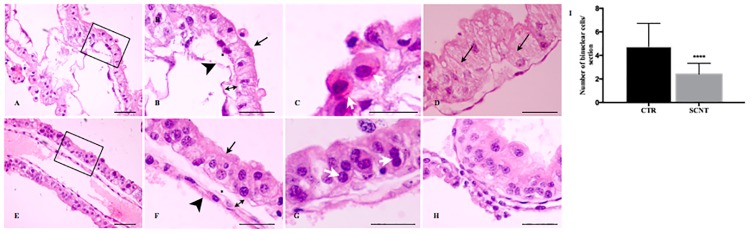
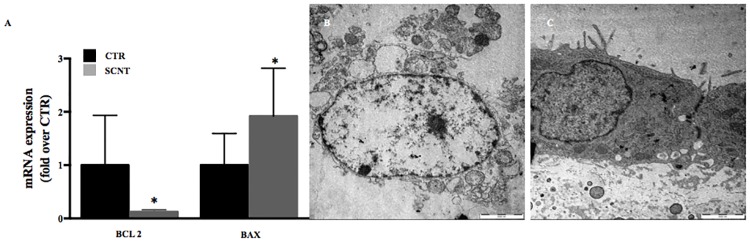
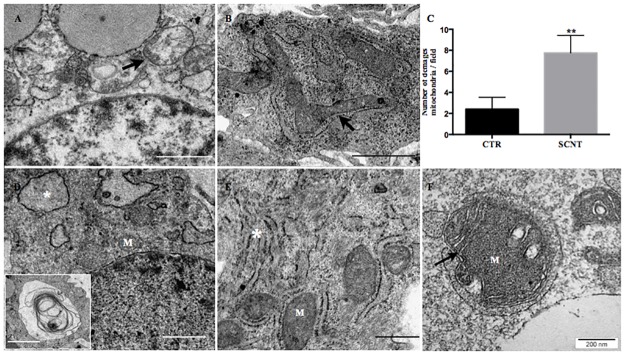
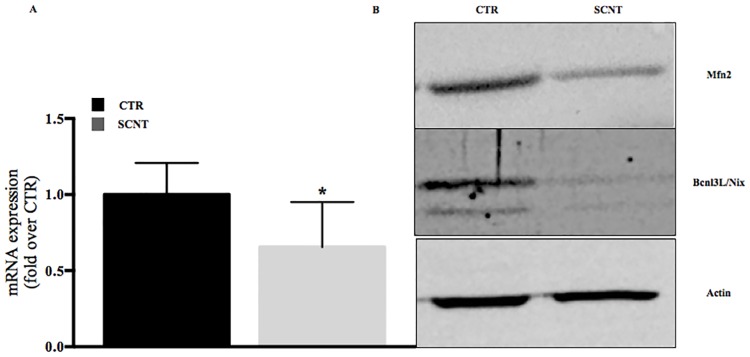
In various animal species, the main cause of pregnancy loss in conceptuses obtained by somatic cell nuclear transfer (SCNT) are placental abnormalities. Most abnormalities described in SCNT pregnancies (such as placentomegaly, reduced vascularisation, hypoplasia of trophoblastic epithelium) suggest that placental cell degeneration may be triggered by mitochondrial failure. We hypothesized that placental abnormalities of clones obtained by SCNT are related to mitochondrial dysfunction. To test this, early SCNT and control (CTR, from pregnancies obtained by in vitro fertilization) placentae were collected from pregnant ewes (at day 20 and 22 of gestation) and subjected to morphological, mRNA and protein analysis. Here, we demonstrated swollen and fragmented mitochondria and low expression of mitofusin 2 (Mfn2), the protein which plays a crucial role in mitochondrial functionality, in SCNT early placentae. Furthermore, reduced expression of the Bcnl3L/Nix protein, which plays a crucial role in selective elimination of damaged mitochondria, was observed and reflected by the accumulation of numerous damaged mitochondria in SCNT placental cells. Likely, this accumulation of damaged organelles led to uncontrolled apoptosis in SCNT placentae, as demonstrated by the high number of apoptotic bodies, fragmented cytoplasm, condensed chromatin, lack of integrity of the nuclear membrane and the perturbed mRNA expression of apoptotic genes (BCL2 and BAX). In conclusion, our data indicate that deregulated expression of Mfn2 and Bcnl3L is responsible for placental abnormalities in SCNT conceptuses. Our results suggest that some nuclear genes, that are involved in the regulation of mitochondrial function, do not work well and consequently this influence the function of mitochondria.
在各种动物物种中,通过体细胞核移植(SCNT)获得的妊娠胚胎流产的主要原因是胎盘异常。SCNT妊娠中描述的大多数异常情况(如胎盘肿大、血管形成减少、滋养层上皮发育不全)表明,胎盘细胞变性可能由线粒体功能衰竭引发。我们假设,通过SCNT获得的克隆胚胎的胎盘异常与线粒体功能障碍有关。为了验证这一点,从怀孕母羊(妊娠第20天和第22天)收集早期SCNT胎盘和对照(CTR,来自体外受精获得的妊娠)胎盘,并进行形态学、mRNA和蛋白质分析。在此,我们证明了SCNT早期胎盘中线粒体肿胀和碎片化,以及线粒体融合蛋白2(Mfn2)表达降低,该蛋白在线粒体功能中起关键作用。此外,观察到在选择性清除受损线粒体中起关键作用的Bcnl3L/Nix蛋白表达降低,这反映在SCNT胎盘细胞中大量受损线粒体的积累上。这种受损细胞器的积累可能导致SCNT胎盘中不受控制的细胞凋亡,这表现为大量凋亡小体、细胞质碎片化、染色质浓缩、核膜完整性缺失以及凋亡基因(BCL2和BAX)的mRNA表达紊乱。总之,我们的数据表明,Mfn2和Bcnl3L的表达失调是SCNT胚胎胎盘异常的原因。我们的结果表明,一些参与线粒体功能调节的核基因不能正常发挥作用,因此影响了线粒体的功能。