Lian Wei, Wang Renzhi, Xing Bing, Yao Yong
Department of Neurosurgery, Peking Union Medical College Hospital, Chinese Academy of Medical Science& Peking Union Medical College, Beijing, 100730, People's Republic of China.
Nutr J. 2017 Jan 11;16(1):1. doi: 10.1186/s12937-016-0223-4.
Fish, rich in ω-3 polyunsaturated fatty acids, has been found to be associated with lower risk of several types of cancer risk, and beneficial for brain development. However, the association between fish intake and brain tumor risk is still inconsistent. Therefore, we conducted a meta-analysis to clarify the association.
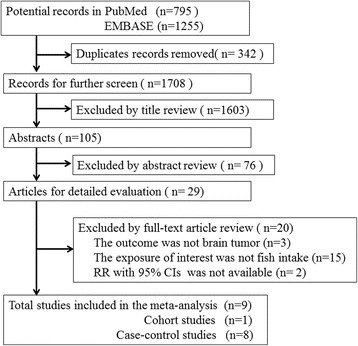
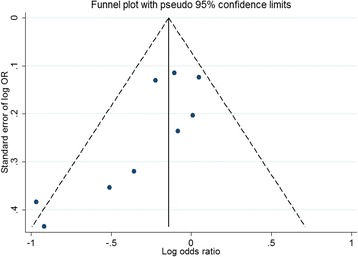
Relevant studies were identified from PubMed and EMBASE databases. The pooled relative risks were obtained by the fixed-effects model when no substantial heterogeneity was observed. Otherwise, the random-effects model was employed. Subgroup and publication bias analyses were also performed.
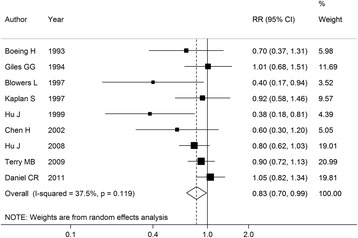
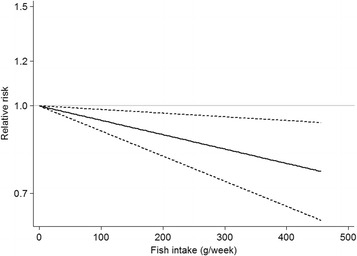
Nine observational studies were included in the meta-analysis. The pooled relative risk of brain cancer for the highest vs. lowest category of fish intake was 0.83 (95% confidence interval [CI]: 0.70-0.99). No significant heterogeneity was detected. Dose-response analysis showed that the RR per 100 g/day increase in fish intake was 0.95 (95% CI: 0.91-0.98). The results remained unchanged in subgroup and sensitivity analyses.
The results of our meta-analysis suggest that fish intake might be associated with lower risk of brain cancer risk. The finding should be further confirmed by future cohort studies with validated questionnaires and strict control of confounders.
富含ω-3多不饱和脂肪酸的鱼类已被发现与几种癌症风险降低有关,并且对大脑发育有益。然而,鱼类摄入量与脑肿瘤风险之间的关联仍不一致。因此,我们进行了一项荟萃分析以阐明这种关联。
从PubMed和EMBASE数据库中识别相关研究。当未观察到实质性异质性时,通过固定效应模型获得合并相对风险。否则,采用随机效应模型。还进行了亚组分析和发表偏倚分析。
该荟萃分析纳入了9项观察性研究。鱼类摄入量最高组与最低组相比,患脑癌的合并相对风险为0.83(95%置信区间[CI]:0.70 - 0.99)。未检测到显著异质性。剂量反应分析表明,鱼类摄入量每增加100克/天,相对风险(RR)为0.95(95%CI:0.91 - 0.98)。在亚组分析和敏感性分析中结果保持不变。
我们的荟萃分析结果表明,鱼类摄入可能与较低的脑癌风险相关。这一发现应通过未来使用经过验证的问卷并严格控制混杂因素的队列研究进一步证实。