Langarizadeh Mostafa, Moghbeli Fateme
Department of Health Information Management, School of Health Management and Information Sciences, Iran University of Medical Sciences, Tehran, Iran.
Acta Inform Med. 2016 Oct;24(5):364-369. doi: 10.5455/aim.2016.24.364-369. Epub 2016 Nov 1.
Naive Bayesian networks (NBNs) are one of the most effective and simplest Bayesian networks for prediction.
This paper aims to review published evidence about the application of NBNs in predicting disease and it tries to show NBNs as the fundamental algorithm for the best performance in comparison with other algorithms.
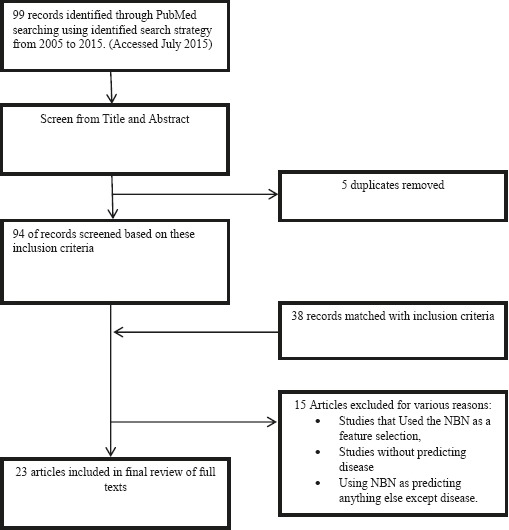
PubMed was electronically checked for articles published between 2005 and 2015. For characterizing eligible articles, a comprehensive electronic searching method was conducted. Inclusion criteria were determined based on NBN and its effects on disease prediction. A total of 99 articles were found. After excluding the duplicates (n= 5), the titles and abstracts of 94 articles were skimmed according to the inclusion criteria. Finally, 38 articles remained. They were reviewed in full text and 15 articles were excluded. Eventually, 23 articles were selected which met our eligibility criteria and were included in this study.
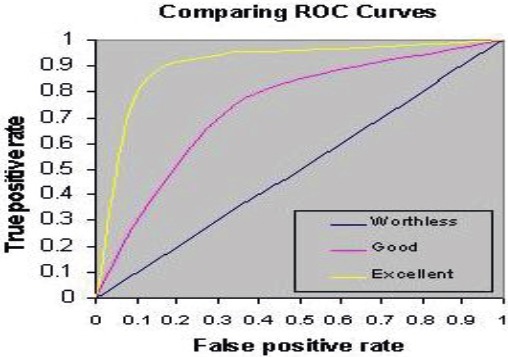
In this article, the use of NBN in predicting diseases was described. Finally, the results were reported in terms of Accuracy, Sensitivity, Specificity and Area under ROC curve (AUC). The last column in Table 2 shows the differences between NBNs and other algorithms.
This systematic review (23 studies, 53,725 patients) indicates that predicting diseases based on a NBN had the best performance in most diseases in comparison with the other algorithms. Finally in most cases NBN works better than other algorithms based on the reported accuracy.
The method, termed NBNs is proposed and can efficiently construct a prediction model for disease.
朴素贝叶斯网络(NBNs)是用于预测的最有效且最简单的贝叶斯网络之一。
本文旨在综述已发表的关于NBNs在疾病预测中应用的证据,并试图将NBNs展示为与其他算法相比具有最佳性能的基础算法。
通过电子方式在PubMed上检索2005年至2015年间发表的文章。为了对符合条件的文章进行特征描述,采用了全面的电子搜索方法。根据NBN及其对疾病预测的影响确定纳入标准。共找到99篇文章。在排除重复项(n = 5)后,根据纳入标准浏览了94篇文章的标题和摘要。最后,剩下38篇文章。对这些文章进行了全文审阅,排除了15篇文章。最终,选择了23篇符合我们纳入标准的文章并纳入本研究。
在本文中,描述了NBN在疾病预测中的应用。最后,根据准确率、敏感性、特异性和ROC曲线下面积(AUC)报告了结果。表2的最后一列显示了NBNs与其他算法之间的差异。
这项系统评价(23项研究,53725名患者)表明,与其他算法相比,基于NBN预测疾病在大多数疾病中具有最佳性能。最后,在大多数情况下,根据报告的准确率,NBN比其他算法表现更好。
提出了称为NBNs的方法,该方法可以有效地构建疾病预测模型。