Sanfilippo Christine M, Allaire Catherine M, DeCory Heleen H
Bausch & Lomb, 1400 North Goodman Street, Rochester, NY, 14609, USA.
, 38, rue de Villiers, 92300 , Levallois Perret, France.
Drugs R D. 2017 Mar;17(1):167-175. doi: 10.1007/s40268-016-0164-6.
The aim of this study was to evaluate the safety and efficacy of topical besifloxacin ophthalmic suspension 0.6% compared with gatifloxacin ophthalmic solution 0.3% in the treatment of bacterial conjunctivitis in neonates.
This was a multicenter, randomized, double-masked, parallel group study. Subjects ≤31 days of age with severity grade ≥1 (scale 0-3) for both conjunctival discharge and conjunctival hyperemia were randomized to besifloxacin or gatifloxacin instilled three times daily for 7 days, and completed five study visits (three clinic visits and two phone calls). Primary endpoints included clinical resolution (absence of both conjunctival discharge and conjunctival hyperemia) at visit 5 (day 8 or 9) and ocular and non-ocular treatment-emergent adverse events (AEs). Bacterial eradication was a secondary endpoint.
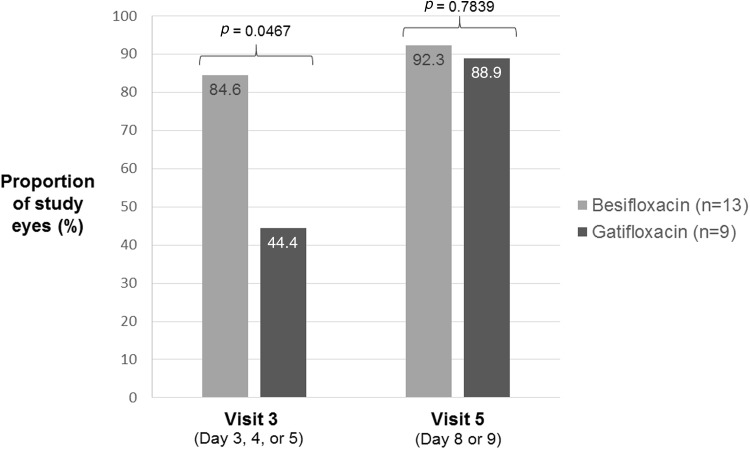
Thirty-three subjects were included in the intent-to-treat (ITT) population. All were aged <28 days, with a mean (standard deviation) age of 15.5 days (6.0), and 57.6% were female. Twenty-two subjects had culture-confirmed conjunctivitis in at least one eye (modified ITT [mITT] population), most often with Gram-positive bacteria. Visit 5 clinical resolution and bacterial eradication rates were comparable among besifloxacin- and gatifloxacin-treated study eyes (clinical resolution: 12/16 [75.0%] vs. 12/17 [70.6%] for the ITT population, and 11/13 [84.6%] vs. 7/9 [77.8%] for the mITT population; bacterial eradication: 12/13 [92.3%] vs. 8/9 [88.9%] for the mITT population, respectively). No AEs were reported in the besifloxacin treatment group, and AEs reported in the gatifloxacin group were considered not treatment-related.
In this small study in neonates, both besifloxacin and gatifloxacin appeared effective and safe in the treatment of bacterial conjunctivitis. Larger studies are warranted.
本研究旨在评估0.6%的贝西沙星眼用混悬液与0.3%的加替沙星滴眼液相比,治疗新生儿细菌性结膜炎的安全性和有效性。
这是一项多中心、随机、双盲、平行组研究。年龄≤31天、结膜分泌物和结膜充血严重程度分级≥1(0-3级)的受试者被随机分为贝西沙星组或加替沙星组,每天滴眼3次,共7天,并完成5次研究访视(3次门诊访视和2次电话随访)。主要终点包括第5次访视(第8或9天)时的临床治愈(结膜分泌物和结膜充血均消失)以及眼部和非眼部治疗中出现的不良事件(AE)。细菌清除是次要终点。
意向性分析(ITT)人群纳入了33名受试者。所有受试者年龄均<28天,平均(标准差)年龄为15.5天(6.0),57.6%为女性。22名受试者至少一只眼睛经培养确诊为结膜炎(改良ITT [mITT]人群),最常见的是革兰氏阳性菌感染。在贝西沙星和加替沙星治疗的研究眼中,第5次访视时的临床治愈率和细菌清除率相当(ITT人群中临床治愈率:12/16 [75.0%] 对比12/17 [70.6%],mITT人群中为11/13 [84.6%] 对比7/9 [77.8%];mITT人群中细菌清除率分别为12/13 [92.3%] 对比8/9 [88.9%])。贝西沙星治疗组未报告不良事件,加替沙星组报告的不良事件被认为与治疗无关。
在这项针对新生儿的小型研究中,贝西沙星和加替沙星在治疗细菌性结膜炎方面似乎都有效且安全。需要进行更大规模的研究。