Krucoff Max O, Rahimpour Shervin, Slutzky Marc W, Edgerton V Reggie, Turner Dennis A
Department of Neurosurgery, Duke University Medical Center Durham, NC, USA.
Department of Physiology, Feinberg School of Medicine, Northwestern UniversityChicago, IL, USA; Department of Neurology, Feinberg School of Medicine, Northwestern UniversityChicago, IL, USA.
Front Neurosci. 2016 Dec 27;10:584. doi: 10.3389/fnins.2016.00584. eCollection 2016.
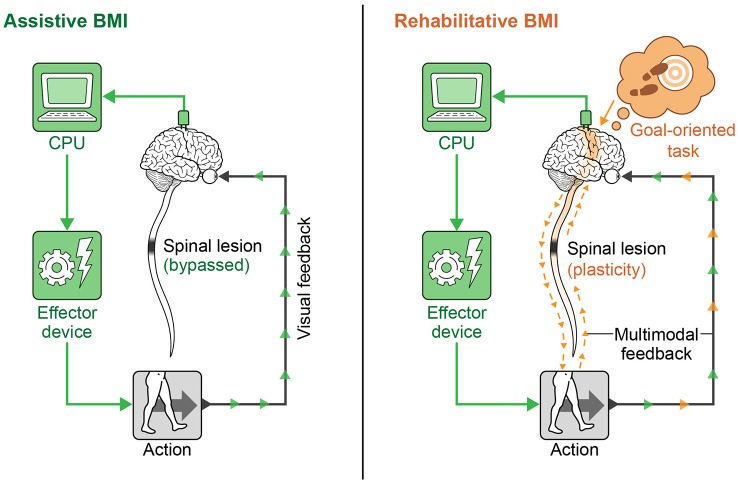
After an initial period of recovery, human neurological injury has long been thought to be static. In order to improve quality of life for those suffering from stroke, spinal cord injury, or traumatic brain injury, researchers have been working to restore the nervous system and reduce neurological deficits through a number of mechanisms. For example, neurobiologists have been identifying and manipulating components of the intra- and extracellular milieu to alter the regenerative potential of neurons, neuro-engineers have been producing brain-machine and neural interfaces that circumvent lesions to restore functionality, and neurorehabilitation experts have been developing new ways to revitalize the nervous system even in chronic disease. While each of these areas holds promise, their individual paths to clinical relevance remain difficult. Nonetheless, these methods are now able to synergistically enhance recovery of native motor function to levels which were previously believed to be impossible. Furthermore, such recovery can even persist after training, and for the first time there is evidence of functional axonal regrowth and rewiring in the central nervous system of animal models. To attain this type of regeneration, rehabilitation paradigms that pair cortically-based intent with activation of affected circuits and positive neurofeedback appear to be required-a phenomenon which raises new and far reaching questions about the underlying relationship between conscious action and neural repair. For this reason, we argue that multi-modal therapy will be necessary to facilitate a truly robust recovery, and that the success of investigational microscopic techniques may depend on their integration into macroscopic frameworks that include task-based neurorehabilitation. We further identify critical components of future neural repair strategies and explore the most updated knowledge, progress, and challenges in the fields of cellular neuronal repair, neural interfacing, and neurorehabilitation, all with the goal of better understanding neurological injury and how to improve recovery.
在经历了最初的恢复期后,长期以来人们一直认为人类神经损伤是静止不变的。为了提高中风、脊髓损伤或创伤性脑损伤患者的生活质量,研究人员一直在努力通过多种机制恢复神经系统并减少神经功能缺损。例如,神经生物学家一直在识别和操纵细胞内和细胞外环境的成分,以改变神经元的再生潜力;神经工程师一直在制造脑机接口和神经接口,绕过损伤部位以恢复功能;神经康复专家一直在开发新方法,即使在慢性病中也能使神经系统恢复活力。虽然这些领域都有前景,但它们各自实现临床应用的道路仍然困难重重。尽管如此,这些方法现在能够协同增强天然运动功能的恢复,达到以前认为不可能的水平。此外,这种恢复甚至可以在训练后持续存在,并且首次有证据表明在动物模型的中枢神经系统中存在功能性轴突再生和重新布线。为了实现这种类型的再生,似乎需要将基于皮层的意图与受影响回路的激活和积极的神经反馈相结合的康复模式——这一现象引发了关于有意识行动与神经修复之间潜在关系的新的、影响深远的问题。因此,我们认为多模式疗法对于促进真正强大的恢复是必要的,并且研究性微观技术的成功可能取决于它们能否融入包括基于任务的神经康复的宏观框架中。我们进一步确定了未来神经修复策略的关键组成部分,并探索了细胞神经元修复、神经接口和神经康复领域的最新知识、进展和挑战,所有这些都是为了更好地理解神经损伤以及如何改善恢复情况。