Rehabilitation Medicine Department, National Institutes of Health, Bethesda, MD, USA.
J Neuroeng Rehabil. 2022 Sep 28;19(1):104. doi: 10.1186/s12984-022-01081-9.
Brain-computer interfaces (BCI), initially designed to bypass the peripheral motor system to externally control movement using brain signals, are additionally being utilized for motor rehabilitation in stroke and other neurological disorders. Also called neurofeedback training, multiple approaches have been developed to link motor-related cortical signals to assistive robotic or electrical stimulation devices during active motor training with variable, but mostly positive, functional outcomes reported. Our specific research question for this scoping review was: for persons with non-progressive neurological injuries who have the potential to improve voluntary motor control, which mobile BCI-based neurofeedback methods demonstrate or are associated with improved motor outcomes for Neurorehabilitation applications?
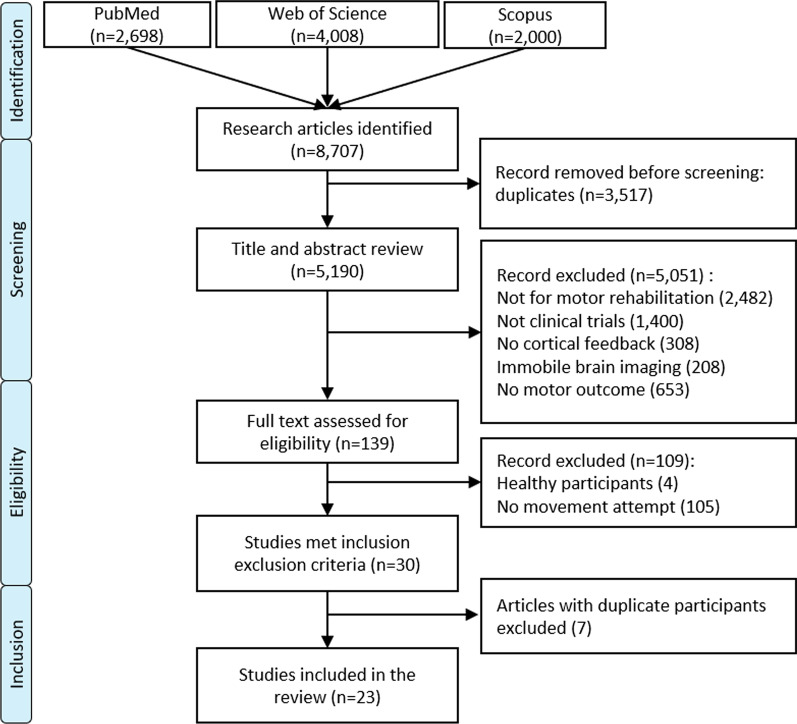
We searched PubMed, Web of Science, and Scopus databases with all steps from study selection to data extraction performed independently by at least 2 individuals. Search terms included: brain machine or computer interfaces, neurofeedback and motor; however, only studies requiring a motor attempt, versus motor imagery, were retained. Data extraction included participant characteristics, study design details and motor outcomes.
From 5109 papers, 139 full texts were reviewed with 23 unique studies identified. All utilized EEG and, except for one, were on the stroke population. The most commonly reported functional outcomes were the Fugl-Meyer Assessment (FMA; n = 13) and the Action Research Arm Test (ARAT; n = 6) which were then utilized to assess effectiveness, evaluate design features, and correlate with training doses. Statistically and functionally significant pre-to post training changes were seen in FMA, but not ARAT. Results did not differ between robotic and electrical stimulation feedback paradigms. Notably, FMA outcomes were positively correlated with training dose.
This review on BCI-based neurofeedback training confirms previous findings of effectiveness in improving motor outcomes with some evidence of enhanced neuroplasticity in adults with stroke. Associative learning paradigms have emerged more recently which may be particularly feasible and effective methods for Neurorehabilitation. More clinical trials in pediatric and adult neurorehabilitation to refine methods and doses and to compare to other evidence-based training strategies are warranted.
脑-机接口(BCI)最初旨在绕过外围运动系统,使用脑信号来外部控制运动,目前也被用于中风和其他神经障碍的运动康复。这种方法也被称为神经反馈训练,已经开发出多种方法将与运动相关的皮层信号与辅助机器人或电刺激设备连接起来,以便在主动运动训练中使用,报告的功能结果变化多样,但大多为阳性。我们本次综述的具体研究问题是:对于有非进行性神经损伤、有改善自愿运动控制潜力的患者,哪些基于移动 BCI 的神经反馈方法可用于神经康复应用,并能改善运动结果?
我们独立地对 PubMed、Web of Science 和 Scopus 数据库进行了检索,从研究选择到数据提取的所有步骤均由至少 2 人完成。检索词包括:脑机器或计算机接口、神经反馈和运动;但是,仅保留需要运动尝试而不是运动想象的研究。数据提取包括参与者特征、研究设计细节和运动结果。
从 5109 篇论文中,共审查了 139 篇全文,并确定了 23 项独特的研究。所有研究都使用了脑电图,除了一项研究外,其余研究都是针对中风患者。报告最多的功能结果是 Fugl-Meyer 评估(FMA;n=13)和动作研究臂测试(ARAT;n=6),然后用于评估效果、评估设计特征,并与训练剂量相关联。FMA 在训练前后的变化具有统计学和功能意义上的显著差异,但 ARAT 没有。在机器人和电刺激反馈范式之间,结果没有差异。值得注意的是,FMA 结果与训练剂量呈正相关。
本次关于基于 BCI 的神经反馈训练的综述证实了先前关于改善运动结果的有效性的发现,并提供了一些证据表明中风成人的神经可塑性增强。最近出现了联想学习范式,这些范式可能是神经康复的特别可行和有效的方法。需要在儿科和成人神经康复中进行更多的临床试验,以完善方法和剂量,并与其他基于证据的训练策略进行比较。