Sugai Tamotsu, Eizuka Makoto, Takahashi Yayoi, Fukagawa Tomoyuki, Habano Wataru, Yamamoto Eiichiro, Akasaka Risaburo, Otuska Kouki, Matsumoto Takayuki, Suzuki Hiromu
Department of Molecular Diagnostic Pathology, School of Pharmacy, Iwate Medical University, Morioka, Japan.
Pharmacodynamics and Molecular Genetics, School of Pharmacy, Iwate Medical University, Morioka, Japan.
Cancer Sci. 2017 Mar;108(3):427-434. doi: 10.1111/cas.13164.
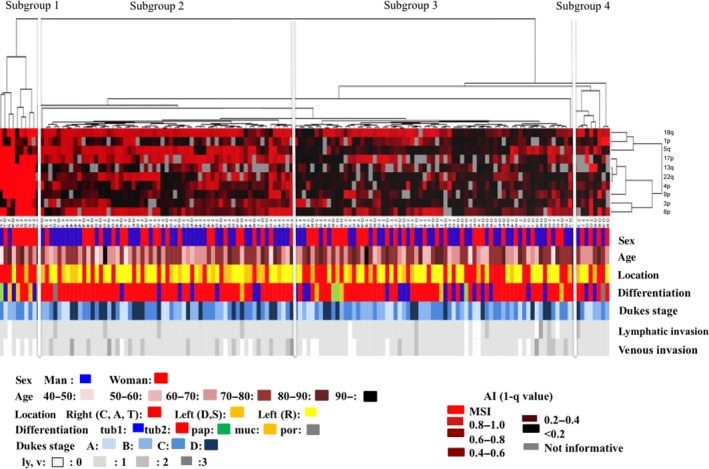
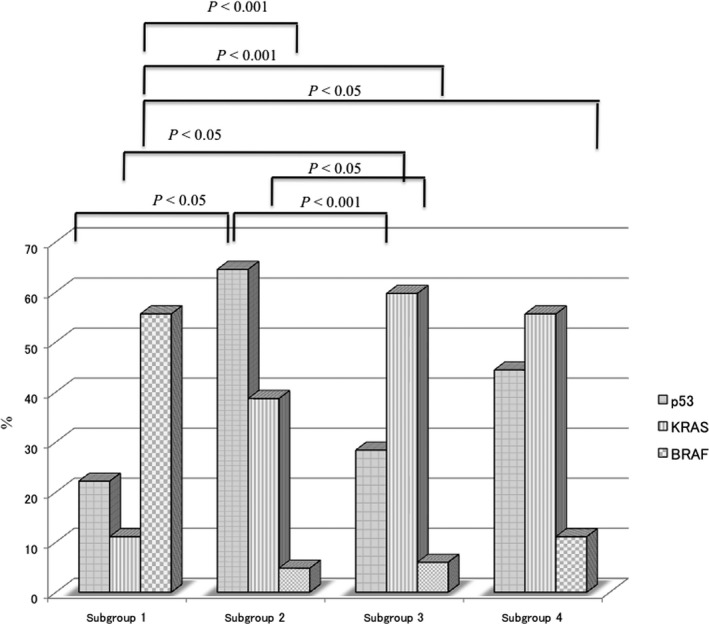
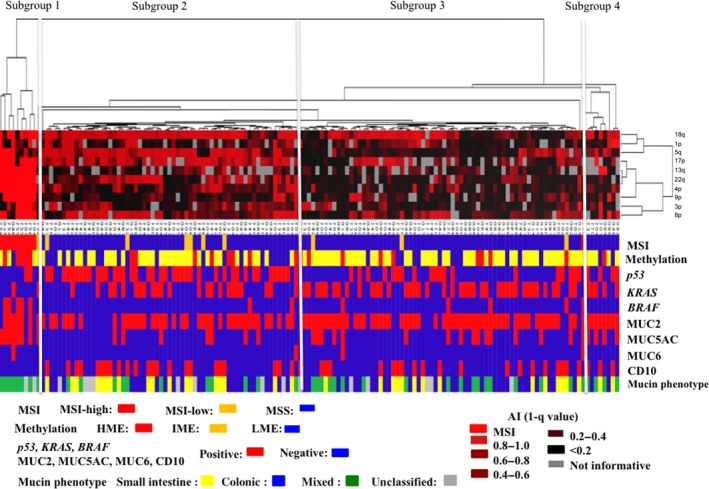
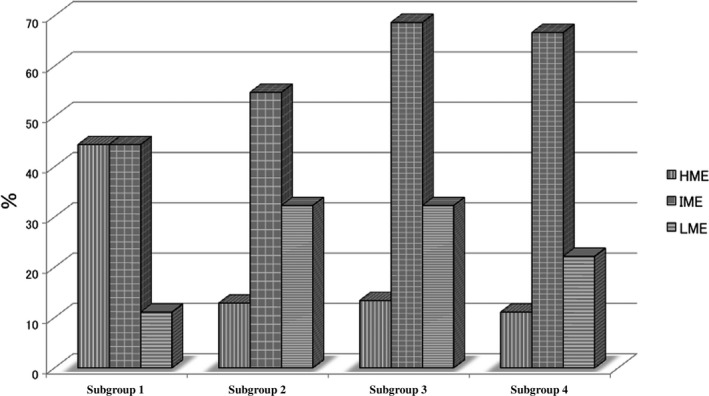
Tumor tissue consists of a heterogeneous cell population. The allelic imbalance (AI) ratio, determined in isolated tumor glands, is a good index of tumor heterogeneity. However, associations of the patterns of AI and microsatellite instability (MSI) development, observed in most cases of colorectal cancer (CRC), with tumor progression have not been reported previously. In this study, we examined whether CRC genetic profiles stratified by a combination of the AI ratio and MSI facilitate categorization of CRC, and whether these genetic profiles are associated with specific molecular alterations in CRC. A crypt isolation method was used to isolate DNA from tumors and normal glands obtained from 147 sporadic CRCs. AI and MSI statuses were determined using PCR-based microsatellite analysis and stratified based on AI ratio and MSI status. DNA methylation status (high methylation, intermediate methylation and low methylation status and mutations in KRAS, BRAF, and TP53 were examined. In addition, mucin markers were immunostained. Based on this analysis, four subgroups were categorized. Subgroup 1 was characterized by a high MSI status and BRAF mutation; subgroup 2 was closely associated with a high AI ratio, which accumulated during the early phases of colorectal carcinogenesis, and TP53 mutation; subgroup 3 was associated with a low AI ratio, seen during the later phases of colorectal carcinogenesis, and KRAS mutation; and subgroup 4 was defined as a minor subgroup. These results confirmed that classification of distinct molecular profiles provides important insights into colorectal carcinogenesis.
肿瘤组织由异质性细胞群体组成。在分离的肿瘤腺体中测定的等位基因不平衡(AI)比率是肿瘤异质性的良好指标。然而,在大多数结直肠癌(CRC)病例中观察到的AI模式与微卫星不稳定性(MSI)发展与肿瘤进展之间的关联此前尚未见报道。在本研究中,我们研究了通过AI比率和MSI的组合分层的CRC基因谱是否有助于CRC的分类,以及这些基因谱是否与CRC中的特定分子改变相关。采用隐窝分离法从147例散发性CRC患者的肿瘤和正常腺体中分离DNA。使用基于PCR的微卫星分析确定AI和MSI状态,并根据AI比率和MSI状态进行分层。检测DNA甲基化状态(高甲基化、中度甲基化和低甲基化状态)以及KRAS、BRAF和TP53的突变。此外,对粘蛋白标记物进行免疫染色。基于该分析,分为四个亚组。亚组1的特征是高MSI状态和BRAF突变;亚组2与高AI比率密切相关,其在结直肠癌发生的早期阶段积累,以及TP53突变;亚组3与低AI比率相关,见于结直肠癌发生后期,以及KRAS突变;亚组4被定义为一个较小的亚组。这些结果证实,不同分子谱的分类为结直肠癌发生提供了重要的见解。