Moise Imelda K, Verity Jaclyn F, Kangmennaang Joseph
Department of Geography and Regional Studies, University of Miami, 1300 Campo Sano Ave, Coral Gables, FL, 33124, USA.
University of Waterloo, Waterloo, ON, N2L 3G1, Canada.
Int J Health Geogr. 2017 Jan 13;16(1):2. doi: 10.1186/s12942-016-0075-3.
Very little is known about reproductive health service (RHS) availability and adolescents' use of these services in post-conflict settings. Such information is crucial for targeted community interventions that aim to improve quality delivery of RHS and outcomes in post-conflict settings. The objectives of this study therefore was to examine the density of RHS availability; assess spatial patterns of RHC facilities; and identify youth-friendly practices associated with adolescents' use of services in post-conflict Burundi.
A cross-sectional survey was conducted from a full census of all facilities (n = 892) and provider interviews in Burundi. Surveyed facilities included all public, private, religious and community association owned-centers and hospitals. At each facility efforts were made to interview the officer-in-charge and a group of his/her staff. We applied both geospatial and non-spatial analyses, to examine the density of RHS availability and density, and to explore the association between youth-friendly practices and adolescents' use of RHS in post-conflict Burundi.
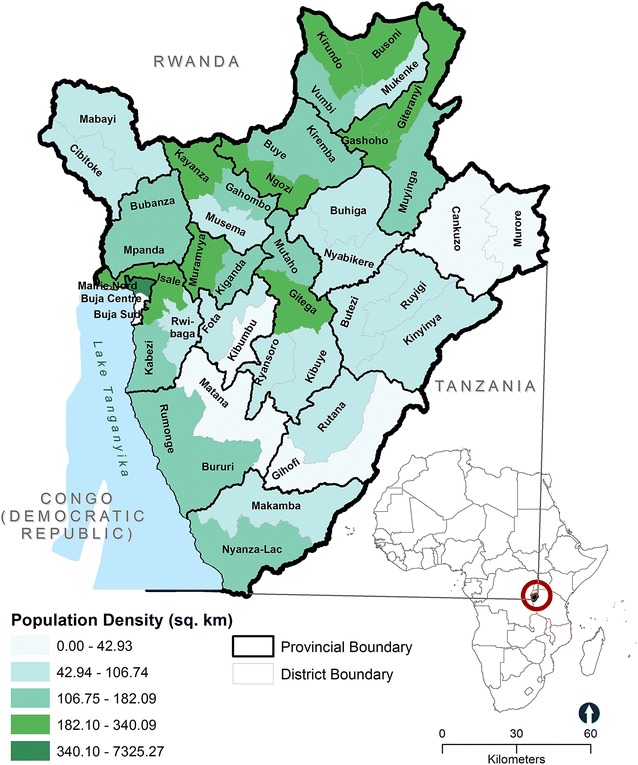
High spatial patterning of distances of RHC facilities was observed, with facilities clustered predominantly in districts exhibiting persistent violence. But, use of services remained undeterred. We further found a stronger association between use of RHS and facility and programming characteristics. Community outreach, designated check-in/exam rooms, educational materials (posters, print, and pictures) in waiting rooms, privacy and confidentiality were significantly associated with adolescents' use of RHS across all facility types. Cost was associated with use only at religious facilities and youth involvement at private facilities. No significant association was found between provider characteristics and use of RHS at any facility.
Our findings indicate the need to improve youth-friendly service practices in the provision of RHS to adolescents in Burundi and suggest that current approaches to provider training may not be adequate for improving these vital practices. Our mixed methods approach and results are generalizable to other countries and post-conflict settings. In post-conflict settings, the methods can be used to identify service availability and spatial patterns of RHC facilities to plan for targeted service interventions, to increase demand and uptake of services by youth and young adults.
对于冲突后环境中生殖健康服务(RHS)的可及性以及青少年对这些服务的利用情况,人们了解甚少。此类信息对于旨在改善冲突后环境中生殖健康服务的高质量提供及结果的针对性社区干预至关重要。因此,本研究的目的是调查生殖健康服务的可及密度;评估生殖健康中心设施的空间格局;并确定与冲突后布隆迪青少年使用服务相关的青少年友好型做法。
在布隆迪对所有设施(n = 892)进行全面普查并与提供者进行访谈,开展了一项横断面调查。被调查的设施包括所有公立、私立、宗教和社区协会所有的中心及医院。在每个设施,都努力访谈负责人及其一组工作人员。我们应用了地理空间分析和非空间分析,以调查生殖健康服务的可及密度和设施密度,并探讨冲突后布隆迪青少年友好型做法与青少年使用生殖健康服务之间的关联。
观察到生殖健康中心设施的距离存在高度空间格局,设施主要集中在暴力持续的地区。但是,服务的使用并未受到阻碍。我们进一步发现,生殖健康服务的使用与设施及规划特征之间存在更强的关联。社区外展、指定的登记/检查室、候诊室的教育材料(海报、印刷品和图片)、隐私和保密与所有设施类型中青少年使用生殖健康服务显著相关。费用仅与宗教设施的使用以及私立设施中的青年参与相关。在任何设施中,均未发现提供者特征与生殖健康服务的使用之间存在显著关联。
我们的研究结果表明,在布隆迪为青少年提供生殖健康服务时,需要改进青少年友好型服务做法,并表明目前的提供者培训方法可能不足以改善这些重要做法。我们的混合方法及结果可推广至其他国家和冲突后环境。在冲突后环境中,这些方法可用于确定生殖健康中心设施的服务可及性和空间格局,以规划有针对性的服务干预措施,增加青年和年轻成年人对服务的需求及使用。